On a dive beside an Israeli power plant, marine biologists Ido Sella and Shimrit Perkol-Finkel found a clue hiding in plain gray sight. A cast-concrete seawall was barren until a sharp line divided one batch from the next. On the other side of that line, more bryozoans and other fixed marine organisms had settled. Same contractor. Probably a different day of pouring. To the two scientists, it looked less like a construction inconsistency than an invitation: perhaps concrete was not inherently hostile to life. Perhaps the recipe and the shape were wrong.
That observation became ECOncrete in 2012. The company now sells a patented system for turning mandatory marine infrastructure - seawalls, quay walls, breakwaters, cable mats, pipeline protection and offshore foundations - into usable habitat. It does not ask a port to swap concrete for a coral reef. It asks the port to make the concrete it already needs behave a little more like one.
Three edits to a very old material
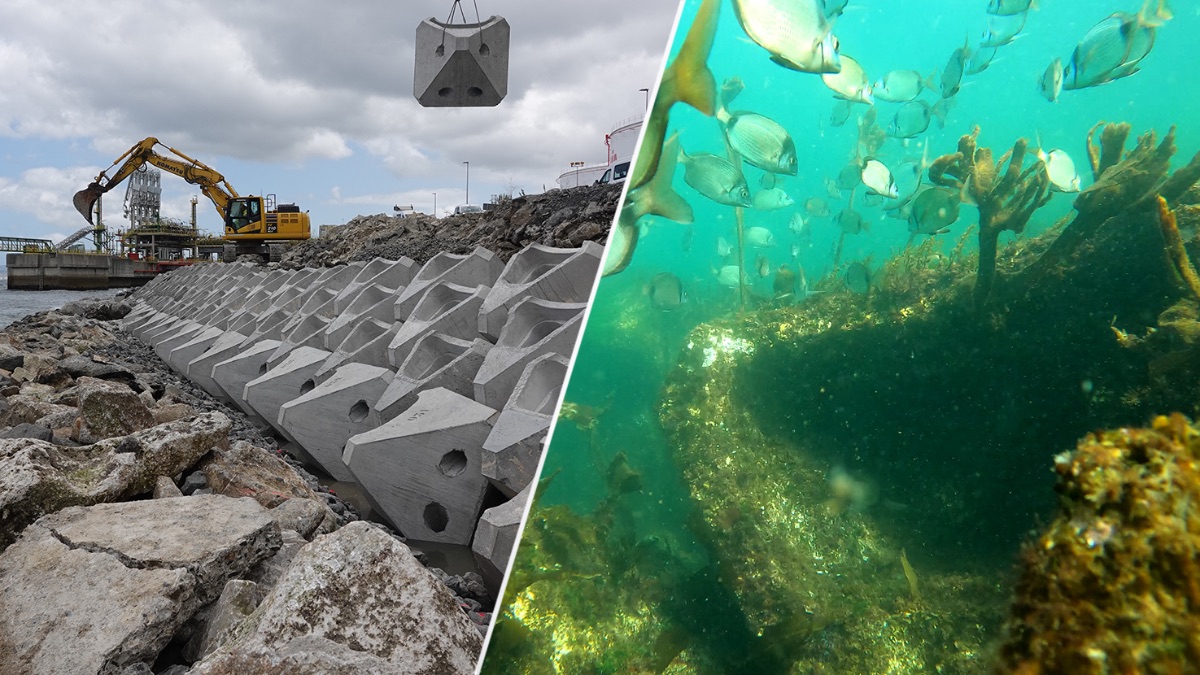
ECOncrete's product is not one miraculous additive. It is a stack of three changes. First, a bio-enhancing admixture alters the chemistry of the concrete. The company says the mix is made from more than 90 percent recycled and byproduct materials, reduces permeability and is dosed at about 10 percent of the cementitious material. Second, textured liners and agents make the surface rough enough for drifting larvae to grip. Third, large-scale geometry adds the things a flat wall forgot: holes, ledges, crevices, caves and pockets that keep water when the tide goes out.
Lower permeability and make the surface friendlier to marine settlement.
Rough micro-surfaces give larvae attachment points instead of a biological slipway.
Tide pools, caves and overhangs create shelter for different species and life stages.
Its best-known product, COASTALOCK, makes the idea unusually legible. The interlocking armor unit has a deep cavity. Point it upward and the cavity retains water like a tide pool. Rotate it and the same void becomes a cave or overhang. The block can sit on slopes as steep as one vertical to one horizontal, so the ecological feature also has to survive a civil engineer's questions about waves, stability and constructability.
The customer is not the fish
Ports, public agencies, utilities and offshore developers write the checks. Their engineering firms, precasters and marine contractors help specify and install the work. The Port of San Diego uses COASTALOCK in a Harbor Island revetment. New York State put ECOncrete armor and tide pools into Living Breakwaters off Staten Island. The Port of Vigo installed enhanced seawalls and revetment units. Offshore, marine mattresses and trench blocks protect power cables, while a Holcim US partnership developed Droplock units for wind-turbine scour protection.
This customer list explains the real problem being solved. Coastal owners face several bills at once: storm exposure, erosion, aging assets, environmental permitting, biodiversity loss and the mitigation penalties created when a project damages habitat. Conventional concrete handles the first engineering task and often makes the ecological tasks worse. Artificial reefs can compensate, but they add material somewhere else. ECOncrete's wager is that the required structure can do the compensation on site.
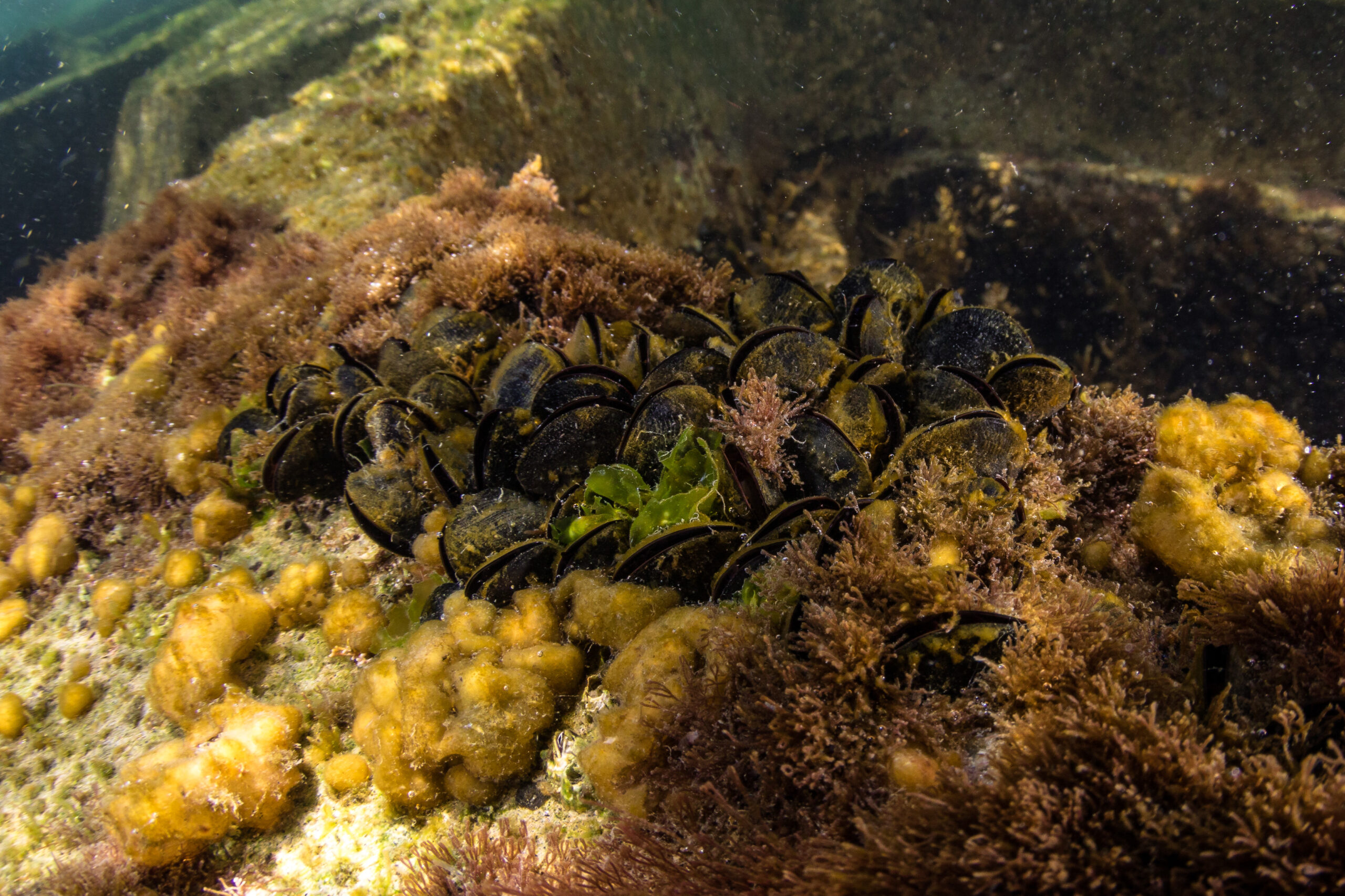
The biological layer can also become part of the engineering case. Oysters, tubeworms, coralline algae and other calcifying organisms fasten themselves to the surface. ECOncrete calls the resulting crust “bioprotection”: extra mass and a living buffer against chloride and hydrodynamic forces. Independent testing cited by the company found lower chloride permeability and up to 10 percent higher compressive strength when its admixture was added. Those are reported maxima, not a promise that every block in every sea will hit them.
A premium with a counterpunch
The uncomfortable number comes first: a BloombergNEF case study put ECOncrete's price premium at roughly 10 to 15 percent over conventional concrete. In public works, where bids are sharpened to the decimal, that is not pocket lint. The company counters by selling against the whole project ledger. Habitat built into the asset may reduce off-site compensation, environmental penalties, permitting friction and maintenance.
Living Breakwaters is the cleanest public example. The approximately $75 million project originally faced about $18 million in environmental mitigation penalties. After ecological design changes and ECOncrete technology were integrated, the penalty reportedly fell to about $4 million. Roughly $14 million stayed in the project - around 15 percent of its total cost. That does not prove every tide pool prints money. It proves ecological performance can move a construction budget, not merely decorate its sustainability report.
What failed first
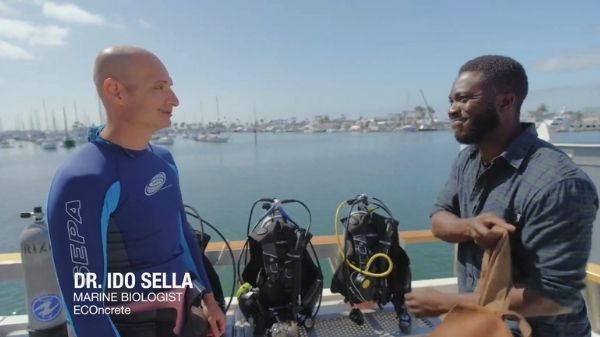
The first failure was the status quo: smooth, chemically harsh marine concrete that tended toward low diversity and invasive dominance. The first company hurdle was translation. Sella and Perkol-Finkel were marine biologists walking into engineering offices with a proposal about concrete. They had to learn standards, concrete technology, casting, shipping and construction procedure. Sella has said it took almost three years to reach proof of concept and something the market might accept.
The founders also considered making the work a nonprofit. They chose a for-profit company because they believed a business could spread the technology more sustainably and efficiently. That decision changed the design of the company. ECOncrete does not own a globe-spanning chain of precast yards or ship five-ton blocks from New York. It supplies intellectual property, admixture, molds, design and support; local concrete companies cast with local labor, materials and familiar equipment. Heavy manufacturing stays close to the project. The high-value recipe and evidence travel.
That is also where ECOncrete sits in the market. It is more integrated than a low-carbon admixture company, because it tackles biology and form. It is more structural than an artificial-reef maker, because the product must carry a real engineering load. And it is more specialized than an ordinary coastal contractor, because marine ecology, industrial design and long-term monitoring sit inside the offer. Its moat is the combination - patents, field data, constructable geometry and the credibility to get all of it into a public specification.
The playbook worth stealing
Coasts already need protection. Improve the mandated asset instead of inventing a separate green purchase.
Chemistry, texture and geometry work as a system. A single green ingredient would be easier to copy and easier to dismiss.
License the recipe and tools, then let established precasters handle mass, labor and standards near the job site.
Species counts, live cover and structural testing turn a charming story about oysters into procurement evidence.
There are limits. This is not magic concrete for an office floor, nor a cosmetic texture to add after engineering is finished. Results depend on a viable marine or intertidal ecosystem, local larvae and target species, correct depth and orientation, project-specific hydraulic design, compliant concrete mixes and years of monitoring. A badly sited block cannot summon an oyster population. A team that brings ecology in after the drawings are locked will capture less value than one that designs habitat and structure together.
The company now has about 48 employees by the supplied company record, four international hubs and a portfolio spanning ports from Rotterdam to San Francisco, shorelines from New York to New Zealand and cable infrastructure in the Mediterranean and Atlantic. In May 2026 it announced a $14 million fundraise led by Builders Vision, joined by Barclays Climate Ventures, ReOcean Fund and other impact investors, plus an Open Road Impact financing facility. ECOncrete said revenue had grown 3.4 times over the preceding 18 months.
The next test is repetition. A fascinating pilot can win awards; a construction technology wins when engineers specify it again. San Diego is the useful signal. After more than three years of monitoring found over 60 species and the units remained structurally sound, the port announced expansion to more sites. At Denmark's Port of Esbjerg, first monitoring in July 2026 found algae, barnacle recruitment and shore crabs after only ten weeks, ahead of a plan for several hundred units. That is the quiet payoff inside ECOncrete's loudest visual trick. The point is not that gray blocks eventually turn green. It is that a port looked at the data and ordered another shoreline.