The first clue was a disobedient patch of concrete. Ido Sella and his research partner, Shimrit Perkol-Finkel, were diving along power-plant seawalls, recording the familiar ecological monotony of built waterfronts: smooth surfaces, sparse native life, invasive species enjoying the vacancy. Then one section changed the view. It held more bryozoans and other fixed organisms than the concrete beside it. Structurally, the wall was the same. Biologically, it was a different neighborhood.
The construction records supplied a deliciously specific mystery. The lively section lined up with one casting day and one batch of concrete. A tiny deviation in the material had produced a visible difference underwater. For two marine biologists, this was catnip. Sella and Perkol-Finkel began asking whether concrete could be adjusted so local larvae received a better invitation to settle.
They knew almost nothing about concrete. This turned out to be useful in the irritating way ignorance sometimes is. They were free to ask impolite questions of an old material. Why should a seawall perform only one job? Why should structural competence require ecological boredom? Why were ports designed as though the water below them were empty?
A childhood with too many tanks
Sella was born in Jerusalem, a mountain city that he jokes is far from the sea only by Israeli standards. The Mediterranean is roughly a 45-minute drive away, close enough for a persistent child to campaign for weekend expeditions. By about 11, he was collecting marine invertebrates and keeping them in aquariums at home. In another recollection, he described dozens of aquariums and terrariums occupying his room. He started sailing around the same time.
The wilderness had already claimed him. His family hiked from the time he was three. He joined a youth hiking and climbing group, eventually guided within it, and says those years taught him more about geography, geology, biology, and ecology than school did. At 17 he backpacked through Ireland for a month. Before 18, he spent three months hiking in Africa. The friends from those years remain his companions on regular desert trips.
After military service, Sella became first mate on a major research vessel in the eastern Mediterranean. The job joined what he calls his two loves: machinery made of steel and rust, and biology. Graduate study at Tel Aviv University followed, with an M.Sc. in Ecology and Environmental Quality and a Ph.D. in Zoology. His research moved through coral physiology, aquaculture, the Red Sea, the Indian Ocean, and the African coast. The through line was the boundary where engineered systems meet living ones.
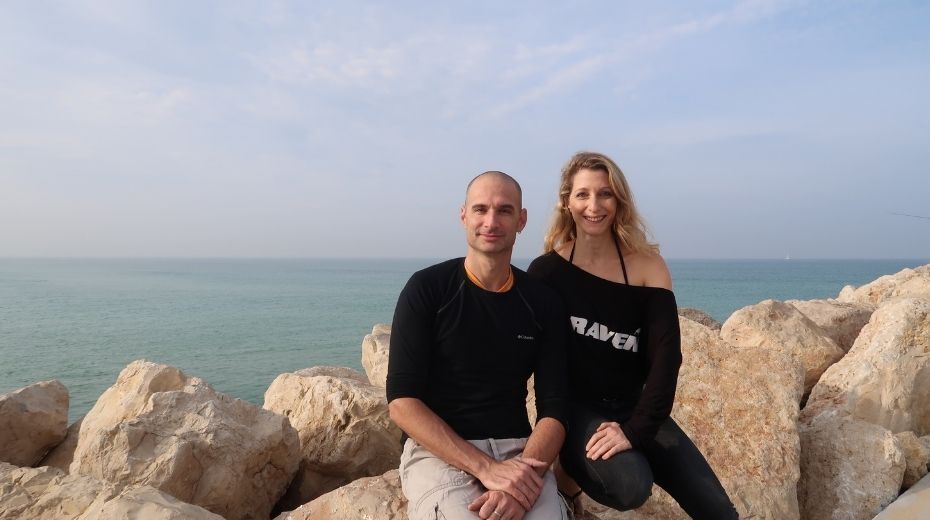
The three-part invitation
A marine larva has one consequential real-estate decision. Corals, oysters, barnacles, and other sessile organisms drift through the water until they encounter a surface. They sense its chemistry and texture. If it feels wrong, they keep drifting, risk being eaten, or run out of chances. If it feels right, they settle. For some, that is the last move of their lives.
Conventional marine concrete often favors tolerant invasive species because local organisms reject it. ECOncrete's answer works at three levels: an admixture changes chemical properties; patterned textures provide grip and complexity; three-dimensional forms create pools, crevices, shade, and other niches. The package is folded into infrastructure that was going to be built anyway, using local materials, batching plants, and workers.
The habitat stack / three adjustments, one structure
The biology does more than decorate the structure. Oysters, barnacles, corals, mussels, and bryozoans build calcium-carbonate shells or skeletons. As those organisms accumulate, they form a biogenic crust. That living layer can slow chloride penetration into concrete, helping protect the steel reinforcement inside. Ecological activity becomes part of asset performance, while feeding more complex communities in the surrounding water.
When the surface starts working
Reported carbon sequestration per square foot compared with standard marine concrete.
Science learns procurement
Sella and Perkol-Finkel started ECOncrete in 2012, first supporting themselves through ecological marine consulting. Their surveys covered offshore drilling, gas pipes, underwater cables, utilities, power plants, and desalination projects around the Mediterranean. The company remained tiny for years: the founders, a research assistant, concrete tiles hanging beneath piers, and an academic instinct to keep measuring.
Experiments ran in the Red Sea, the Mediterranean, and, with NOAA collaboration, from Key West and Savannah to New York, the Hudson, and the Great Lakes. Ecological monitoring does not respect startup tempo. Sella describes a three-year cycle: repeated seasonal observations, analysis, publication, and peer review. Proof of concept took about three years. Broader commercialization arrived around 2016.
The founders had no business-school training. Perkol-Finkel leaned into business development; Sella concentrated on technical development and learning concrete. They recruited engineers, designers, geologists, and materials specialists. The company gradually learned an essential fact about selling environmental infrastructure: moral appeal opens a conversation, but solved problems close a contract.
The remark is not cynical. It is an operating brief. A port may need a permit. A cable route may cross sensitive habitat. A coastal project may need development-bank funding or support from an Indigenous community. An owner may want a longer-lasting asset. ECOncrete becomes commercially relevant where measurable biodiversity helps resolve those constraints. Good intentions are asked to bring their paperwork.
Do not sell ecological virtue as an optional ornament. Attach it to the permit, durability, funding, or community problem the customer must already solve.
The partnership inside the mission
Sella and Perkol-Finkel had been students together, completed doctoral work alongside each other, published together, and supported one another through research and postdoctoral projects. By his account, they shared work so thoroughly that they functioned almost like one mind. Every message was visible. Each could lift the other's responsibilities. Building the company felt like working with a best friend who could carry the stress on a bad day and double the pleasure on a good one.
In 2021, Perkol-Finkel was killed in a traffic accident near their office, one month before the planned close of a Series A round. Sella regrouped the team and decided to continue. The investors independently gave him the same answer: if he went forward, they would invest. The round closed weeks later. Continuing ECOncrete became part mission, part promise to his co-founder.
Sella now keeps managerial panic on a shorter leash. Infrastructure moves slowly, decisions slip, and a delay can echo through years of work. His response is perspective, earned at a terrible cost: most business emergencies are pain to handle, not calamity. The work continues, people go home to those they love, and the problem that consumed Tuesday may be forgotten in two weeks.
A desert office, briefly
Every few months, Sella disappears for four or five days with two old hiking friends. They protect the dates with comic seriousness, booking the next trip over the last coffee of the current one. A financing round once threatened that rhythm. Instead of canceling, they found a hilltop with phone reception in Israel's Ramon Crater.
His friends kept hiking. Sella assembled a chair under a canopy, connected his laptop to their batteries, and played Leonard Cohen through a speaker so every arriving email would announce itself. He sat there from sunrise to sunset, answering lawyers from a crater in the Negev. The round closed around midnight. There are more polished founder stories, but few with better stage direction.
The habit is not escape so much as recalibration. In the desert, he says, you can hear your own footsteps and remember how small you are. At sea, the effect is amplified. Stones and water make short work of inbox grandeur. That humility fits the design philosophy: humans are temporary visitors, and our structures should occupy less than the whole imagination.
The coast as a living client
In New York, where ECOncrete is headquartered, Sella has dived in turbid water for roughly a decade. He says the change is visible. When work began at Brooklyn Bridge Park in 2014, natural oyster recruitment was absent from places where it now appears. At Tottenville on Staten Island, the Living Breakwaters project uses chains of offshore structures to reduce wave energy, encourage a wider beach, and provide oyster habitat. Early breakwaters are already being colonized.
The concrete does not conjure oysters. Sella is careful about this. Improved water quality makes larvae available; the structure offers them somewhere suitable to settle. The distinction matters because he is wary of nature-positive claims that skip measurement. Every intervention, he argues, needs monitoring and scientific validation. Otherwise an attractive idea can produce damage or greenwash.
The scale is rising. ECOncrete reported more than 50 projects across 10 seas and more than 30 countries and states in 2026. In May, it announced a $14 million fundraise to expand in coastal protection, sustainable ports, and offshore infrastructure. The company said it had delivered technology to more than 20 marine projects over the previous 18 months, creating more than 90,000 square meters of habitat while revenue grew 3.4 times.
Sella's aspiration is less about a special object than a changed default. He does not want to toss artificial reefs beside poorly designed infrastructure after the fact. His phrase is plainer: “If you build it, build it right.” The concrete will be poured, the cables buried, the ports expanded, and the shorelines defended. His argument is that every one of those decisions can include another client, quiet but exacting, waiting below the tide.