The first customer in this story is a dentist in Michigan. On July 11, 1983, he placed a stock trade using early E*TRADE technology. Imagine the ordinary absurdity of that moment: a personal computer, still an unfamiliar household object, reaching into a market organized around professional intermediaries. The important invention was the shortened distance between an intention and an order.
- E*TRADE gives individuals brokerage, retirement and automated-investing tools.
- Morgan Stanley acquired it in 2020, linking self-directed investing with advice and workplace wealth.
- Zero base commissions leave plenty to compare: contract charges, borrowing costs, fund expenses and who makes the decisions.
That distance remains the company’s subject. Today you can research a stock, buy an ETF, open an IRA, examine an options strategy or delegate a portfolio’s upkeep. The question has expanded from whether a computer can place your trade to how much responsibility you want to keep once it can.
The click became a relationship
William Porter and Bernard Newcomb started TradePlus in 1982. By August 1996, E*TRADE was publicly traded. Its proposition was concrete: give ordinary investors access through the machine already on their desk. The company’s later history is a useful correction to the belief that a technology business succeeds simply by making an existing task faster.
In February 2020, Morgan Stanley announced an all-stock acquisition valued at roughly $13 billion. E*TRADE brought more than 5.2 million client accounts and over $360 billion in retail client assets. Those are announcement-era figures. The attraction was a different way of reaching people: an investor could arrive through an employer’s stock plan, trade independently, and eventually need financial advice.
Approximate all-stock transaction value
The interpretation is straightforward. A brokerage account can become the beginning of a relationship lasting longer than any individual trade. E*TRADE now occupies the self-directed entrance to a much larger institution. Its neighbors include Schwab and Fidelity in broad brokerage, Robinhood in app-led investing, and Interactive Brokers among active traders. Its case rests on the combination of tools and room to grow into other services.
Then the price of a click became zero
October 2019 exposed the limits of competing on access alone. E*TRADE eliminated base retail commissions on online US-listed stocks, ETFs and options. Its annual report estimated a $300 million annual revenue impact, using second-quarter operating results. A lower customer price had a very real company cost.
“With price removed from the equation, the customer experience became the primary differentiator in our space.”
E*TRADE shareholder letter, discussing 2019
Competitive pressure helps explain that turn. Industry commission cuts and the announced Schwab-TD Ameritrade combination changed the landscape. Nothing in the public record requires inventing a private moment when management changed its mind. The economics had changed in plain sight.
The revenue model survived the disappearance of the headline charge. Margin borrowing generates interest. Options retain per-contract fees. Managed accounts charge for advice. Order-routing reports disclose payments associated with customer orders. Investors should therefore ask a better question than whether the buy button is free: what does this particular account, with this particular behavior, cost?
Base commission
Eligible online US-listed stock and ETF trades
Standard options contract charge
50¢ at 30+ qualifying trades per quarter
Core Portfolios annual advisory fee
$500 initial minimum; ETF expenses extra
Three monitors, or fewer decisions?
Power E*TRADE Pro addresses the person who wants more controls. Its downloadable desktop workspace supports multiple monitors, charting, market-depth views and options analysis. There is a pleasing contradiction here: the company that shortened the route to a trade also sells tools for thinking longer before making one.
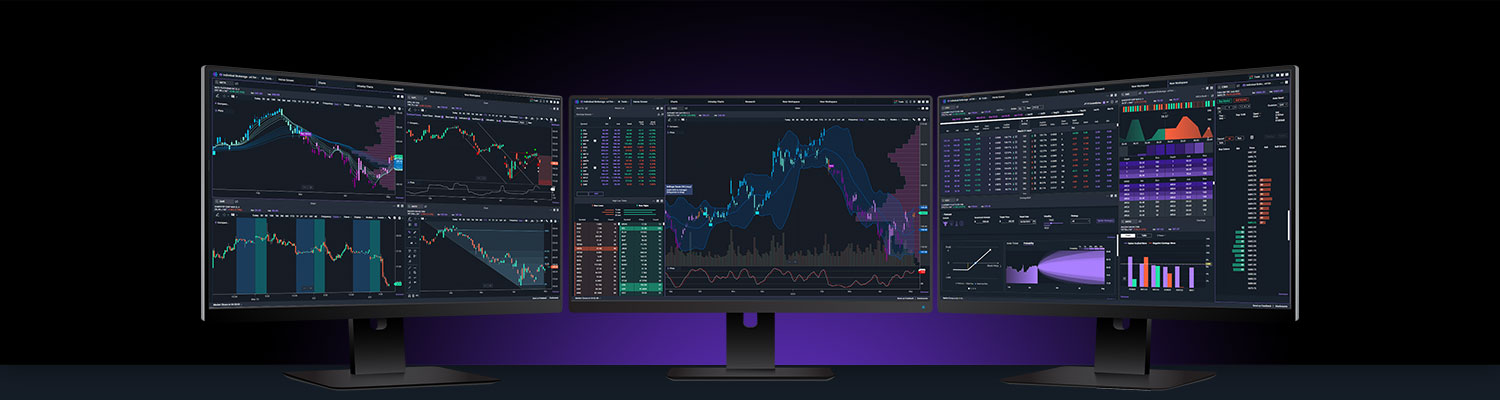
Its paper-trading environment supplies $100,000 in virtual money. This is a copyable product lesson: let people rehearse a complicated action before they commit. A simulation helps a user learn the controls; it cannot reproduce every live fill, liquidity constraint or emotional reaction when the money belongs to them.
Core Portfolios serves a different temperament. Investors answer questions about goals and risk, and the service builds and maintains an ETF portfolio. On $10,000, its 0.30% annual advisory rate works out to $30 before underlying fund expenses. Clients can monitor the account, but they cannot place self-directed trades inside it. Delegation buys fewer routine decisions and requires surrendering those controls.
That distinction matters more than the screen design. A retirement saver seeking a repeatable process has different needs from someone studying options probabilities. Research, retirement accounts, education and affiliated banking fill out the offering. Access to Morgan Stanley financial advisers creates another route, with separate eligibility requirements and possible fees.
The risk that lived behind the screen
E*TRADE’s hardest lesson came from its own investments. In 2007, exposure to mortgage-related assets damaged the business. Its reporting describes about $2.5 billion of losses in an asset-backed securities portfolio. A Citadel-led transaction supplied a $2.5 billion cash infusion. These were separate numbers: losses on one side, rescue financing on the other.
The first major weakness in this episode was balance-sheet risk, far from the customer’s trading interface. A useful service can coexist with dangerous financial decisions elsewhere in the company. For anyone studying the business, that is the uncomfortable detail worth remembering alongside the dentist and the desktop.
One login still contains boundaries
In July 2026, E*TRADE completed its crypto rollout for eligible clients through linked zerohash accounts, initially covering Bitcoin, Ethereum and Solana at 0.50% per transaction. The same announcement highlighted fractional shares and guided retirement planning. The breadth fits the ambition: serve more of an investor’s changing needs in one place.
The account boundaries still matter. Crypto custody sits with zerohash and lacks FDIC insurance and SIPC protection. Securities and bank deposits also have different protections. For a product builder, E*TRADE offers a practical sequence: remove a specific obstacle, teach the customer, then earn the next task. For the investor, the Michigan dentist’s new freedom leaves an old responsibility intact: deciding whether to place the trade at all.