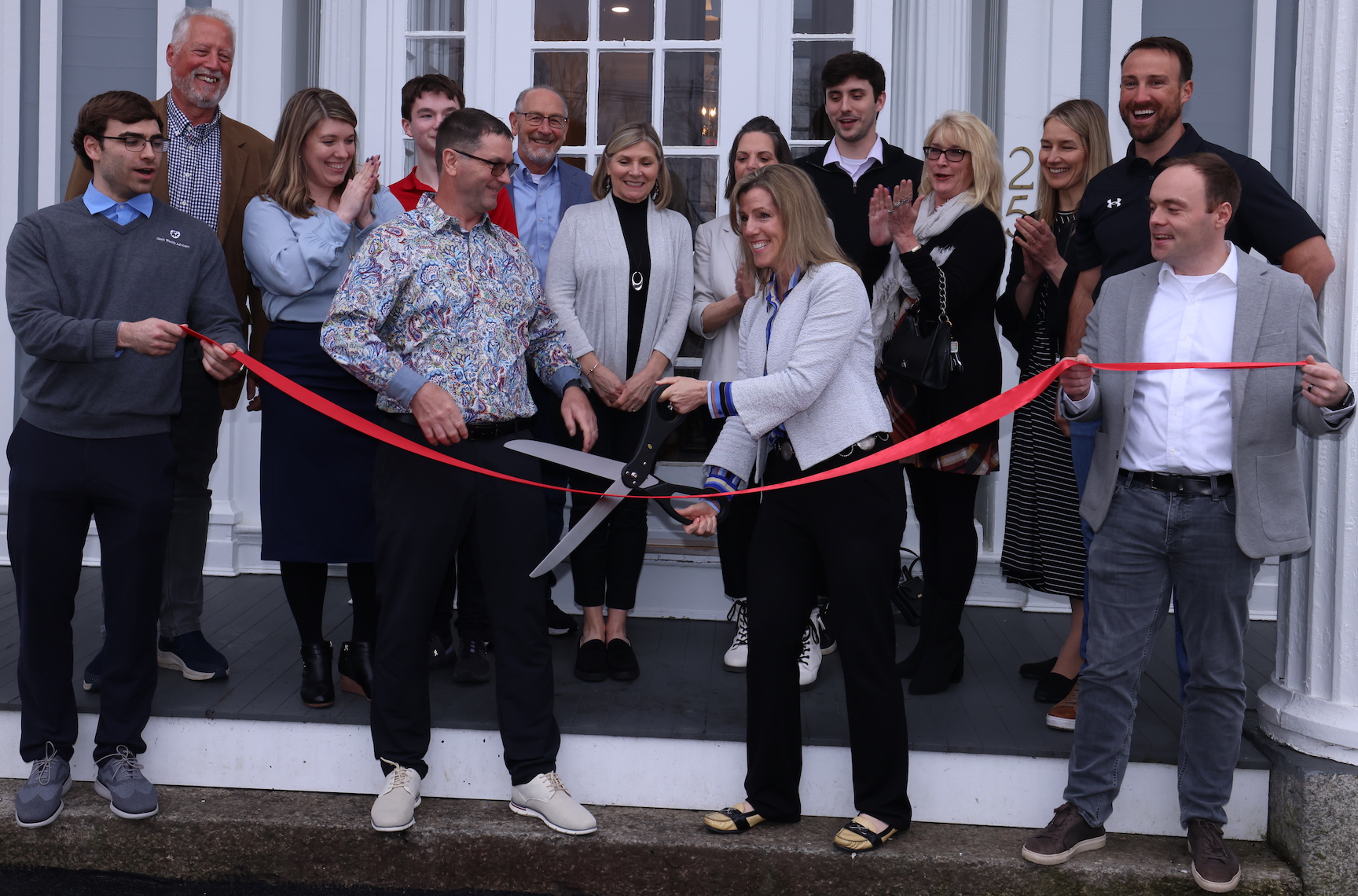
At the opening of Oasis Wealth Advisors’ Hopkinton office, Dawn Smith has both hands occupied by an enormous pair of scissors. A red ribbon stretches across the group gathered outside. People clap. Someone has evidently decided that a normal pair of scissors would undersell the occasion. It is April 2024, and the practice is celebrating its new office at 25 Main Street.
The photograph offers a pleasingly literal picture of a business milestone. Smith stands among other people, doing the ceremonial work of opening a door. Her title is chief executive officer of Oasis Wealth Advisors, a private wealth advisory practice of Ameriprise Financial Services, LLC. She is also a private wealth advisor. There is the responsibility of running the practice, and there is the responsibility of sitting across from someone whose future is under discussion.
By then, her registration history stretched back more than thirty years. A ribbon is a wonderfully brief assignment compared with a career: one cut, a round of applause, finished. The work that earned the gathering is harder to photograph. It involves decisions made over time, relationships maintained, and plans revisited after the circumstances that produced them have changed.
The psychology degree came first
Smith studied psychology at Dartmouth College, attending from 1988 to 1992 and graduating with a bachelor’s degree. Her public professional biography also records that she graduated with honors. The combination is useful background for understanding a career in which calculations and human judgment continually meet. Money arrives with numbers attached. People arrive with expectations, habits and competing priorities.
Her securities registration with the firm now named Ameriprise Financial Services dates to February 12, 1993. She passed the Series 7 examination that February and the Series 63 later the same month. Those dates give the early career a firm outline: college, then the examinations and registrations that permitted her to begin working in the business.
It is tempting to read a whole destiny into a college major. The more interesting point is the continuity of the subject. An advisor can calculate an allocation, explain its purpose and still encounter a client who finds it difficult to live with. Understanding that gap requires attention to the person making the decision. Smith’s education supplies a particularly relevant starting point for that kind of work.
Psychology B.A.
registration
on Main Street
A plan with room for a person
Today, Smith’s stated areas of focus are women’s financial strategies, wealth preservation and retirement planning. Together they describe an advisory practice concerned with who holds the money, what it must support and how long it needs to last. Each phrase opens a different conversation. Preserving wealth asks something different from accumulating it. Approaching retirement changes the timetable again.
Her services include examining progress toward goals, aligning risk tolerance with asset allocation, and using ongoing advice and progress meetings to revisit decisions. Clients can document goals and follow their progress online. That gives the work a recurring structure. A financial plan is reviewed against someone’s changing priorities, with investments considered in relation to those priorities.
The initial consultation is offered without charge and provides an overview of financial planning concepts. Written analysis and recommendations are outside that first meeting. There is something useful about the distinction: the opening conversation establishes what a prospective client wants to address before the relationship proceeds further.
The practical appeal is understandable. People have several financial questions at once, and those questions rarely observe departmental boundaries. A retirement date can affect an investment decision; a family priority can alter a savings goal. An ongoing advisory relationship creates a place to bring those questions back together. Its value has to be considered in the context of the individual relationship and the services actually provided.
The office has more than one chair
Oasis presents its work as a team effort. Alongside Smith, the current advisor roster includes Connell McNamara, a private wealth advisor and client relationship manager, and associate financial advisors Cooper Korbey, Harry Shuman and Michael Muccio. The broader staff includes people responsible for paraplanning, financial planning support, operations and client relationships.
That division of work makes her executive title more concrete. A practice needs someone to manage the business through which advice reaches clients. Scheduling, administration and follow-through occupy the less photogenic end of the profession. They still influence how a client experiences an organization, especially when a question arrives between formal reviews.
The practice lists locations in Hopkinton, Andover and Wellesley. Its physical footprint remains recognizably Massachusetts, even as Smith’s securities registrations extend to multiple jurisdictions. The combination allows a local office to sit within a larger financial services organization. It also calls for precision about her role: she leads Oasis Wealth Advisors, the advisory practice affiliated with Ameriprise.
The ribbon-cutting photograph brings that arrangement down to human scale. The group fills the entrance. The office is a place in a town, with a front step and neighbors gathered to mark its opening. Financial services can sound weightless when described entirely in products and platforms. Here, at least, there is a door.
Twenty finishes, six of them Boston
Smith’s interests include running, reading, travel and good food. Her professional profile records twenty marathons, including six Boston Marathons, and participation in the Hopkinton Running Club. It also says that much of her spare time is devoted to her four children. These are useful details because they restore a person to a résumé otherwise crowded with professional abbreviations.
A marathon count says something specific about repeated participation. It cannot tell us how someone handles a client meeting, and it would be silly to pretend that finishing a race certifies investment judgment. It does, however, make the long run a reasonable image for the span of her career. Twenty races mean returning to the same demanding distance more than once.
Her life outside work has smaller-scale pleasures too. In a 2020 neighborhood interview, she included Sudoku, hiking and movies among her interests. There is a pleasing change of pace between a marathon and a number puzzle. One takes up a road; the other can fit on a page. Both supply an ending that a financial plan, continually subject to revision, tends to withhold.
The sentence that carries the story
In June 2020, Smith offered a succinct account of discipline during market uncertainty: “Now is when you do what you know, and not what you feel.” The line belongs to that moment. It captures the tension between a previously considered plan and the impulse to react when conditions become uncomfortable.
Read as a statement about her professional outlook, it gives the psychology degree a practical echo. A person can understand an idea and still find it difficult to act on it. The distance between the two can become especially apparent when the subject is money. Knowledge does not automatically silence apprehension, impatience or the very human wish to do something immediately.
The sentence also helps explain why an advisor’s work extends beyond producing a document. A plan has to remain intelligible to the person using it. Questions need answering as circumstances change. The relationship supplies opportunities to revisit assumptions, consider developments and understand a decision before taking it. That is a description of the work, rather than a promise about how any investment will turn out.
Smith discussed another side of her career on Brenda Loan-Baker’s Fearless Females podcast in January 2020. The episode concerns building her business, working through challenges and the experiences that helped her along the way. It places the advisor in the company of women discussing leadership as something assembled through work, with obstacles included in the account.
A psychology degree.
A career in financial advice.
A continuing interest in how people decide.Education and practice, side by side
What the awards actually measure
Smith’s recognition includes Forbes Best-in-State Wealth Advisors appearances from 2018 through 2026 and Best-in-State Women Wealth Advisors from 2022 through 2026. Oasis Wealth Advisors is listed among Forbes Best-in-State Wealth Management Teams from 2023 through 2026. The individual and team awards describe different units of recognition, a distinction worth preserving when reading the list.
Her Five Star Wealth Manager record covers 2013 and 2015 through 2026. For the 2026 Boston award, 449 wealth managers were selected from 4,973 considered. The award was issued in February 2026, using a research period in 2025. Those dates matter: an award year and the period evaluated are separate parts of the same description.
The criteria have boundaries. Five Star’s assessment considers professional eligibility and practice measures; it does not evaluate the quality of investment advice. Its disclosure says a promotional fee was paid for marketing materials. Forbes rankings use SHOOK Research’s qualitative and quantitative process, and investment performance is excluded as a criterion.
Recognition is part of Smith’s career record, and readers deserve the nouns and the fine print together. An award can identify an advisor’s appearance on a particular list. It cannot provide a personal forecast for the next client. Keeping those meanings separate makes the achievement easier to understand on its actual terms.
Back to Main Street
The career now spans the interval from a 1993 registration to a practice with three Massachusetts locations and a named team around its CEO. Across that span, the recurring subject is the person making a financial choice: someone preparing for retirement, trying to preserve what they have accumulated, or reconsidering a goal as family circumstances develop.
Smith’s current public activity includes sharing Ameriprise commentary on the economic and investment outlook for the second half of 2026. It is a contemporary version of the ongoing assignment: bring changing market information into a conversation about a longer financial life. The information keeps arriving. The need to make sense of it persists.
And there is still the photograph on the step at Main Street. It has the useful untidiness of a real occasion: people looking in different directions, a ribbon held across a group, scissors large enough to require attention. A business opening gets a ceremony. The years that follow will be made of smaller appointments. For Smith, those appointments continue a career that began soon after Dartmouth, when the study of people became the work of advising them.