The first Edward Jones branch was in Mexico. Missouri, that is. It opened in 1957, in a place unlikely to appear on anyone's map of global finance. Yet the location contained a useful idea: perhaps the distance between a household and an investment professional mattered as much as the distance between an investor and the market.
- Local advisors are the front door to investing and planning.
- Account choice determines who makes decisions and how fees work.
- The firm is adding services around that relationship, including a planned bank.
Edward Jones now serves more than 9 million clients. Its network approaches 15,000 branches across North America. That is a lot of doors. The interesting question is what happens after someone walks through one.
A branch was the breakthrough
Edward D. Jones Sr. founded the firm in St. Louis in 1922. Its first office had a desk, three chairs and a hat rack. His son Ted later developed the branch concept, traveling between Missouri communities to meet investors. The business would take financial services to people who lived beyond the usual financial centers.
The firm's history records another important turn: John Bachmann brought in management thinker Peter Drucker, who encouraged metropolitan expansion. The neighborhood idea could work in a city, too. The company reached its thousandth office in Stoughton, Wisconsin, during the 1980s.
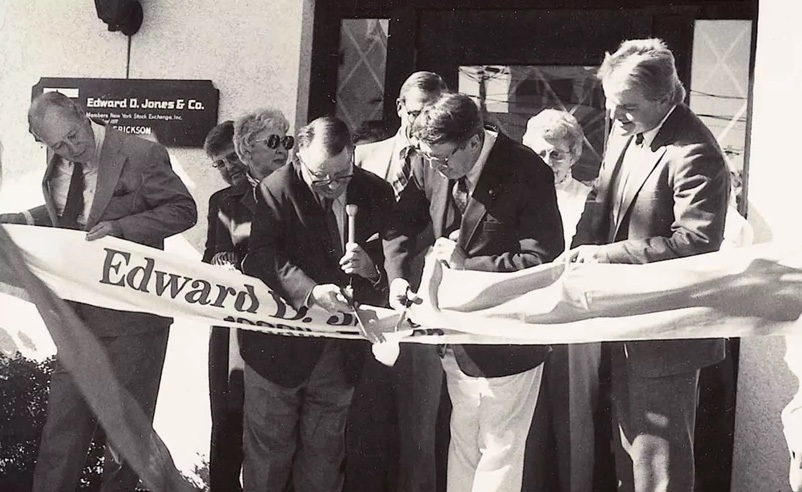
Today, the practical offering is familiar: help assembling investments, preparing for retirement, funding education and thinking through family wealth. The products include stocks, bonds, funds and annuities. The proposed advantage is continuity: a professional who can connect a portfolio to the person who owns it.
Assets under care belong to clients. They are not company revenue or valuation.
Who holds the steering wheel?
Consider the distinction between help choosing investments and help managing them. Edward Jones offers both. Its Select brokerage account lets clients choose investments with advisor guidance and pay applicable transaction charges. Guided Solutions offers ongoing advice for an asset-based fee while leaving investment decisions with the client. Advisory Solutions puts investment management into the firm's hands through portfolio models.
Transaction charges.
Ongoing advice fee.
Asset-based fee.
These are consequential differences. Two clients sitting in the same branch can be buying different services. A retiree who wants portfolio management and a saver who wants help making occasional purchases should understand which relationship they are entering. The sign outside does not settle that question.
For someone considering the firm, the first meeting can therefore be quite practical. Bring the decisions that need making: how much income retirement might require, which accounts already exist, and where family obligations complicate the arithmetic. Then ask the advisor to describe the proposed account, who can authorize changes and what support continues between meetings. The firm advertises a no-cost, no-obligation initial consultation. That is an opportunity to understand the arrangement before buying it.
Put the price in dollars
The published starting annual fee for Guided and Advisory Solutions combines a 1.35% program fee with a 0.05% platform fee. Rates vary with asset tiers and possible reductions. Investments can have internal expenses as well. Select instead carries applicable commissions and sales charges.
Assumes a constant balance at the starting rate. Before investment expenses, discounts or other charges.
Personal attention needs to justify its expense. Someone comfortable constructing and maintaining a portfolio may prefer a self-directed brokerage or a different advice arrangement. Merrill, Morgan Stanley, independent advisers, Schwab, Fidelity and Vanguard occupy overlapping parts of this market, with different service packages. Comparing the actual service and total cost is more useful than comparing familiar names.
The relationship had a disclosure problem
Proximity does not eliminate conflicts. In 2004, regulators found that Edward Jones had inadequately disclosed payments from preferred mutual fund families and the incentives those payments created. The firm agreed to pay $75 million in disgorgement and civil penalties, settling without admitting or denying the SEC's findings.
The settlement required specific changes, including disclosures on its website and to clients, alongside independent review. This is a documented failure with a concrete response. A familiar face still needs to explain how the business gets paid.
A bigger share of the kitchen table

Under managing partner Penny Pennington, the firm is extending the conversation. Its Generations offering, announced in 2025, targets U.S. clients with at least $10 million in investable assets. It adds expanded planning, investment management and dedicated support. The brokerage associated with ordinary households is deliberately courting substantial family fortunes.
Technology is joining the meeting, too. A 2026 update described complimentary access for U.S. clients to Carefull's financial safety platform, plus investments in Carefull and personal finance software company Quicken. Those moves extend the firm's attention toward fraud protection and everyday money management.
“They want a more complete view of their financial lives.”
David Chubak · February 2026 bank announcement
That is how wealth management head David Chubak explained demand in the bank announcement. Regulators conditionally approved Edward Jones Bank in February 2026, with an opening planned for early 2027. Existing co-branded checking and credit cards come through U.S. Bank. Approval and operation are different milestones.
In September 2026, Edward Jones also announced a paid McLaren Racing partnership covering Formula 1 and IndyCar. The neighborhood business is acquiring a rather less neighborhood stage.
What travels beyond finance
There is a business lesson here: make expertise easier to reach, give clients a recognizable relationship owner, then build support behind that person. Edward Jones's private partnership structure and eligible associate profit sharing reinforce its emphasis on participation. Neither removes the need to scrutinize incentives.
The model depends on customers valuing the relationship enough to pay for it. It offers no escape from investment risk, and it loses appeal when personal service adds little to a client's decisions. The useful question at that local address remains wonderfully plain: what will this person help me do, and what will I pay?
Keep the conversation going
Explore Edward Jones, its newsroom and market insights. Find the firm on LinkedIn, X, Facebook and YouTube.
▶ Watch The Deciding Factor Stories, behavioral science and financial decisions ↗