There are worse places to discover an insurance company than the back seat of a black car. Dustin Walsey discovered his there, conversation by conversation, while Uber was still largely a service of polished vehicles and professional drivers. He already sold commercial coverage to taxi and limousine operators around Georgia. An Uber ride could double as a sales call. He would climb in, talk with the driver, learn the route and learn the risk. By his telling, he came to know much of that market from the passenger seat.
Then UberX arrived. The car stayed personal, but the work became commercial whenever the app lit up. Insurance, a trade fond of clear labels and carefully ruled boxes, was being asked to cover a vehicle that moved between categories by the minute. Walsey faced an awkward professional fact: when a driver told him the truth about using a personal car for paid rides, he had no suitable policy to sell.
Most founders dream of demand. Walsey found something more specific - a customer, a risk and an honest application form that could not comfortably coexist. The missing product became the beginning of Buckle in late 2016 and early 2017.
Chapter oneThe categories stopped behaving
Walsey had useful preparation for noticing a mismatch. Born and raised in Atlanta, he grew up in a family of entrepreneurs and worked in the newspaper business as an intern. Newspapers teach an unromantic lesson early: what matters is not merely what happened, but whether you can explain it clearly before somebody turns the page.
He studied finance and marketing at Indiana University Bloomington from 1993 to 1997, followed by an executive leadership program at the University of Virginia’s Darden School of Business in 2007. His working life crossed banking, technology and sales. At Akamai Technologies, he worked in business development with large companies including Coca-Cola and Cox. For more than a decade he owned and led AutoTown Insurance, an independent agency in the Southeast.
That combination matters. Finance teaches how risk is priced. Marketing teaches how a product is understood. Technology sales teaches how old organizations absorb new behavior. Agency work teaches the punishment for getting the details wrong. When rideshare put a commercial income stream inside a personal car, Walsey did not need a futurist’s vocabulary. He needed a policy that fit.
“Simplicity really wins.”Dustin Walsey
His method was decidedly low-tech. He rode. He asked. He sold what he could and took note of what he could not. Even after Buckle began, he said the company used brand ambassadors to talk directly with drivers. The habit survived the pitch deck.
The route from policy gap to platform
Chapter twoA four-word doorway
Buckle’s early description was almost comic in its economy: insurance for Uber drivers. Behind those four words sat underwriting, data, distribution, claims, regulatory compliance and capital. But Walsey has little patience for mistaking operational complexity for a complicated story. He has said that if his teenage children cannot hear a founder’s explanation and articulate it back, the explanation is not ready.
There is a sly discipline in that test. A teenager is not grading the elegance of the business model. A teenager is deciding whether the speaker knows what the company does. For Walsey, founders should tighten the story, the addressable market and their place in it. Then they should speak with customers, partners, investors and other founders. The pitch becomes clear by surviving other people.
He applies a similar instinct to teams. As Buckle grew, Walsey argued for diversity and open communication because a narrow room produces agreement too easily. He also described leadership as an exercise in moving away from daily functions and toward people trusted with large goals. The founder’s usefulness changes: first he knows the driver; later he must know who can build what he cannot.
Chapter threeFairness needs machinery
The first Buckle thesis was social as well as commercial. Gig workers often moved in and out of app-based work, living in a financial world that treated them as exceptions. Walsey objected to using consumer credit history as a central insurance-pricing tool and argued for other data, including driving and work information. A low credit score could make insurance dearer even when it said little about the work being insured.
Buckle’s ambition expanded beyond a single auto policy. The company talked about insurance, vehicle leasing and financial services for an “emerging middle market.” It formed relationships with rideshare platforms, including Lyft, and sought continuous coverage for drivers moving on and off the clock. The human problem was fluid; the institution built around it could not be flimsy.
In 2020 Buckle acquired and recapitalized Gateway Insurance Company. That move brought carrier licenses and a sturdier regulatory base. A $31 million financing package combined Series A equity and debt that year. In 2021 came a $60 million Series B alongside additional debt. A further $15 million term-loan increase in March 2022 took the company’s reported capital raised to approximately $115 million.
Capital is a dramatic number in a headline and a quiet obligation everywhere else. Insurance expansion happens state by state. Walsey has compared the experience of crossing state lines to moving between countries because rules and filings change at each border. Every new program brings regulators, rates, forms, claims and reinsurance into the room. The clever part is inseparable from the clerical part.
Chapter fourThe pivot behind the policy
By 2022, Buckle’s founders were also talking publicly about working with managing general agents. An MGA can design and distribute a specialized insurance program while relying on a carrier to issue the paper and on reinsurers to take much of the risk. Buckle had assembled pieces both sides wanted: licenses, carrier infrastructure, data capabilities and relationships with reinsurance panels.
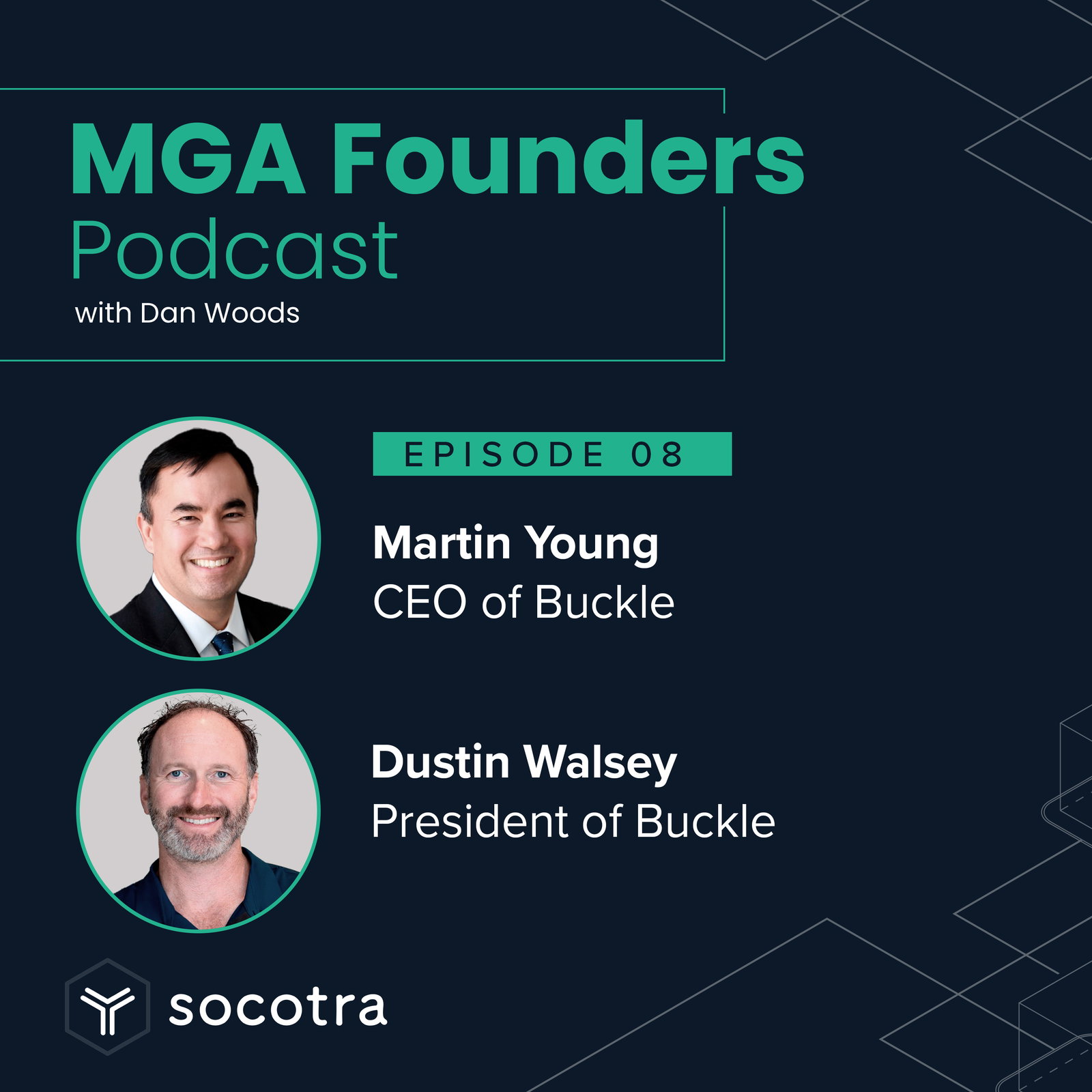
The strategic emphasis sharpened. Martin Young, Walsey’s co-founder and then chief executive, stepped aside in 2023. Walsey succeeded him as CEO. Public regulatory records also identify Walsey as president and director of Gateway. Buckle now presents its fronting work as a way for small and midsize MGAs to reach auto, commercial and specialty markets, share risk through a cell captive and operate with lower costs.
The customer changed, but the diagnostic remained familiar. In the rideshare chapter, a driver sat between personal and commercial insurance. In the fronting chapter, a specialized MGA sits between an idea for risk and the licensed, capital-backed structure required to carry it. Walsey’s business keeps returning to the same terrain: capable operators stranded between categories, looking for a bridge sturdy enough to use.
“As an insurance entrepreneur, I understand the importance of relationships.”Dustin Walsey
That sentence could pass for courtesy, but in fronting it is operating doctrine. The MGA needs a carrier that will not compete with it. The carrier needs confidence in underwriting and distribution. Reinsurers need intelligible risk. Regulators need compliance. Nobody gets very far by winning a single transaction and poisoning the next one.
Home fieldAtlanta stays in the frame
Walsey’s attachment to Atlanta is unusually plain. He speaks about the city’s growth and sports teams as parts of his own life. He chose Georgia for Buckle’s opening market because he knew its insurance terrain and because Atlanta had a substantial rideshare population. It was home-field advantage without pretending home was easy.
He also treats the city as a talent argument. Georgia Tech, Georgia State, Morehouse and Spelman feed a broad business community. Walsey served as a Georgia Tech VentureLab Fellow, mentoring university-linked companies, and he supports youth sports locally. In his telling, new corporate arrivals add to a flywheel: people learn inside larger organizations, then some leave to start the next company.
The newspaper kid, the Akamai salesman, the insurance agent and the founder all make sense in that city. Atlanta rewards a person who can move between old institutions and new networks without becoming precious about either. Walsey’s own preferred pose is “salesman at heart,” which is less grand than visionary and probably more revealing. A salesman must notice the moment when the customer wants to buy and the catalog has nothing honest to offer.
Buckle began at precisely that moment. The app said one thing, the car title said another and the policy said no. Walsey listened from the back seat until the contradiction became simple enough to name. The company has since changed its audience and added heavier machinery, but its founder’s useful trick remains intact: find the category that reality has already broken, then build for the people standing in the crack.