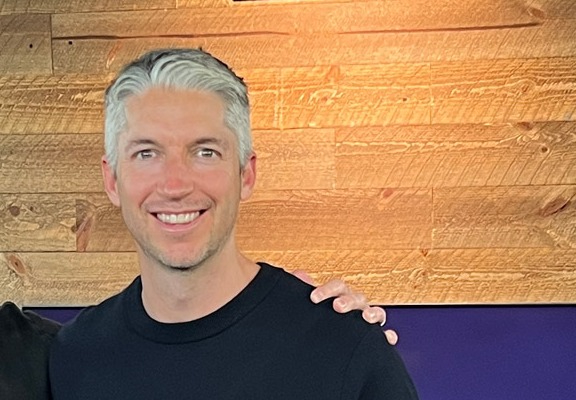
He left the trading floor to measure blood. Then he convinced Tony Robbins and a moon-shot physicist to help.
CO-FOUNDER & CEO · LIFEFORCEDugal Bain-Kim runs Lifeforce, a health optimization company that begins not with a pep talk but with a needle. An at-home blood draw, 40-plus biomarkers, and a clinician on the other end reading the results. The pitch is almost rude in its simplicity: you do not have to put up with feeling average.
Lifeforce is what happens when an operator who spent years inside finance and telehealth gets personally annoyed enough to build the thing he wanted to buy. It pairs lab data with doctors, coaches, supplements and prescriptions, and sells it as a membership. The company says its aim is to extend quality of life and lifespan for five million people by 2030. That is the kind of number you put on a wall, not a spreadsheet.
He is, by his own framing, not a doctor. He came from the business world. In a field crowded with white coats and supplements that promise the moon, the outsider lens is the product: translate the science, strip the friction, make proactive health a habit instead of a panic.
"It was overwhelming to see the positive effect we were having on people's lives."
After his daughter was born, Bain-Kim did what disciplined people do: he tried to get back on track. The old habits, the ones that had always worked, suddenly did nothing. The body that used to bounce back simply sat there. His physiology had quietly changed and nobody had sent a memo.
So he went looking for answers the way a modern person does, by buying things. Finger-prick kits. Saliva tests. A scattered relay race of vendors who each held one puzzle piece and none of the picture. It was, he has said, fragmented and expensive and not especially effective. Most people would shrug and order a different supplement. He filed it as a market failure.
The fix arrived through a network, not a eureka. Courtney Reum at M13 Ventures connected a handful of people who had all, separately, been chasing the same frustration. Tony Robbins. Dr. Peter Diamandis, the XPRIZE founder. Joel Jackson. In February 2022, after a first meeting, Lifeforce existed. The company grew past a thousand customers in its early months largely on referrals, then tripled its team to keep up.
A motivational icon, a moon-shot physician-entrepreneur, and an operator. All on parallel health journeys, introduced through M13. The board reads like a longevity supergroup - the trick was turning four people's frustration into one product.
Bain-Kim is Australian-born and educated at the University of Queensland, where he collected degrees in finance, American history and political science - an unusually literate combination for a man who would end up arguing about hormones and biomarkers. He later earned an MBA from the University of Cambridge.
The throughline is operations. Strategy at BlackRock, operational excellence at a national telehealth platform, then a company of his own. He talks about finance the way people talk about an ex they learned a lot from: useful, formative, and not a place he wanted to stay. Mission and intrinsic motivation, he has noted, were not part of that first career decision. They are the entire premise of this one.
To round out the clinical side, he recruited Dr. Kurt Hong as Chief Medical Officer - because a non-doctor building a medical product knows exactly which seat he should not sit in.
It starts at home, with a draw that measures 40-plus biomarkers. Numbers before narrative. The point is to replace the guesswork that sent him chasing finger-prick kits in the first place.
Results turn into a personalized, proactive plan built around individual biology and goals - energy, body composition, sleep, longevity - with clinicians and coaches attached, not a PDF left to rot.
It's a subscription with quarterly diagnostics, so the data updates and the plan adjusts. Health as a standing appointment rather than an emergency.