The membership platform betting that the fastest way to a longer life is simply knowing what your body is doing.
Walk out of a routine physical and you usually leave with a handshake, a few numbers, and the vague sense that everything is probably fine. Function Health was built on the frustration inside that word - probably. The company, founded in Austin in 2021, sells a different arrangement: pay a flat annual fee, give two blood draws a year at a Quest Diagnostics lab, and get back more than a hundred results spanning heart, thyroid, hormones, metabolic health, nutrients, inflammation, and markers tied to cancer and fertility. Function says that is roughly five times what a standard physical measures.
The pitch is less about any single test than about the layer wrapped around them. Results land in a dashboard that explains each marker in plain language, flags what is out of range, and points to a next step or a retest. It is the part of medicine most people never see - the interpretation - turned into a consumer product.
"A fulfilling life depends on health, and health depends on awareness."
— Function Health, company missionNone of the underlying science is new. Quest runs the blood; the panels already existed for anyone whose doctor ordered them. What Function assembled was access, a readable report, and a price that fits on a single line: one membership, one dashboard, one explanation. That assembly, more than any breakthrough assay, is the company.
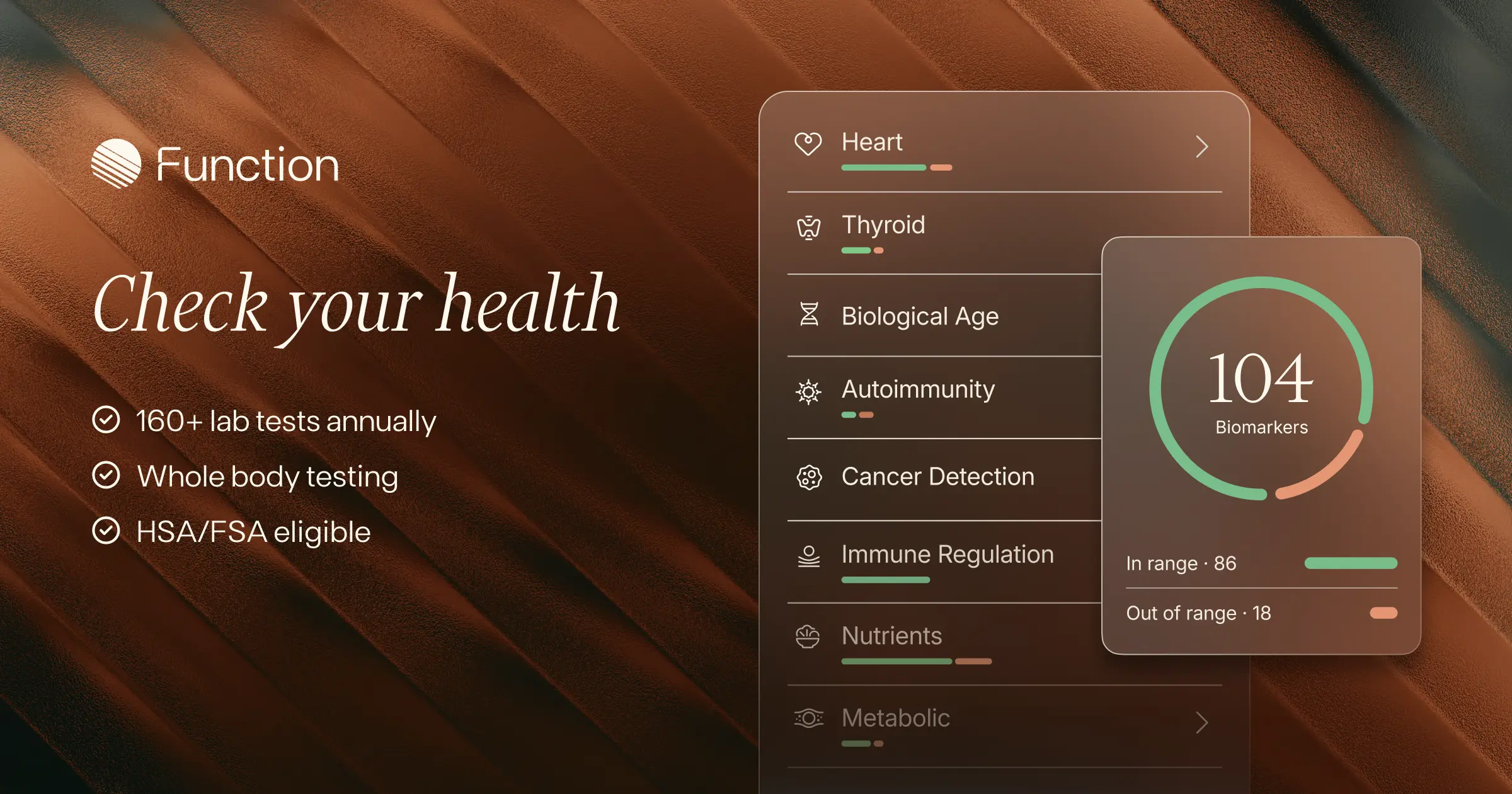
Function's members skew toward the health-conscious: longevity enthusiasts, athletes, people who track their sleep and their macros, and a growing set of employers folding preventive testing into benefits. By 2024 the company reported more than 100,000 members and a waitlist of roughly 200,000 - a line nearly as long as the membership itself.
That waitlist is the loudest signal in the numbers. Demand a company has to ration says more than any growth chart, and Function spent its early years deliberately metering who got in while it scaled testing capacity through its lab partners.
Conventional healthcare tends to start when a symptom shows up. Function's founding premise is that the most useful moment to look is long before that - when a drifting marker is still just a number, not a diagnosis. The company frames its whole reason for being around a single reframed assumption: that healthcare should begin with awareness, not with a crisis.
Its differentiation is less any one feature than the bundle. Rivals tend to specialize - imaging from Prenuvo, blood analytics from InsideTracker, metabolic tracking from Levels, single-panel kits from Everlywell. Function stitches lab testing, full-body imaging, and AI interpretation into one membership, then competes hardest against the thing most people already have: the fragmented, once-a-year physical.
"We want living 100 healthy years to be the expectation - not the exception."
— Function HealthIt is not without critics. Some physicians and academics argue that testing this broadly can surface incidental findings, drive anxiety, and trigger follow-ups of uncertain value. It is a fair challenge, and the honest version of Function's model is narrower than "test everything" - it is "test what is actionable, and explain it well." That tension sits at the center of the category the company is trying to build.
100+ lab tests a year across heart, thyroid, hormones, metabolic health, nutrients, inflammation, and cancer and fertility markers, delivered via two Quest blood draws with clinician-reviewed, readable results.
≈ $499 / yearA 22-minute whole-body scan, added through the Ezra acquisition and priced at $499 - about a third of the prior market rate - designed to flag early cancer, aneurysms, and other silent findings.
$499 add-onA HIPAA-aligned generative AI effort that reads a member's labs, imaging, wearables, and records to produce personalized, plain-language insight.
Launched with Series BLongitudinal tracking that explains every biomarker, highlights out-of-range results, and recommends next steps and retests over time.
IncludedFunction runs on a direct-to-consumer subscription - roughly $499 a year - that bundles testing, insight, and software. It does not own labs; specimen collection and analysis run through third parties, chiefly Quest Diagnostics, which keeps the model asset-light. Add-on revenue comes from services like the $499 full-body MRI, alongside employer and partnership channels such as Equinox and the NBA Players Association.
The capital arc is steep: a $3M seed in 2022, a $53M Series A in 2024 at a $191M valuation, and a $298M Series B in November 2025 led by Redpoint Ventures at a $2.5B valuation - roughly $354M raised in total across four years.
| Round | Amount | Date | Lead / Notable Investors |
|---|---|---|---|
| Seed | $3M | Mar 2022 | Early angels & institutions |
| Series A | $53M | Jun 2024 | a16z, Wisdom.vc, Draft Ventures; Matt Damon, Kevin Hart, Pedro Pascal |
| Series B | $298M | Nov 2025 | Redpoint Ventures, a16z, Battery Ventures, NFDG, Anthony Wood |
The founding team pairs clinical credibility with consumer software instincts. CEO Jonathan Swerdlin leads the company; physician and author Mark Hyman serves as chief medical officer, lending Function its medical voice. Around them, co-founders Pranitha Patil, Seth Weisfeld, Daniel Swerdlin, and Mike Nemke cover business, design, and legal - a mix that shows in a product built to feel more like an app than a clinic. Its expertise is less in inventing assays than in orchestrating a lab network, an interpretation layer, and, increasingly, an AI stack.
A physician and a team of technologists launch in Austin to make comprehensive testing consumer-accessible.
Early capital funds the membership testing platform.
The platform scales fast, completing more than three million tests in a single year.
Raises $53M at a $191M valuation and passes 100,000 members with a long waitlist.
Acquires Ezra for a $499 full-body MRI, joins TIME's Most Influential Companies, and closes a $298M Series B.
Connects member data to ChatGPT, Claude, and other assistants for plain-language insight.
Function sits at the meeting point of three currents: the longevity movement, direct-to-consumer diagnostics, and the arrival of AI that can read health data in plain language. Against specialized rivals - Superpower, Prenuvo, InsideTracker, Levels, Everlywell, LifeForce - its wager is that consumers would rather have one platform for testing, imaging, and interpretation than assemble the pieces themselves.
Its real opponent, though, is inertia: the assumption that a yearly physical is enough. If Function is right that people will pay to understand their own biology, it has room to grow. If the critics are right that broad testing creates more noise than signal, the ceiling is lower. Either way, at a $2.5B valuation and a TIME nod in 2025, it has become the most visible test case for whether preventive care can be sold as a product.
Recognition that put Function alongside the year's most consequential businesses.
The full-body scan dropped from ~$1,500 and 60 minutes to $499 and 22 minutes.
The full-body MRI takes 22 minutes - down from the hour Ezra's scan once required.
The cap table reads like a red carpet: Matt Damon, Pedro Pascal, Kevin Hart, and Zac Efron have all invested.
Function pitches roughly 5x the biomarkers of a standard annual physical.
The company turned up in an Academy Awards nominee gift bag.
Members give two blood draws a year at Quest - about 35–85 mL across visits.
Results can now be queried through ChatGPT and Claude in everyday language.
Sources: Function Health · Wikipedia · TechCrunch · CNBC · Fierce Healthcare · PR Newswire · MedCity News. Figures are drawn from public reporting and are approximate where noted. Employee count reflects supplied dataset.