The deal arrived disguised as a small piece of paperwork. Mike Mann had paid $70 for Menus.com. In 1998, he sold the address for $25,000. The spread was startling, but the revelation mattered more: an ordinary English word, followed by three letters and a dot, could behave like property. It could be found, held, priced, and transferred. It could also contain the opening move of somebody else’s company.
Mann had already been looking for leverage. In the early 1990s, he spent long hours in libraries reading business books and periodicals, searching for a larger opportunity than the small ventures and jobs that had occupied him. He had run messenger operations, imported goods from Guatemala, and worked around a Washington pretzel startup. In 1994 he founded an internet service provider called Internet Interstate. Verio bought it in 1997, and Mann became president of VerioDC.
Then Menus.com supplied the cleanest equation of his career. The name did not need a warehouse. It did not spoil. Its value depended on scarcity, memory, language, and the arrival of a buyer with a plan. Mann founded BuyDomains in 1998 and began assembling inventory at a scale that made the secondary domain market look less like a swap meet and more like retail.
I could not imagine anything having a higher profit margin than that.Mike Mann, recalling the Menus.com sale
A runaway learns the value of an address
The neatness of the business contrasts with Mann’s early life. Born in Washington, D.C., during a blizzard, he has written that he was kicked out of school and home by 15. He hitchhiked around the country, sometimes following the Grateful Dead. Beds were improvised: Volkswagen vans, woods, beaches, cheap motel rooms. Entry to sold-out shows could require a fence, a bribe, or a forged ticket.
It is tempting to make the adult career a tidy correction to that instability. Mann’s own description is rougher. “My nature is to hustle and survive,” he told The Washington Post. Survival, in this telling, is not a chapter that ends. It becomes a working style: absorb information, keep moving, look for asymmetry, and do more repetitions than the next person is prepared to do.
His domain operation turned those instincts into a system. Names had to be found, filtered for commercial usefulness, screened for trademark trouble, scored, priced, and renewed. The glamorous version of domaining is a single sale announced with many zeros. The daily version is a ledger full of annual bills and no guarantee that today will bring the right buyer.
BuyDomains eventually held about 500,000 premium names. Mann sold a majority interest in 2005 to Highland Capital Partners and Summit Partners, together with the Seeq.com search portal. After his noncompete ended, he returned to the trade. DomainMarket.com, formed in 2008, gave the second act a fittingly literal name.
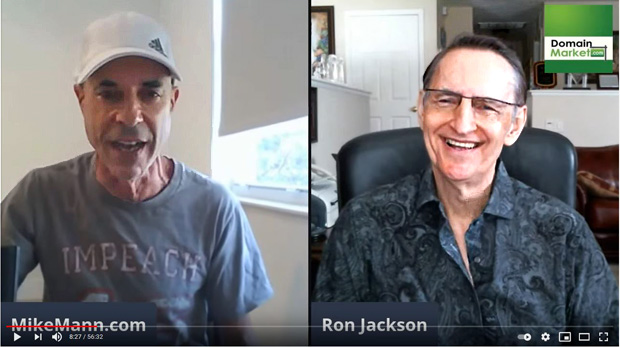
The headline sale and the hidden machinery
Sex.com produced the sort of number that escapes industry newsletters. In 2010, the domain was headed toward a foreclosure auction after its owner, Escom, ran into bankruptcy. Mann was an investor connected to Escom’s creditors and argued that a quick auction would destroy value. The sale moved to brokerage firm Sedo. Clover Holdings paid $13 million, a figure recognized at the time by Guinness as a record for an internet domain address.
A record can distort a career by making one moment appear to explain everything. Mann’s actual bet is distributed across many smaller judgments. Does a phrase sound like a company? Is it easy to spell after hearing it once? Does it carry purchase intent? Could a founder build a category around it? And, quietly underneath every question: how long can the owner afford to wait?
Four turns of the flywheel
From one instructive sale to a catalog of possible companies.
That patience can look eccentric from outside. In 2014 Mann offered HappyBirthday.com for $2 million. His portfolio has also included Obey.com, Tasty.com, Angola.com, and Mali.com. A buyer sees a price attached to a word. Mann sees the years of renewals, the alternatives that failed his filters, and the commercial future the word might organize.
The model also requires comfort with an illiquid market. A share of public stock can find a buyer in seconds. A domain may wait years for the one organization that values its exact combination of clarity and authority. Mann once explained that even when thousands of names were priced as bargains, only a handful might sell on an ordinary day. The inventory is visible to everyone, but demand arrives one founder, rebrand, or product launch at a time.
That makes pricing part arithmetic and part theater. Set the number too low and the singular asset is gone forever. Set it too high and another renewal cycle begins. Mann’s public sales posts turn these private calculations into a running tape: the name, the sale price, sometimes the acquisition cost, and a compact lesson in waiting.
His latest public appraisal framework reduces the craft to three connected questions: the inherent quality of the name, evidence from comparable sales and market data, and the fit between the domain and an end user’s economics. Machines can help with research and ranking. Mann has spoken about using AI for valuation, landing pages, and search work. But the final price remains an argument about human ambition.
Companies hiding in plain sight
Mann has never treated domains only as trading cards. A good one can become the front door of an operating business. Phone.com and SEO.com grew into companies with more than 100 employees, according to Mann’s account. DomainMarket.com, Phone.com, and SEO.com all appeared on the 2012 Inc. 500. AccurateAppraisals.com applies his pricing experience as a service. Earlier ventures ranged from WashingtonVC to Yield Software, which was acquired by Autonomy in 2011.
The connecting idea is almost mischievously simple: sometimes the business plan is latent in the noun. Software.com suggests its market before a pitch begins. Phone.com does the same. A strong name cannot rescue an indifferent company, but it can remove a little friction from every introduction, search, advertisement, and recommendation that follows.
His 2003 invention, known as WhoisPlus or NameFind, approached the same problem from the customer’s side. When a desired address was unavailable, software could suggest useful alternatives instead of presenting a dead end. Mann received a patent connected to the technology. Variations of that interaction later became familiar across registrar search boxes: type an idea, then browse a machine-made shelf of nearby possibilities.
I’m mostly a working man and a family man to the best of my ability.Mike Mann
“Working man” is a deliberately plain label for a résumé crowded with companies. It also makes sense of Mann’s public manner. He posts sales, opinions, appraisals, and declarations at a pace that leaves little room for mystique. The self-promotion is not hidden. Neither is the labor. Even his leisure retains percussion and motion: he plays drums, sees live music, seeks beaches and forests, and rides jet skis when time allows.
Profit with somewhere to go
The second half of Mann’s thesis is printed in the title of his book, Make Millions and Make Change! He says a venture capitalist once persuaded him that he could serve charitable causes with more leverage after building wealth. Whether one accepts the premise or not, Mann has organized his career around it.
He served as the founding chairman of Byte Back, which provides computer and job training. He later founded and chaired Grassroots.org for a decade; the organization supplied free technology services to more than 10,000 nonprofits. Grassroots.org also helped create ChangeTheWorld.org with the University of Maryland and other universities, matching business students with nonprofit projects.
Make Change! Trust is the current expression of the idea. The donor-advised fund supports nonprofits with an emphasis on sustainability and earned income, so that a grant can help an organization become less dependent on the next grant. It is the charitable analogue of Mann’s business instinct: do not merely transfer a resource; build a mechanism that keeps producing value.
There is tension in that pairing, and Mann does not sand it away. He calls himself a capitalist, a speculator, and a philanthropist. Domain prices can seem audacious. Renewal math can seem bloodless. Yet the money is supposed to leave the spreadsheet and become training, nonprofit infrastructure, mentorship, or another form of practical help.
More than three decades after the library sessions, Mann is still asking what a good word can do. It can direct a browser. It can shorten an explanation. It can anchor a company. In his preferred equation, it can also pay for work far beyond the internet. The address is never the destination. It is the leverage used to get there.
The teenage Deadhead and the domain operator are not opposites so much as versions of the same restless character. One found improvised ways through gates and across the country. The other built systems for locating overlooked digital property. Both are alert to openings. Mann’s adult life added a ledger, a sales page, and a charitable purpose to that original appetite for movement.