Chris Mann found a rather awkward omission in the subject he had studied at Harvard. Economics could describe a transaction. It was less satisfactory, to him, at accounting for the people and landscapes left outside it. He earned his degree, went into the food business, and eventually acquired a job title that no university careers office was likely to suggest: Chairman of the Gourd.
The gourd was real. So was the problem. Mann became one of the founding partners of Guayakí, the yerba mate company renamed Yerba Madre in 2025. The business would put a South American drink into American stores while trying to give the forests where it grew an economic reason to remain standing. A yellow can was the eventual delivery system. First came years of explaining what was inside.
A restaurant before a rainforest
Before Guayakí, Mann helped build Natural Flavors, an organic vegan restaurant. Its operation involved 25 employees and 60 local farmers. That is a useful place to begin his story: with people producing, preparing and selling food, already linked by a business. The restaurant made the relationship between an enterprise and its suppliers something he could work on directly.
His later career would give that relationship a much longer geography. The growers would be in South America; many customers would be in North America. The central concern remained recognisable. What happens to the people supplying a product when the business buying it succeeds? And can the way it buys encourage a different use of the land?
Mann's dissatisfaction with economic externalities gave those questions a particular bite. An externality is a tidy word for an effect that escapes the price of a transaction. On a page, the word behaves beautifully. In a forest, consequences have a habit of spreading beyond the margin.
The seeds assemble
Guayakí's origin belongs to a group. In 1996, Alex Pryor, an Argentine studying at Cal Poly, introduced David Karr to yerba mate. They began building a business in San Luis Obispo. Michael “Don Miguel” Newton, Steven Karr and Mann joined the founding circle. They became known as the Semillas, the Spanish word for seeds.
Each brought something to a venture that was still finding its shape. Pryor connected it to the plant and its growing regions. Steven Karr worked on its visual identity. Mann brought experience running a food business. In Steven's account of the early operation, the company spread from David's apartment closet into successive rooms, while sacks of mate travelled up and down the stairs.
There is something reassuringly domestic about that beginning. Before there was a brand on a store shelf, there was stock occupying somebody's home. Expansion could be measured in rooms. It is difficult to get too abstract about growth when the product is taking over the kitchen.
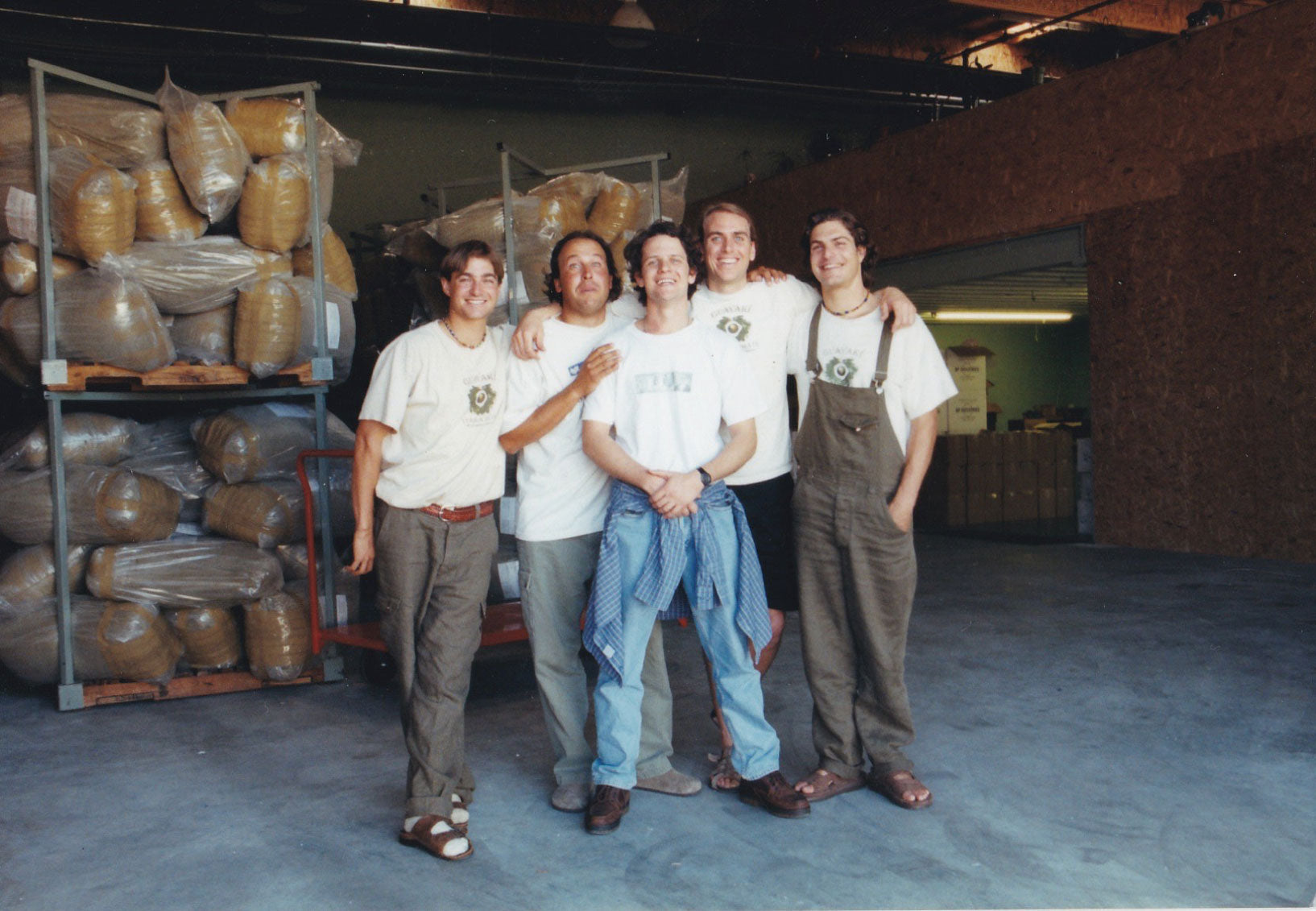
The group's early sales method required considerable human mileage. They took to the road, introduced the drink to strangers, brewed samples and persuaded natural food shops to carry it. Mann and David Karr later recounted that long beginning together. The route into the American market ran through repeated encounters with people who first needed to learn what yerba mate was.
A drink with an explanation attached
For a customer accustomed to buying a familiar beverage, mate presented a small collection of puzzles. There was the name, the plant, and the traditional shared gourd with its metal straw. Guayakí was asking people to try a product and learn a custom at the same time. A supermarket shelf allows rather less conversation than a gourd circle.
Mann remembered the difficulty plainly: “neither the product nor the company had English in its name.” The practical response included familiar formats. Tea bags made the leaves easier to approach. Glass bottles arrived in 2005; canned drinks became part of the range. People could encounter the beverage without first acquiring the equipment or mastering the ritual.
The distinction mattered commercially. An unfamiliar ingredient inside a familiar package gives a shopper one fewer decision to make. Yet packaging also changes the relationship. Sharing a gourd asks people to pause together. A can can travel alone. Guayakí's task was to make the product convenient while keeping its connection to the culture that had brought the founders together.
“We hired for fit, trained for skill”
Chris Mann, discussing Guayakí's growth in 2015
Success took time. Nearly 15 years passed before the company made a significant profit. By 2012, annual sales were about $17 million. A decade later, its founders' podcast appearance described a business with annual revenue above $100 million. These are different dated snapshots of the company, rather than a measure of Mann's personal wealth. They show how long the early work preceded a much larger commercial operation.
The forest enters the accounts
The founding proposition depended on where and how the leaves were grown. Buying shade-grown yerba mate could reward producers for maintaining tree cover. Long relationships and premiums could make forest stewardship part of earning a living. The company called the approach Market Driven Regeneration. The name was substantial; the underlying question was quite practical. What would make keeping trees a workable choice for a grower?
This put the supplying communities inside the business model. Their knowledge, land and livelihoods were part of what the product depended on. Forest conservation and the income of people living there had to be considered together. A commercial buyer could help by providing a market for something harvested beneath the canopy.
That relationship also explains why Mann was interested in the time horizon of money. In a 2011 discussion about mission and finance, he worried about investment funds seeking liquidity within three to five years while Guayakí was pursuing a ten-year mission. Investors and forests do not automatically keep the same calendar. Raising capital can therefore involve deciding whose clock the enterprise will follow.
THE FOUNDING PROPOSITION
- Buy the drinkCustomer demand creates a market.
- Purchase shade-grown leavesGrowers earn income from the forest.
- Support standing treesStewardship becomes part of the business.
A diagram of the intended model, not a quantified claim about each purchase.
The question grew harder as the business grew. A founding group can carry an idea through personal relationships. A larger organisation needs ways to teach it, hire around it and preserve it when decisions are made by people who were never in the original apartment. Mann spoke about turning the early, personal commitment into a more explicit company culture. Growth brought an administrative task alongside the sales opportunity.
Even the string counted
Mann's environmental concerns reached past the growing regions. In 2018, he discussed packaging and transport as major parts of Guayakí's footprint. He also described a very small object with a measurable consequence: removing tea-bag strings and overwrap had saved 44,000 pounds of packaging the previous year. A mission about forests had reached the string on a tea bag.
It is an appealing detail because it gives the ambition a scale a person can hold. The company was also experimenting with electric delivery vehicles and hiring drivers affected by the prison system. Those efforts linked operational choices to the social commitments Mann wanted the business to carry. The delivery route, like the purchasing contract, became somewhere to put the idea to work.
His public work extended into other business circles. He served on the boards of GoLocal Sonoma County and OSC2. He supported Sebastopol's Slow City initiative through Guayakí, including providing space for a gathering. These connections fit a recurring interest in his career: businesses acting together, and a local economy worth participating in even when the product travels much farther away.
There was room in that world for a playful title. Chairman of the Gourd carried an unmistakable reference to the shared vessel at the centre of mate culture. It also made a corporate introduction a little less solemn. Mann's career had plenty of serious questions already; the business card could afford a smile.
A company outgrows its first chapter
Today, Mann is a co-founder and former CEO. The company has changed leadership as well as scale. Robyn Rutledge succeeded him as board chair in 2024, as Ben Mand became CEO. In 2025, a move toward outside distribution brought more than 100 layoffs at The Yerba Mate Co., its distribution operation. The change sits uneasily beside the earlier experiment in building social commitments into delivery.
Those later decisions belong to the company's subsequent leadership. They also make Mann's original questions more interesting. A mission has to survive changes in ownership, management, channels and costs. The business can carry an idea much farther than its founders could carry it themselves, while exposing that idea to decisions they no longer make.
The 2025 name change to Yerba Madre put the plant back into the company's introduction. Mann remains among the founders named in its public account of that history. His contribution runs from a restaurant's network of local farmers to a beverage company built around forest-grown leaves. The distance is considerable. The question connecting the two is still small enough to ask across a table: when this business grows, what else gets to grow with it?