In the O’Reilly household, Shane was expected to mow the lawn. He had cerebral palsy and used a powered wheelchair, which made the usual equipment inconvenient. His father found an old chair the family called the Cherry Picker and connected a mower to it. Shane got a chore. His siblings got a lesson: inclusion could be wonderfully ordinary.
- Clients choose and book their own support workers.
- Hireup employs the workers and handles payroll, tax, super and insurance.
- Joining is free; support is charged by the booked hour.
- Disability support now sits alongside an aged care offering.
The wrong person at the door
Outside the family, the expectations were different. Hireup’s origin account describes unfamiliar workers arriving, Shane’s greetings going unanswered, and day programs offering activities he did not want. Some workers formed good relationships with him. The trouble was that he could not choose who came next. What failed first was continuity: a service could deliver a person without delivering a relationship.
“We could see his spirit being crushed,” his brother Jordan recalled. Shane died in 2011, aged 21. Laura and Jordan O’Reilly went on to launch Hireup in 2015, with technical co-founder Murray Bunton. The company had been registered the year before. Their product gave people seeking support a way to decide who would provide it.
Choose the person. Keep the employer.
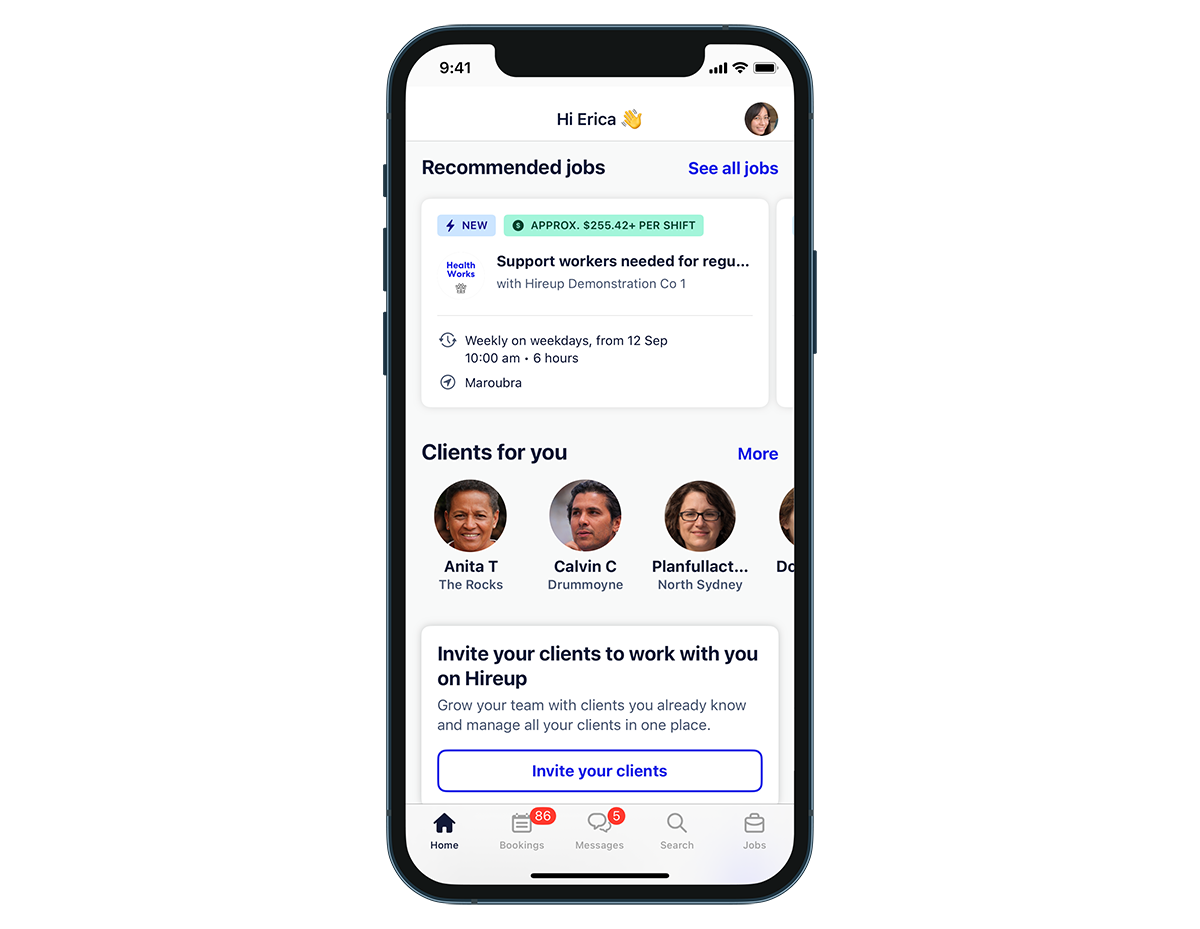
Today, a client can search local workers, filter for qualifications and interests, exchange messages, arrange a meet and greet, then book support. A family member can manage the account. Support can mean personal care, help around the house, transport, or getting out into the community. The interface makes the selection visible instead of leaving it inside an agency’s roster.
But the consequential decision sits behind that interface. Hireup employs its support workers. It handles their wages, tax, superannuation and insurance. Workers can choose shifts without needing an Australian Business Number to run a contracting business. Clients choose the person without becoming that person’s employer. Hireup carries the employment administration that makes the arrangement possible.
You choose the person.
The Hireup model, in plain English
The platform carries the paperwork.
This places Hireup between a traditional provider and a contractor marketplace. Mable, a prominent alternative, connects clients with independent workers who agree their rates directly. Both offer selection and booking tools. Their employment arrangements differ. A useful comparison therefore starts with who employs the worker, what the full booking costs, and how much organising the customer wants to do.
The price of taking responsibility
Hireup is free to join. Its published standard weekday daytime disability rate, checked in October 2026, is A$72.74 an hour for bookings of at least two hours. A three-hour booking therefore costs A$218.22 before any applicable extras. Saturday, Sunday and public-holiday rates rise. Shorter shifts and specialised requirements can change the bill; the standard rate is a starting point.
AUD per hour · Standard disability support · Bookings ≥2 hours · Checked October 2026
The charge supports a business with obligations beyond introducing two people. Hireup’s published pricing includes screening, insurance, payroll, compliance and incident response. This is a service business delivered through software, earning income when support hours are booked. The gap between the client’s charge and a worker’s pay has operating costs to cover. Treating it all as profit would miss the model.
Its growth also needed capital. In August 2021, Hireup announced A$40 million from SEEK Investments. Its director of impact and innovation described the attraction as practical: SEEK understood multi-sided platforms, and Hireup needed to invest in people and technology. Earlier philanthropic and impact backing had given it room to develop a business with both financial and social aims.
The work after the match
Choosing workers leaves another job: organising them. Hireup PLUS supplies a dedicated Support Team Lead to help with rosters, routines, life administration and living arrangements. It adds a person to the coordination problem. The service makes sense for someone who wants control but needs help exercising it consistently, especially when a family has been doing much of that work.
Support coordinators can also share account access with participants or relatives. Booking Requests can reach up to ten selected workers, reducing individual messages when a shift needs filling. These are modest, useful improvements. A roster is made of repeated small decisions; reducing the number of times someone must chase a reply can matter more than adding another dashboard.
Training is part of the machinery too. Hireup Academy, developed with Thrive, puts learning inside the worker experience. Required completed training appears on worker profiles. A paid Community Advisory Group brings clients, account managers and workers into product discussions. Paying those advisers is a useful detail: the people receiving support contribute expertise, rather than simply supplying testimonials.
For readers building other services, the lesson is portable: identify the choice customers care about, then absorb the administrative work surrounding it. For someone considering care, the conditions are more specific. There must be suitable local workers, someone able to manage the account, and funding that covers the required support. A search result alone cannot guarantee the right person will be available.
Another family. The same question.
Hireup expanded into aged care in 2025, following another family experience: Laura and Jordan’s grandfather Frank needed support after a fall and surgery but wanted to remain at home. The service lets older Australians choose workers too. Funded users need a compatible approved provider offering self-management; private payment is another option. Commonwealth Home Support Program funding is not accepted.
In January 2026, Hireup announced Peter Willis as CEO, succeeding Laura. He had led its client and worker support services. The next chapter extends the platform into another part of Australian care, but the original question survives. A worker is going to enter somebody’s home. Does the person living there get a meaningful say in who it is?