Stephen Schwarzman had a perfectly reasonable suggestion for his father: put a store everywhere in America. The family sold curtains and linens in Philadelphia. Customers kept coming. Surely the next step was Pennsylvania, then the country. His father disagreed. He liked his business, his house, his cars and the prospect of sending his children to college. Stephen, about fourteen, kept negotiating the geography downward. His father kept saying no. The proposed empire remained a shop.
It is an unusually useful beginning for a financier’s life story. No secret formula appears. There is a boy folding merchandise, a father with a workable definition of enough, and a disagreement about how large a life ought to become. Schwarzman has returned to the exchange in public interviews. Decades later, the argument still seems to interest him. His father’s contentment was comprehensible. It simply offered no career plan that Stephen wished to adopt.
Born in Philadelphia on February 14, 1947, Schwarzman grew up around the family business before moving to the suburbs. He attended Abington High School, then Yale, graduating in 1969. The young expansion enthusiast did not arrive at university with a settled profession. In his recollection, becoming educated was work enough. This is a useful correction to the tidy biographies in which every childhood activity points obligingly toward the eventual job title.
His first employer after Yale was Donaldson, Lufkin & Jenrette. After time in the Army Reserve, Harvard Business School followed. At Harvard, he initially wondered whether he belonged. He wrote to investment banker Dick Jenrette about his doubts. Jenrette answered with a long, encouraging letter and advised him to stay. Schwarzman did. He received his MBA in 1972. Even someone inclined to argue for more occasionally needed another person to argue for patience.
“There are no patents in finance.”Stephen A. Schwarzman
A salesman learns to listen
Lehman Brothers supplied the next apprenticeship. Schwarzman joined in 1972 and became a managing director in 1978, aged thirty-one. Mergers and acquisitions put him in the business of discovering what somebody wanted, what somebody else would accept, and whether the distance between them could be crossed. The work rewarded preparation, persistence and an ear for the unstated condition. A persuasive presentation was useful. Understanding the person across the table was more useful still.
One transaction helped establish him: Tropicana’s $488 million sale to Beatrice Foods in 1978. Later, he oversaw Lehman’s 1984 sale to American Express. These were consequential assignments for a banker still in his thirties. They also placed him inside institutions whose futures could be rearranged by a transaction. After negotiating his departure, he began talking with Pete Peterson, Lehman’s former chairman and chief executive. Breakfast meetings at New York’s Mayfair Hotel became planning sessions for a firm of their own.
In 1985, Peterson and Schwarzman started Blackstone with $400,000 between them. The figure is modest beside the numbers now attached to the firm, but it bought no exemption from the ordinary difficulties of starting a business. Famous former employers and established connections did not cause investors to produce chequebooks on command. Schwarzman’s recollections of those early pitches contain rejection, repeated visits and the discovery that a strong résumé does not constitute a customer base.
At a 2016 appearance, he described a turning point over lunch with Prudential’s chief investment officer in Newark. The investor was eating a tuna sandwich. Prudential committed $100 million, giving the young firm an institutional reference that could help unlock other conversations. The sandwich survived in Schwarzman’s memory. There are elegant theories about reputation and capital formation. Sometimes the memorable detail is lunch. His practical lesson was to rehearse a pitch before taking it to the prospect whose answer mattered most.
The deal he kept on his desk
Success did not make every subsequent decision sound. In 1989, Blackstone invested in Edgcomb, a steel distributor. Steel prices fell and the investment failed. In his October 2026 account, Schwarzman acknowledged that a partner had warned about the company’s dependence on rising prices. He had favoured the confidence of another colleague who knew the business. Familiarity had been allowed to outweigh the warning. An angry investor subsequently made the cost of that judgment painfully personal.
The response was procedural. Senior partners would receive written investment proposals in advance. Each had to challenge assumptions and take responsibility for the decision. Silence ceased to be a comfortable option. Schwarzman also kept an enlarged, black commemorative deal plaque on his desk, converting a customary trophy into a reminder of failure. It eventually disappeared from the desk, he wrote, while remaining in his thoughts. Office decoration rarely receives such a pointed job description.
That episode complicates the usual portrait of the forceful founder. Schwarzman’s appetite for scale could get a proposal into the room; the room needed permission to resist it. The institutional achievement lay partly in making questions compulsory. A business handling other people’s money cannot treat the founder’s conviction as sufficient evidence. The tension between ambition and objection is central to understanding how he describes Blackstone’s development.
- Write it downCirculate the proposal before the meeting.
- Question the assumptionsEvery senior partner has to speak.
- Return with answersRevise the proposal before approval.
What a large number contains
Blackstone expanded beyond its original work into real estate, credit, infrastructure and other investment businesses. It went public in 2007. By June 30, 2026, it reported more than $1.3 trillion in assets under management. That is client capital managed across strategies, rather than Schwarzman’s personal fortune. Keeping the distinction clear matters: the figure represents obligations to investors as well as the firm’s commercial reach. Scale brings a larger audience for both good decisions and expensive mistakes.
His October 2026 recollection of the 2007 Equity Office Properties acquisition returned to the latter concern. The roughly $39 billion transaction involved Sam Zell’s office-property business. Schwarzman described feeling frightened about buying near the peak of the cycle. The admission sits awkwardly, and usefully, beside the public image of the assured dealmaker. Nervousness can persist at a much larger denomination. A bigger balance sheet does not remove the need to ask what a market is about to do.
The current opportunity he discusses most visibly is artificial intelligence. In July 2026, he wrote about Blackstone’s exposure to data centres, power and utilities, alongside investments in private technology companies. The physical requirements are central to that argument. Software still needs buildings, electricity and capital. It is a recognisable Schwarzman approach: find the expanding activity, then examine the institutions and assets required to accommodate it. Whether the returns meet the expectations remains an investment question, rather than a biographical achievement already banked.
A different kind of expansion
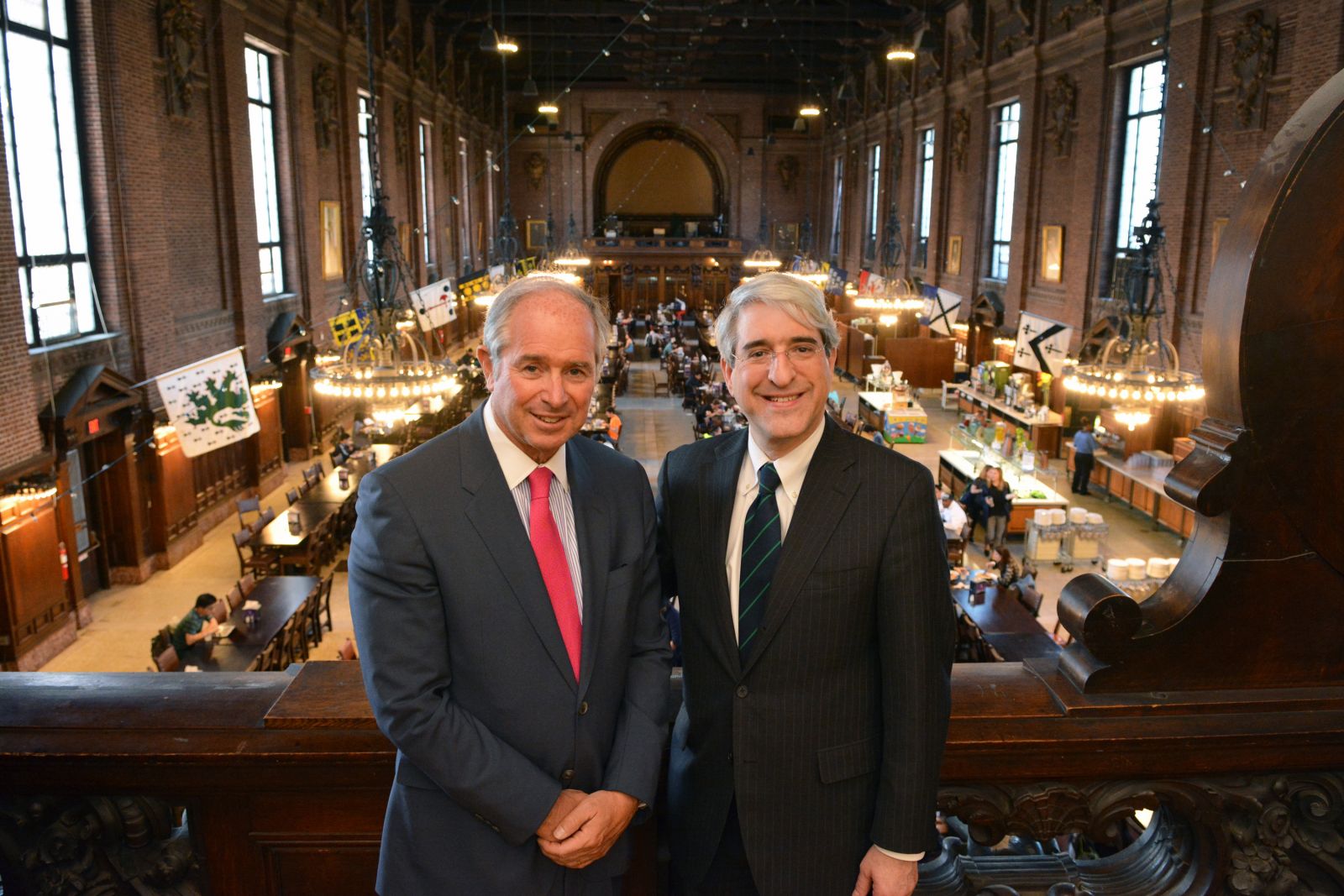
Outside finance, Schwarzman has applied his appetite for institution-building to education and culture. His $150 million gift to Yale in 2015 supported the Schwarzman Center in the university’s historic Commons. The setting makes a pleasing return journey: a graduate once uncertain about his direction helped create a place where later students could eat, meet and encounter the arts. Buildings provide an unusually tangible answer to what a donor hopes will remain when the announcement is over.
Schwarzman Scholars takes that idea abroad. Announced in 2013, the programme welcomed its first class in 2016 at Tsinghua University in Beijing. Inspired by the Rhodes Scholarship, it supports a one-year master’s in global affairs and brings together students from China, the United States and other countries. Its stated purpose is to prepare future leaders who understand China and develop relationships across borders. The connections are part of the education, rather than something to collect after the coursework.
His interest in AI also reached universities before the recent investment rush. A $350 million foundational gift announced in 2018 helped establish MIT’s Schwarzman College of Computing. MIT designed it to connect computing with other disciplines, including the ethical and policy questions raised by the technology. The money supported an institutional rearrangement: researchers in separate fields would have a shared structure for work whose consequences refused to stay inside departmental boundaries.
Oxford supplies a related experiment through the humanities. Schwarzman’s original £150 million gift in 2019 grew, with additional gifts, to £185 million by the centre’s opening announcement in 2025. The Schwarzman Centre brings seven humanities faculties together with a library and research institutes, including the Institute for Ethics in AI. Its academic opening was set for October 2025, with a public cultural programme following in 2026. Philosophers, musicians and computer ethicists have rather different daily routines; the building makes them neighbours.
There is a family precedent for giving, too. In his 2020 Giving Pledge letter, Schwarzman remembered his father extending credit to newly arrived immigrants and allowing them to pay when they could. The father who declined a chain of stores had a broader definition of responsibility than the teenage sales pitch allowed for. Schwarzman committed to giving away the majority of his wealth. His letter described philanthropy as work requiring money, personal involvement and the participation of other donors.
Still negotiating with tomorrow
The familiar public description is co-founder, chairman and chief executive of Blackstone. There are other ways into the personality: the former student seeking reassurance from a mentor; the salesman remembering a tuna sandwich; the executive keeping a failed investment within sight. His 2019 book, What It Takes, turned such episodes into lessons. He is clearly interested in explaining the method as well as recording the result.
In the opening instalment of his autumn 2026 personal history, he returned to Japan and the people who had helped Blackstone in its early years. He singled out Yasuo Kanzaki of Nikko Securities and described an ambition to repay that support through future investment. Gratitude, in this telling, has a long commercial memory. The international firm began with particular people agreeing to take a chance.
He also offered two guiding ideas: “a better tomorrow” and “learn every day.” They sound almost modest beside the sums now associated with him. Yet they bring the story back to the shop. His father knew what was enough. Stephen kept looking for the next opening. After four decades at Blackstone, the more interesting question is how he makes room for the person who tells him to think again.