Three couriers called about one order. Djasur Djumaev had come to Tashkent for the New Year holidays, and his mother wanted to buy mobile phones for her grandchildren. The online purchase acquired an unexpectedly large supporting cast. Two callers were bringing separate parts of it. A third wanted him to choose a different model: the one ordered was unavailable. A family errand had become a small lesson in the distance between a shop window and a functioning shop.
Djumaev saw an opportunity in that distance. The customer could browse and click; the machinery behind the click was another matter. Storage, stock information and coordinated delivery needed work. Most shoppers would have settled for getting the phones. His eventual response involved warehouses, banking, installment payments and a company called Uzum. There are cheaper ways to handle a disappointing purchase.
Founded in 2022, Uzum became Uzbekistan’s first technology unicorn in March 2024. That description travels easily. The more revealing story concerns a founder trying to make a complicated system feel ordinary to the person using it.
The experience he brought home
Djumaev arrived at Uzum with earlier businesses behind him. He graduated from Westminster International University in Tashkent, and his career included co-founding KupiKupon, the discount platform. He also founded Quantum A Group, whose work involved technology for telecommunications and digital services. These were useful apprenticeships for a business that would have to coordinate sellers, customers, software and physical operations.
His telecom ventures had worked across markets including India, Indonesia, Egypt and Brazil. The geographic range matters because Uzum’s ambition combined international experience with a particular home market. He had seen technology businesses operate under different conditions. Uzbekistan offered a place to apply that experience, provided the imported knowledge could survive contact with local habits.
Uzum Market launched in October 2022. Its founder had chosen a problem that extended well beyond the screen: persuading people that the item they ordered would actually turn up.
He also committed his own capital. Looking back in July 2025, Djumaev said proceeds from earlier exits financed the first acquisitions and new businesses. The initial idea had involved a neobank; the scope widened as he and his colleagues examined other models, including Kazakhstan’s Kaspi. He described the personal commitment simply: “That was a very high bet for me.” The story of the family order helps explain the customer problem. This account of his investment explains how he began paying for a response.
A familiar voice, a paper receipt
Djumaev’s account of building Uzum returns repeatedly to trust. In a 2025 interview, he put the product-design problem plainly: “You can’t just copy-paste a product from elsewhere.” People bring their own expectations to shopping and money. A product that seems effortless to its designers can feel baffling to a first-time customer.
Consider two adaptations he described later that year. Some customers wanted physical receipts, so confirmations could be printed at pickup points. Others preferred speaking to typing, so Uzum added voice support. Neither makes a particularly glamorous demonstration at a technology conference. Both acknowledge the customer as someone with preferences, rather than as a person awaiting correction.
He also emphasized clear repayment terms and support in Uzbek. Together, these details suggest a practical approach to familiarity: let people begin with something they understand, then introduce additional services gradually. A printed slip of paper can be a perfectly respectable accessory to digital ambition.
“You can’t just copy-paste a product from elsewhere.”
Djasur Djumaev · May 2025
The partners behind the purple
Uzum’s leadership includes co-founders Nikolay Seleznev, responsible for strategy and business development, and Roman Lavrentyev, its chief operating officer and CEO of Uzum Fintech. Their presence helps explain why this is a story about assembling capabilities as much as founding a marketplace. The group brought existing businesses together alongside new operations.
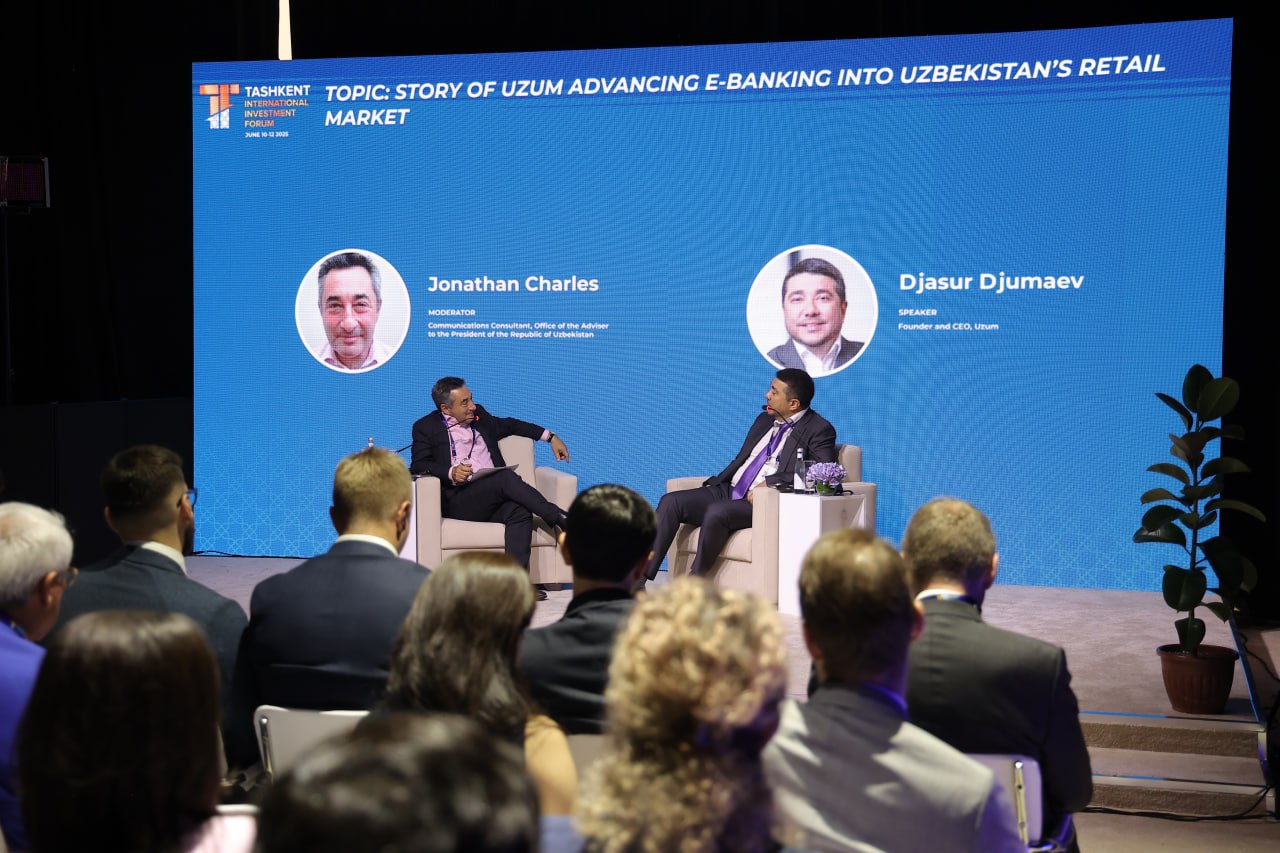
At the June 2025 Tashkent International Investment Forum, Djumaev described his recruiting philosophy in entrepreneurial terms. He sought partners who would take ownership of the task. That preference suits a company where the next obstacle may belong to logistics in the morning and finance in the afternoon. Delegation requires people who can make decisions while the founder is occupied elsewhere.
He also used the forum to describe a second job that came with building Uzum: explaining Uzbekistan to investors. Familiarity with the region varied considerably. Meetings and presentations became a way to replace broad assumptions with a particular market, a particular business and its operating record.
When shopping meets the bank
The underlying arrangement is easy to picture. Uzum Market handles marketplace shopping. Uzum Tezkor provides express delivery. Uzum Bank supplies digital banking, while Uzum Nasiya offers installment purchasing. For the customer, these can become connected parts of an errand. For the company, they require several kinds of operational competence at once.
Djumaev has argued for designing financial products around everyday activity. Shopping supplies a reason to engage; payments and banking create more frequent occasions to return. The attraction is understandable. A person might buy a new appliance occasionally, while moving money is a much more regular affair. Bringing those activities together changes how often a business can be useful.
The bank’s card programme supplied one measure of adoption. By the August 2025 funding announcement, Uzum reported issuing more than two million co-branded Visa debit cards in the first half of that year. The cards carried embedded credit limits. The same announcement described plans to broaden lending, deposits and the financial infrastructure supporting them.
A simplified view of connected services, rather than a required customer journey.
Demand also unsettled the original arithmetic. Djumaev recalled an early forecast of roughly $20 million in gross merchandise value, followed by $150 million in the first year. Those are merchandise sales figures, rather than company revenue. He remembered the strain of building capacity while demand was already arriving. The admission adds a useful wrinkle to the polished growth story: even the people who had committed to the opportunity had underestimated its immediate size.
Three rounds, three different numbers
In March 2024, Uzum announced $114 million in financing: $52 million of equity and $62 million of debt. FinSight Ventures led the equity round, joined by Xanara Investment Management and Uzum’s senior management. The resulting post-money valuation exceeded $1 billion. The unicorn label attached to the company; the money had distinct jobs and distinct terms.
In August 2025, nearly $70 million of equity financing followed, led by Tencent and VR Capital, with FinSight participating. Uzum put its post-money valuation at approximately $1.5 billion. The investor list had become another part of Djumaev’s effort to bring international capital into a business serving Uzbekistan.
March 2026 brought a different structure again. An investment exceeding $130 million, anchored by sovereign entities of Oman, combined primary equity with structured capital. Its announcement specified a $2.3 billion pre-money valuation reference, with conversion terms linked to the next qualified financing round. The distinction matters: placing all three figures on a smooth upward line would hide the changing terms beneath them.
Equity + debt
Above $1bn post-money
Equity financing
~$1.5bn post-money
Equity + structured capital
$2.3bn pre-money reference
A company needs a classroom, too
Djumaev’s views on growth extend to the people expected to deliver it. In January 2025, he described combining international technical experience with local cultural knowledge, and investing in employees’ development. He also pointed to a seller academy teaching the basics of sourcing and marketplace operations. A marketplace cannot improve solely by making its own staff more capable; sellers need to learn the system as well.
There is a personal connection in Uzum’s university relationships. In March 2024, his alma mater signed a cooperation memorandum with the company. Djumaev later wrote that his time at Westminster International University in Tashkent had shaped his career and approach to leadership. The relationship gave that educational history a practical continuation.
A separate agreement with the Ministry of Digital Technologies, announced in July 2024, proposed joint education programmes in programming, cybersecurity and artificial intelligence. These arrangements address a fairly unromantic constraint on ambition: someone has to do the work. Funding can arrive in a transaction. Experienced teams take longer to develop.
The award with thousands of names behind it
In August 2026, Djumaev announced that he had received the Faol Tadbirkor badge, a recognition for entrepreneurs in Uzbekistan. His response dwelt on the team behind the name on the award. He described more than 14,000 direct jobs and a wider network of sellers, pickup-point owners, restaurants and other partners working around Uzum.
He framed the recognition as a responsibility for future work. That is consistent with the public role he has taken on: a founder making the case for entrepreneurship as part of Uzbekistan’s development. His argument places the shopkeeper and the software builder in the same economic picture. Both need infrastructure that makes reaching customers easier.
His July 2026 writing had also named obstacles ahead, including demand for senior technical talent exceeding local supply and the different habits encountered beyond Tashkent. He advocated locally informed AI and financial services, particularly products that understand Uzbek language and regional preferences. Expansion, in that account, requires closer attention to differences within the country.
A public listing remains an ambition he has discussed, rather than an outcome to presume. In June 2026, he described a potential future IPO as a medium-term possibility. For now, the work he describes still concerns access, people and the infrastructure connecting them.
The grandchild waiting for a phone has little use for a valuation reference point. A merchant waiting for a customer has little use for a handsome presentation. Djumaev’s career at Uzum keeps returning to the space between those expectations and the machinery required to meet them. The company has acquired investors, services and an award along the way. The original test remains pleasantly specific: does the right thing arrive?
Follow the conversation
Interviews, writing and the businesses behind the story.
- Djasur Djumaev on LinkedIn
- Uzum · leadership and company website
- On designing fintech for local customers
- Listen · Djumaev and Seleznev with Nick Lall
- Read · Djumaev on building digital infrastructure
- Read · Uzbekistan’s entrepreneurial next chapter
- His reflection on the Faol Tadbirkor award