Dinesh Lodha has an unusual answer to the question of how to get ahead: consider a job with less rank. Looking back on his career, he credited a move from finance into a lower-ranking supply-chain assignment with opening the route to sales and eventually the CEO’s office. The attraction was what he could learn. A title told him where he stood in an organisation. A new function showed him how the organisation worked.
There is something pleasantly awkward about that advice. Careers are usually presented as staircases, with each new business card printed a little nearer the executive floor. Lodha’s account includes a downward step. The route still led to general management, but it passed through the machinery of a company: money, stock, customers, decisions. The machinery was an education.
Today, he is Managing Director and Group CEO of Medikabazaar, based in Gurugram. He joined as Group CEO in August 2024, bringing experience from GE, Samsung, Healthium, Rupa and TI Medical. His current work involves a distribution platform, manufacturer relationships and international expansion. It also involves the distinctly unromantic question of whether growth leaves enough money behind.
“Evaluate role from learning angle and not just position.”
Dinesh Lodha, reflecting on his career
The education between departments
His early work crossed commercial management and finance. At Grasim’s cement business, he held a commercial role; at GE, he moved through global supply-chain finance, supply-chain leadership and sales. These are adjacent departments on an organisation chart, but they can describe the same transaction in different languages. One sees a receivable. Another sees a shipment. A third sees a customer waiting for an answer.
That progression helps explain the breadth of his later assignments. It gave him experience on several sides of a business before he was asked to run one. A sales plan has consequences for stock. A purchasing decision has consequences for cash. A promising order can be a very expensive object if nobody has thought about the route from signature to payment.
By March 2013, Lodha was director of sales for South Asia at GE Healthcare. Samsung then appointed him country manager for its newly established Indian equipment division. The announcement described responsibility for steering its growth. Moving from an established sales organisation to a new division meant taking on the commercial work of building a market presence.
Samsung was a familiar name to Indian consumers. A new business inside a familiar company still has to earn its customers. The logo can introduce you; it cannot conduct every meeting. That distinction makes this chapter useful in understanding Lodha’s career. His job was to connect a company’s capabilities with buyers in a particular market, a task that would recur under other names.
- 2013Samsung
Country-manager appointment - 2019Rupa
CEO appointment - 2022TI Medical
Group CEO - 2024Medikabazaar
Group CEO appointment
A wardrobe full of working capital
After leadership at Healthium, Lodha became Rupa’s CEO in February 2019. The consumer apparel company offered a different catalogue and a different set of buying habits. A career in equipment had made room for innerwear. It is a transition with more practical continuity than its novelty suggests: products must find customers, distributors need support, and unsold stock has an unfortunate talent for occupying both shelves and capital.
In 2021, Rupa described improved performance after a difficult previous financial year. For the period discussed in a business profile, profit after tax had risen substantially. Lodha spoke about building a business that could perform under adverse conditions. The consumer setting widened his experience beyond institutional sales, putting brand, retail demand and distribution into the same management conversation.
The earnings calls give that chapter texture. In November 2021, he discussed using SAP HANA to automate inventory planning and working with banks on credit for distributors. It was the sort of conversation that rarely supplies a glamorous photograph. Yet decisions about planning and credit can determine how easily the next season’s products get from the business to the buyer.
By May 2022, Rupa’s working-capital cycle was under pressure. Lodha explained the effects of inventory and receivables, alongside rising input costs and changes in product mix. He also described software’s role in ordering and supply-chain automation. These were company-wide challenges, not a claim that one executive could solve every variable. The calls show him answering detailed questions about the relationship between operations and financial performance.
His departure was discussed on that May call. Management said he had requested to leave for personal reasons and had stayed through the board meeting; he was also helping with the appointment of a successor. The chapter closed with a handover. TI Medical followed, before another change of employer brought him to Medikabazaar.
An assignment with unfinished business
The August 2024 appointment arrived during a leadership transition. Medikabazaar’s board had been strengthening its organisation and governance following financial discrepancies. Lodha entered as a professional executive, with an operating remit and a business that needed steadier foundations. The circumstances made accountability a practical requirement, rather than a decorative word in an appointment announcement.
He was part of a wider leadership group. CFO Raman Chawla brought experience from Campus, Reckitt Benckiser and PwC. Ravishankar Gopalakrishnan joined the operating leadership, and Raja Venkatraman was brought in as a senior adviser. The reset involved several people with different responsibilities. A turnaround needs more desks than the one occupied by the CEO.
In April 2025, the company held its ELEVATE leadership meeting. Lodha told colleagues that Medikabazaar had completed its best-performing quarter to that point and acknowledged the team’s contribution. The gathering paired a growth roadmap with departmental recognition. Its billion-dollar ambition was a destination the organisation had set itself, with the operating work still to be done.
Two months later, he described his approach with a short, rather businesslike sentence: “The team is very focused. And my approach is also very focused.” He said employees should be empowered to decide and held accountable for those decisions. That connection is worth keeping intact. Responsibility becomes a peculiar arrangement when the person carrying it must seek permission for every move.
Growth has to leave something behind
By November 2025, Lodha said Medikabazaar had reached its first EBITDA-positive quarter. He described closing unprofitable divisions and concentrating on more viable parts of the business. He also pointed to cash generation. The emphasis was on changing what the company earned from its activity, alongside increasing the activity itself.
EBITDA measures earnings before interest, tax, depreciation and amortisation. A positive quarter is a specific milestone; it does not establish every measure of profitability. In a distribution business, sales, margins and cash each tell a different part of the story. Growth can put more goods in motion while also asking the company to finance more of that motion.
In February 2026, Medikabazaar said it was discussing a $50 million capital raise, including $25 million committed by existing investors. It also described more than 40 exclusive manufacturer partnerships and a growing digital business. The funding conversation was a proposal to support the next phase. Its completion should be judged by a completed transaction, rather than the size of the number in the announcement.
Revenue reported by Medikabazaar in July 2026, with 57% year-on-year growth.
A stated ambition for the full year
The next dated performance update reported ₹592 crore in revenue for the first quarter of FY2026–27, up 57% year on year. Lodha linked the result to execution across the business. The company continued to target ₹3,000 crore in annual revenue. The quarter and the target belong beside each other, with their dates attached. Arithmetic is quite capable of spoiling a good anecdote, which is one reason to invite it in.
A manufacturer needs a way out of the factory
Lodha’s expansion agenda includes helping Indian manufacturers reach buyers abroad. That adds a commercial task beyond selling through an online catalogue: relationships, market entry and distribution have to work together. In June 2026, Medikabazaar announced a global business partnership with Shreeyash Electro Medicals. The stated aim was to take Indian-made products into international markets.
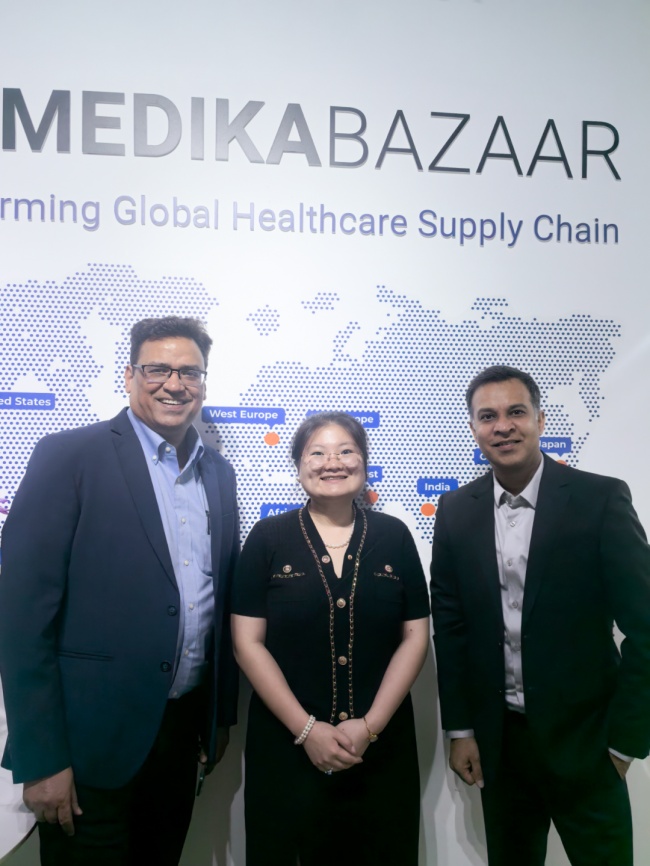
An August 2026 report documented Lodha’s visit to the China operation and meetings with general manager Lin Meihan and the local team. The photograph is a useful change of scale after the financial figures: three people standing together, a company name on the wall, a map behind them. International expansion eventually becomes work done with particular colleagues in particular places.
By September, Medikabazaar was describing its work with Andhra Pradesh MedTech Zone at WHX Nairobi, held from September 16 to 18. It connected the event with Project Bharat, a collaboration intended to help Indian manufacturers expand their commercial reach. Lodha and AMTZ’s Jitendra Sharma were named in the company’s account of that effort.
These are steps in an expansion programme. A partnership announcement records an agreement; an exhibition creates opportunities for conversations. The recurring order comes later. For someone whose career has crossed supply chain and sales, that sequence is familiar. A business relationship becomes valuable through what follows the introduction.
The title at the end of the route
Read Lodha’s career backwards from Medikabazaar and the changes in sector look less abrupt. Rupa brought consumer demand and retail distribution. Samsung brought the task of growing a new division. GE brought successive functions and regional commercial responsibility. His present assignment draws those experiences into a company trying to expand while paying closer attention to the economics of expansion.
The earlier step down gives the story its shape. Lodha has described an occasion when rank was a poor guide to opportunity. There was more to learn in a different department, and that knowledge helped open the next door. Now the title is larger, the markets are wider, and the question remains wonderfully practical: how do all the parts of this business work together?
Follow the career, follow the conversation
Interviews, public reflections & company channels
- Lodha’s career reflection
- Samsung appointment · 2013
- Rupa earnings call · May 2022
- Rupa’s operating plans · 2021
- Rupa earnings call · November 2021
- Medikabazaar appointment · 2024
- Investor annual report · 2024
- ELEVATE leadership meet · 2025
- Operating interview · June 2025
- Turnaround interview · November 2025
- Capital-raise plans · February 2026
- Quarterly company update · July 2026
- China visit · August 2026
- Global partnership · June 2026
- Dinesh Lodha on LinkedIn
- Medikabazaar website
- Medikabazaar on LinkedIn
- Medikabazaar videos
- Medikabazaar on Instagram
- Medikabazaar on X
- Medikabazaar on Facebook