On a crowded Dhaka street, the most consequential retail technology may be invisible. It sits between a shopkeeper noticing the last packet of detergent and a delivery vehicle arriving with the next case. For decades, that interval has been filled by calls, cash, sales representatives, wholesalers and uncertain timing. PriyoShop wants to compress it into an order - then make that order useful far beyond the shelf.
The company’s app lets neighborhood merchants browse inventory and buy from established brands. Behind the screen sits the harder part: hubs, stock handling, delivery routes, supplier relationships and a data trail. A purchase records what moved, when it moved and whether payment arrived. Repeated often enough, those routine facts can describe a small business more clearly than the documents a conventional lender expects it to have.
That is why “B2B marketplace” is accurate but incomplete. PriyoShop is assembling an infrastructure stack for Bangladesh’s micro, small and medium retailers. Procurement is the front door. Distribution keeps merchants coming back. Transaction data supports credit decisions. Digital screens turn shops into advertising inventory. A home brand gives the company another way to influence price and margin. Each layer begins with the same person: the proprietor behind the counter.
The unglamorous problem that touches everything
Bangladesh’s neighborhood stores are small in floor space and enormous in aggregate. PriyoShop says more than five million micro-retailers account for roughly 97 percent of the country’s retail transactions. Many operate outside the systems built for supermarket chains. Their orders are smaller, their storage is tighter and their need to restock is more frequent. A missing case of soap is not a rounding error. It is a customer walking elsewhere.
The traditional route has virtues: relationships, local knowledge and flexibility. It also has friction. Products may pass through several intermediaries. Prices can be inconsistent. A shopkeeper may spend hours sourcing stock without knowing when it will arrive. Brands, meanwhile, can struggle to see beyond the distributor and into the final store. They lose clean information about demand, placement and sell-through.
PriyoShop’s basic promise is straightforward: put a broad catalog in one place, offer consistent pricing and deliver quickly. In 2024, the company described next-day delivery as part of its marketplace proposition. For a small store, reliability can matter more than novelty. The app is useful only if the physical network behind it gets the correct carton to the correct counter while the sale is still available.
A commerce loop with finance inside
Working capital is the second problem. Small retailers often lack collateral, audited accounts or a long formal credit history. Banks therefore have little conventional evidence on which to lend, even when the shop has years of daily sales. Informal loans may be faster but expensive. PriyoShop occupies an unusual vantage point: it can observe inventory purchases as they happen.
In September 2024, PriyoShop joined LankaBangla Finance and Mastercard to launch a co-branded Titanium credit card for cottage, micro, small and medium enterprises. The first phase was designed to enable more than 5,000 merchants to make digital payments through PriyoShop and point-of-sale terminals. In 2025, BRAC Bank added digitally processed lending for rural and semi-urban merchants through its Shafollo platform.
The next step was alternative scoring. With Community Bank Bangladesh and Singapore-based InsightGenie, PriyoShop announced a model using purchase patterns, demographic information, psychometric inputs and behavioral analytics. The partners described short-term facilities of up to $500, delivered through electronic identity checks. The premise is appealing: judge a merchant using the pulse of the business, not merely the paperwork around it.
“Access to credit is the lifeline for small businesses, yet most micro-retailers in Bangladesh are excluded from formal finance.”Asikul Alam Khan, founder and CEO
There are real questions beneath that promise. Alternative data must be accurate, explainable and used with consent. A pattern that predicts repayment can also encode bias. And short credit cycles do not solve every capital need. PriyoShop’s advantage is proximity to commerce; its responsibility is to ensure that proximity does not become opacity. The finance layer will be judged not by how clever its score appears, but by whether merchants receive fair terms and understand them.
One retailer relationship, several businesses
Once a platform earns regular merchant attention, adjacent products become possible. ChutneyAds is the most playful example. PriyoShop says the digital out-of-home network spans more than 200 display panels across Dhaka. A shop can now be three things at once: the marketplace’s customer, the distribution network’s destination and a piece of media inventory. Brands gain a screen near the moment of purchase; merchants gain another potential source of income.
Dipty, the company’s first home brand, moves in the opposite direction - from service layer to shelf. It sells staples including rice, lentils and tea. The name also belongs to co-founder and chief marketing officer Dipty Mandal, a detail too neat to ignore. PriyoShop says the line is designed to give merchants attractive margins while offering consumers dependable value. Private label can improve economics, but it also requires delicacy when the platform distributes products for other brands.
The product family reveals the company’s expertise. This is not pure software. It is merchandising, procurement, warehousing, route planning, merchant support, credit partnerships and brand strategy. PriyoShop also promotes solar power and electric vehicles in its logistics operation. It announced an ambition to be carbon neutral by 2026, though a public accounting of whether that target has been completed is not yet apparent. The electric fleet still matters as an operating experiment in a dense, delivery-heavy market.
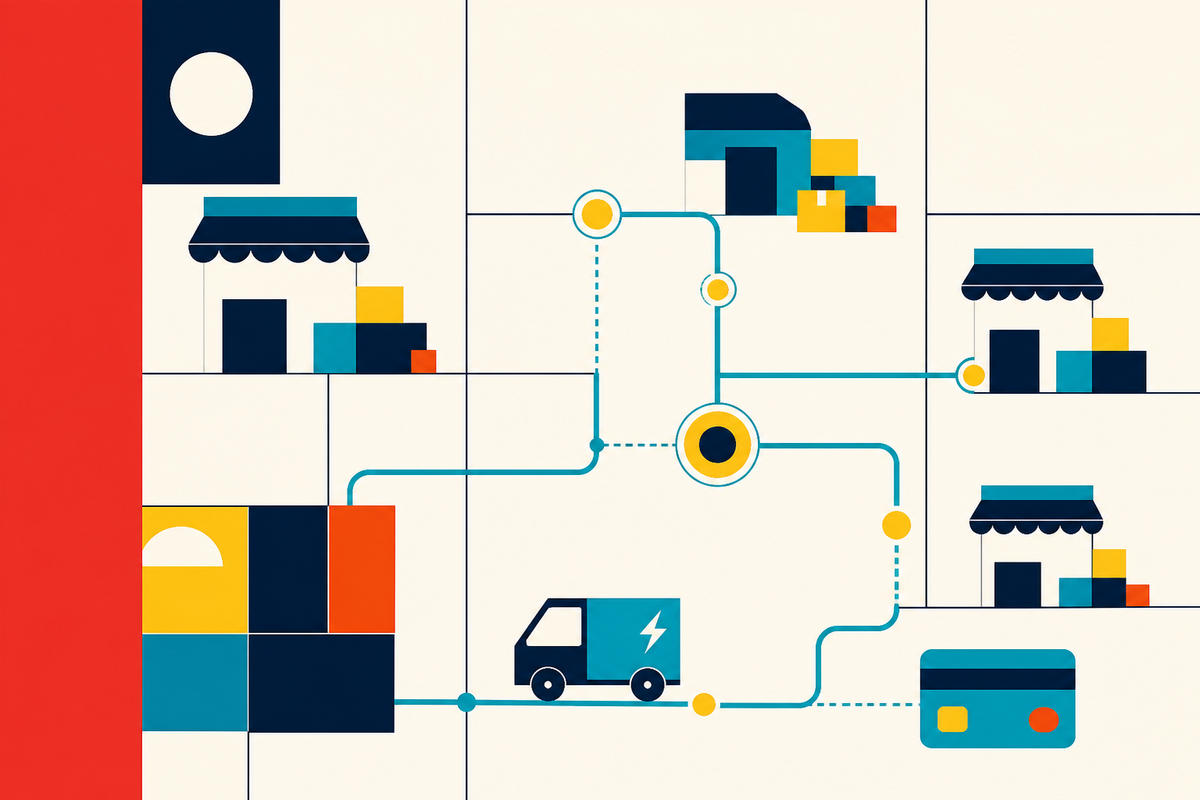
The chart is conceptual, not revenue data. PriyoShop does not publish a segment breakdown or take rates. Its likely income pools include product distribution and marketplace transactions, logistics and brand services, shop-screen advertising, private-label goods and commercial arrangements around financial products. The attraction is a flywheel: more orders generate better route density and richer data; better service and access to credit can encourage larger orders; deeper merchant use makes the network more valuable to brands.
A pivot measured in cartons, not clicks
PriyoShop’s history has two clocks. The name began in 2013 as a consumer e-commerce business. The current B2B company dates its launch to July 2021, when founders Asikul Alam Khan and Dipty Mandal centered the model on small retailers and brands. PriyoShop.Com Limited had been incorporated in 2018. Calling it either a 2013 or 2021 company without that context misses the important part: it learned consumer commerce, then chose the less visible infrastructure beneath it.
Capital followed the pivot. Public databases report a $1.2 million seed round in 2022. In February 2024, PriyoShop closed a $5 million pre-Series A led by Century Oak Ventures, with investors including Evolution Ventures, Iterative, SOSV’s Orbit Startups, GFR Fund, BonBillo, Accelerating Asia, South Asia Tech Partners and Voltity. The company said the money would strengthen technology, widen geographic reach and develop financing services.
By May 2025, PriyoShop reported more than 116,000 MSMEs and 276 brands, up from roughly 55,000 merchants and more than 200 brands announced around the funding round. Later company profiles cite 200,000 or more merchants, a reminder that startup scale figures are snapshots rather than permanent labels. An investor said the business reached operational profitability in May 2025. The company has not released audited financials, so the claim is best read as a reported milestone, not a public earnings statement.
Where PriyoShop has to win
PriyoShop is not alone. ShopUp’s Mokam is the most visible local technology alternative, while traditional distributors, wholesalers and brand sales teams remain the incumbent system. Those human networks are not simply inefficiencies waiting to disappear. They extend informal credit, adapt to local disruptions and are embedded in relationships built over years. A digital platform must beat them on dependable service without discarding the flexibility that made them durable.
The old route
- Several calls or visits
- Prices vary by intermediary
- Limited end-store visibility for brands
- Credit rests on local relationships
PriyoShop’s route
- One digital catalog and order trail
- Coordinated hub and last-mile delivery
- Transaction data for brands and lenders
- Formal finance embedded near procurement
The company’s differentiation is breadth, but breadth can become complexity. Every new layer brings a different operational discipline. Lending requires compliance and responsible underwriting. Retail media requires proof that an impression led to a sale. Private label requires quality control. EV logistics requires charging and route economics. Distribution requires the unromantic excellence of sending the right box, every day.
PriyoShop’s culture statement reads like a field manual for that task: customer obsession, simplicity, humility, respect, integrity, urgency and sustainable growth. “Make it simple” is particularly relevant. A merchant should not need to understand a platform’s architecture to benefit from it. The software disappears when the detergent arrives, the price is clear and the credit terms make sense.
Recent recognition suggests that the model has earned attention. PriyoShop won the South Asia Startup ICT Award in Kathmandu in 2025. In April 2026, it was named Best Retail Startup and Best E-Commerce Platform in the B2B category at the Bangladesh Retail Awards. That summer, it said it was managing Coca-Cola CCI Bangladesh distribution in Dhaka’s Turag region from a new operational hub.
The shelf is only the beginning
For a merchant, the practical answer to “what can I do with PriyoShop?” is still plain: find stock, compare what is available, order products, receive delivery and, if eligible, seek financing without leaving the commerce flow. For a brand, the platform offers distribution, store access, execution data and advertising close to the sale. For a bank, it offers a channel into businesses that conventional files struggle to describe.
The larger market position is more ambitious. PriyoShop wants to be the infrastructure layer between manufacturers and informal retail in an emerging economy. Bangladesh provides the proving ground: millions of small shops, dense urban routes, underserved credit demand and a consumer-goods market that still depends on fragmented distribution. Success would not look like replacing the corner store. It would look like the same familiar shop, open at the same familiar corner, with fewer empty shelves and a less precarious balance sheet.
That makes the company’s most valuable product easy to overlook. It is not a bag of rice, an app screen, a delivery van or a credit card. It is continuity - the merchant’s ability to keep selling tomorrow. PriyoShop has built an unusually broad machine around that modest outcome. The next test is whether it can keep the machine simple enough for the person it was built to serve.