The interesting part of Nuheat’s phone story begins with a cable cut. In a testimonial published by Digitel, Patrick Mann described an incident that severed 2,600 pairs of telephone cables, leaving surrounding customers without phone and internet service for 24 hours. Nuheat had already arranged redundancy with Digitel. Its main number could be redirected. The company kept operating.
There is a useful distinction here between owning a telephone and being reachable. A handset can sit perfectly intact on a desk while the route to it disappears. Digitel Systems Inc., the British Columbia communications provider established in 1984, works in the space between those two things. Its proposition becomes easier to understand when the usual route is unavailable.
- The job: business calling, messaging and collaboration across devices.
- The machinery: Zultys software, hosted services and physical phones.
- The buying question: what happens to your number when the office cannot answer?
The number leaves the building
Digitel began by selling, installing and servicing business telephone systems in Vancouver’s Lower Mainland. Voicemail, headsets, paging and call-center applications accompanied the phones. The business developed around making an organization’s communications work, with the practical installation and service work that entails.
Today, the company delivers voice services to organizations across North America. Its cloud offering brings business calling together with messaging, conferencing and collaboration. The underlying software is Zultys. Digitel supplies the service relationship around it: selecting a configuration, connecting the parts and helping customers use them.
Zultys Advanced Communicator, or ZAC, puts the phone system on a computer. A browser option avoids a local download. Mobile ZAC extends access to a smartphone, including business-number calling that protects a person’s private number. Users can move calls among the mobile app, a desk phone and the computer softphone. The office number becomes less dependent on the office furniture.
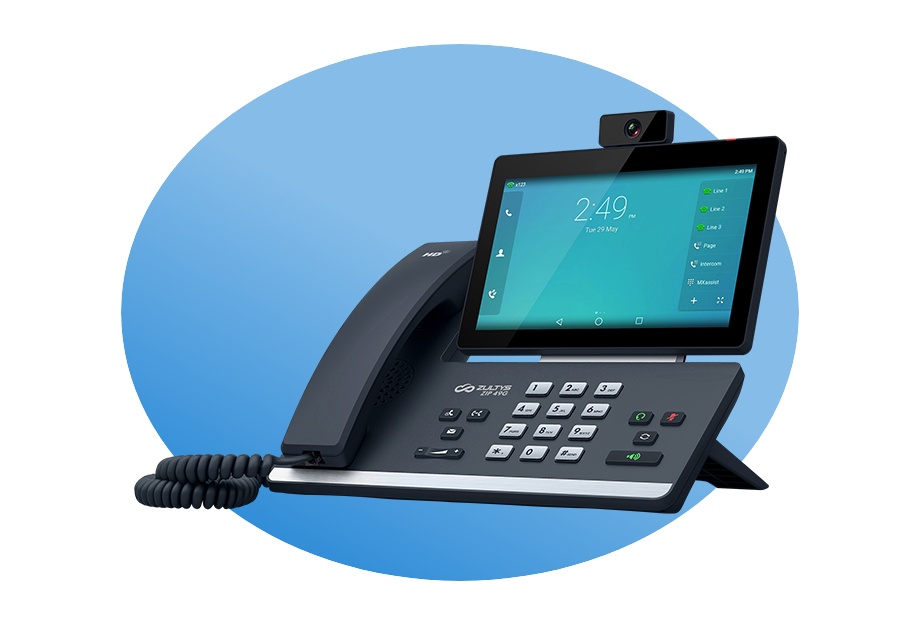
The physical phone remains in the catalogue, too. The ZIP 49GE has a seven-inch touchscreen, programmable keys and wired or wireless headset support. That detail matters. Adopting cloud telephony need not mean asking everyone to conduct business through a laptop. Different people can keep different tools while sharing a communications system.
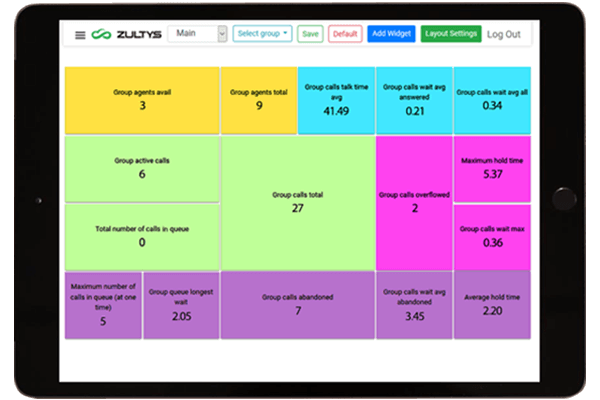
For a busy service team, the more interesting features concern memory. Digitel’s Integrated Contact Center offering can route a returning caller to the previous agent. Call Attached Data lets notes follow a transferred call. A caller can leave voicemail while retaining a place in the queue. Each feature addresses a familiar irritation: explaining the same problem again, or waiting for someone who has lost the thread.
“allowed us to redirect our main number”
Patrick Mann, Nuheat
Customer account published by Digitel
Four prices. Different jobs.
Digitel publishes four monthly user prices, starting with Mobile Director at $19.95 and rising to Contact Center at $64.95. Between them sit Standard at $24.95 and Premium at $29.95. The useful comparison concerns the work each license supports. A receptionist, a mobile employee and a contact-center supervisor have different requirements.
The pricing matrix deserves more attention than the headline prices. It marks SMS as an extra-charge item across the main user tiers, and distinguishes included recording and reporting from paid options. Buyers should resolve those details in a written quote. Multiplying a headline subscription by headcount is a starting calculation; it does not establish the complete bill.
Integrations expand the possible scope. Digitel describes calling within Microsoft Teams, dialing Outlook contacts and bringing Salesforce records into the call workflow. These are useful options for organizations already working in those applications. They also make a demonstration with the buyer’s actual workflow more valuable than a tour of unrelated features.
Buy the detour before the disruption
Digitel says its service gives customers access to two carriers and two Canadian data centers, with hourly backup and replication to a secondary location. It also describes preprogrammed numbers for routing traffic during an outage. Those arrangements give the cloud proposition something concrete beneath the word “cloud.”
The Nuheat account illustrates why arranging an alternate route beforehand matters. It is a customer testimonial, rather than an independently audited availability study. Still, the practical lesson is specific: plan how to reach an available destination before the normal destination becomes unreachable.
Provider redundancy also leaves questions at the customer’s end. A desk phone needs connectivity and power; an application needs a working device and connection. Digitel’s own FAQ recommends testing a prospective customer’s network. A sensible demonstration should include an unavailable agent, an office connection failure and a call moved between devices. The buyer should see what happens next.
The quiet work around the software
Service is part of Digitel’s market position. Organizations can buy cloud calling through carriers, direct software subscriptions or specialist integrators. Digitel’s offering sits in that last conversation, where implementation and ongoing assistance help determine the outcome. Its published support arrangements include an on-call technician outside business hours.
In June 2018, Digitel announced a virtual-CIO role for smaller businesses. The accompanying advice was unusually concrete: begin with an infrastructure diagram, a backup and disaster-recovery document, an internet-use policy and a review of network-change administration. It recommended regular meetings with the provider. That is a useful checklist for anyone buying managed technology.
The company also describes a local commitment beyond installation work. Its owners and other business associates helped start Better Days Society in 2004 to support families facing children’s medical needs. Digitel says it supplies phone services and equipment to nonprofits as well.
For a prospective customer, the takeaway fits on a page: map the routes, assign the right licenses, test the awkward moments and agree who answers when something goes wrong. The value of a business phone service becomes clearest at precisely the moment a working handset is no longer enough.
Put the system through its paces
Explore the service, check the feature matrix, then watch the tools in action.