The most revealing thing about BroadSoft was the name you usually did not see: BroadSoft. A business could buy its phone service from a familiar telecom operator, give employees calling and messaging tools, and never have much reason to think about the software supplier underneath. That arrangement was central to the company’s appeal. BroadSoft gave the phone company something new to sell while letting it remain the phone company.
- BroadSoft supplied communications software; carriers supplied the customer relationship.
- BroadWorks ran in provider networks. BroadCloud offered a cloud delivery route.
- Cisco agreed to pay approximately $1.9 billion net of cash, bringing the business into its portfolio in 2018.
The customer behind the customer
Consider the ordinary office extension. Someone must connect it to the telephone network, decide where incoming calls go, provide voicemail, and make the whole thing manageable. BroadSoft’s expertise lay in turning those functions into software that telecommunications providers could operate and sell across many businesses.
The distinction matters. A retailer of business communications must persuade individual companies to subscribe. BroadSoft could persuade a provider that already had business customers, billing systems and network connections. Its software became part of that provider’s offer. The operator could combine communications with connectivity, apply its branding, and maintain the commercial relationship.
Co-founder Michael Tessler called the strategy BroadSoft Inside
. The phrase captured an unusual bargain: BroadSoft’s technology could spread while somebody else’s name stayed in front. Distribution belonged in the product discussion as much as calling features did.
When the home market stopped listening
The company’s origin was a bet on where value would move. Tessler and Scott Hoffpauir had worked together at Celcore. In his later account, Tessler recalled seeing an industry absorbed by voice transport and hardware. They wanted to build applications in software. BroadSoft was incorporated in 1998, before cloud calling became a familiar purchasing category.
Even the name took a few tries. Tessler says the venture began as iKnow. Once the direction became clearer, the founders searched for a name joining broadband and software, eventually registering BroadSoft.com from a Bessemer office basement in Boston. A grand communications thesis still needed an available domain.
Then the early market seized up. In a 2013 interview, Tessler recalled U.S. competitive telephone companies concentrating on survival after the 2001 collapse. BroadSoft sought receptive customers in Southeast Asia and Australia. Their testing supplied feedback on sellable features and operational requirements. The company changed where it looked for evidence.
That is a useful move to copy when buyers stop experimenting: find a market where the problem still commands attention, and bring the learning home. It depends on the product travelling well. Local telecom rules, integration requirements and purchasing habits can make another country a separate engineering project.
A phone system, minus the cupboard
BroadWorks was the underlying platform: software inside the service provider’s network, supporting business calling across a shared system serving multiple customer organizations. BroadCloud provided a different delivery option, with BroadSoft supplying cloud services for providers to package. That distinction determined who had to run more of the infrastructure.
The visible applications grew around it. UC-One combined voice, video, messaging, presence, screen sharing and meetings across devices. A worker could use a business communications application on a laptop or mobile device instead of treating the desk handset as the whole telephone system. Presence helped colleagues decide whether to call; screen sharing helped them resolve something once connected.
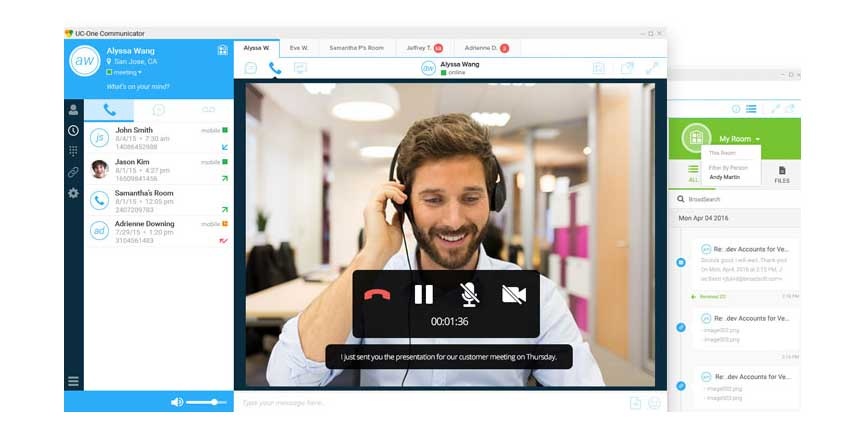
In November 2016, BroadSoft Business assembled UC-One, Team-One and CC-One into a wider portfolio. Team-One supplied persistent workspaces. CC-One addressed contact centers. The Transera acquisition earlier that year added contact center software with omnichannel and analytics capabilities. For carriers, the opportunity expanded from connecting employees to supporting the conversations businesses had with customers.
Open interfaces also mattered. BroadWorks exposed APIs for provisioning and communication events, giving developers ways to connect calling with business applications. Its differentiation rested on integration, deployment choice and the provider relationship, alongside the familiar checklist of communications features.
The price belongs to the provider
BroadSoft earned money from software licenses, subscriptions and maintenance, plus professional services. Its 2016 revenue was $340.962 million. The mix makes clear why describing the historical company simply as a subscription app misses part of the business.
What did a business pay? That depended on its provider and package. One Broadsmart support page, updated in January 2021, listed UC-One as a $9.95 monthly add-on for qualifying users, with inclusion in some bundles. That historical price illustrates the packaging model; it is not a current BroadSoft tariff.
There is a practical lesson here for software builders. Give the intermediary enough control to make a distinctive offer, and make the underlying system manageable across many customers. The arrangement works when both sides contribute something expensive to reproduce. It becomes harder when a provider cannot support the service, when integration costs overwhelm the expected subscriber revenue, or when businesses prefer to buy directly from a competing communications brand. Sharing the customer relationship creates dependencies as well as reach.
The trade-off was responsibility. Reliable calling still required network integration, provisioning and support. A business comparing providers needed to examine number migration, connectivity, emergency calling and service commitments. A small team wanting immediate self-service had a different buying problem from an operator integrating thousands of customer accounts.
The quiet position Cisco bought
In April 2018, Cisco described BroadSoft as having more than 600 channel partners, a presence in over 80 countries and an installed UCaaS base exceeding 19 million business lines. These were historical company-reported figures, but they explain the attraction: software came attached to a substantial distribution network.
More than 19 million business lines.The installed UCaaS base reported by Cisco, April 2018.

Cisco announced the acquisition agreement in October 2017 at $55 per share and announced completion in February 2018. BroadSoft’s provider-led cloud calling complemented Cisco’s existing collaboration products. In March 2018, UC-One SaaS offered another bridge: providers could add cloud collaboration to existing BroadWorks call control, with CBTS named as the first deployment customer.
The underlying choice persists. Cisco reaffirmed its commitment to provider-hosted BroadWorks in April 2025, alongside routes into Webex cloud services. BroadSoft’s lasting idea was to give an established intermediary better software and a reason to sell it. The customer could keep calling the same phone company, even as the machinery behind the call changed.
Keep the conversation going
Explore the platform, the people and the product in action.