A tin of liver sausage is an unusual starting point for a billionaire’s story. For Dietmar Hopp, it was once a football bonus. As a teenage striker at Hoffenheim, he received a tin from a local farmer for every goal. Years later, he would help finance the same club’s journey into the Bundesliga. The incentive scheme had become considerably more expensive.
There is a temptation to tell his life as a ladder: engineer, founder, executive, billionaire, benefactor. The map is more revealing. Heidelberg, Hoffenheim, Karlsruhe, Mannheim, Walldorf. The enterprise software business he helped establish crossed borders. His attention kept returning to a small patch of southwest Germany.
That attachment explains much about Hopp, including the contradictions. Money brought new possibilities to his region. In football, it also brought arguments about whether one person should possess so much influence. A playground and a professional club may share a donor; they produce very different conversations.
The night shift before the ticker symbol
Hopp was born in Heidelberg in 1940 and grew up in Hoffenheim, the youngest of four children. Postwar scarcity formed part of his childhood. His eventual engineering education took him to Karlsruhe; his career then took him to IBM in Mannheim. The sequence matters because SAP’s beginning was rooted in experience with existing businesses.
On April 1, 1972, he and four IBM colleagues established their own company. Hasso Plattner, Klaus Tschira, Hans-Werner Hector and Claus Wellenreuther shared the venture. Their ambition was to make standard business software that connected processes and made information available in real time.
The first customer was the German subsidiary of Imperial Chemical Industries. The founders spent much of their working time at its data centre. Their early circumstances required a peculiar accommodation with the clock: customers used the mainframes, and development and testing fitted into nights and weekends. The future could wait until the computer was free.
The financial accounting system RF followed in 1973. Its R stood for real time. What sounds routine now was the point of the enterprise: useful information arriving when a business needed it. SAP’s beginnings invite a modest question of anyone launching a company: whose working day will your idea actually improve?
Information in real time
A conceptual sketch of the founders’ aim.
Hopp’s later account of leaving IBM is pleasingly short on cliff edges. He believed in the idea. He also believed that, should the new company fail, IBM would take them back. His confidence included an escape route. Even an entrepreneurial leap can have a return ticket.
Gross, net and blue balloons
SAP went public in 1988. Hopp became its executive board spokesman, with responsibilities spanning development, sales, consulting and administration. From 1997, he shared the spokesman role with Plattner. Their partnership belonged to the practical business of running a growing organisation, where invention had to coexist with paying attention to the figures.
At Hopp’s departure from the executive board in May 1998, colleagues released blue balloons and a band played. Plattner’s tribute included a joke about Hopp’s ability to distinguish gross from net. The joke was affectionate, and revealing. Someone had made it possible for the founders to sleep.
Hopp moved to the supervisory board, chaired it until 2003 and left it in 2005. Those dates prevent a common confusion: the co-founder’s continuing association with SAP should not be mistaken for a continuing management job. His later public life took place largely through other institutions.
“Also habe ich das nicht als Risiko gesehen.”
Dietmar Hopp, recalling the departure from IBM.
“So I didn’t see it as a risk.” Translation from German.
The club money could change
Hoffenheim was an especially personal institution. Hopp had worn its shirt before he had a software fortune. His backing helped the club rise from local football to the Bundesliga in 2008. For a former player, the appeal needs little decoding. The place where he had scored goals could now stage a different level of competition.
Yet German football asks questions that a benefactor’s affection cannot settle. Its 50+1 principle generally keeps majority voting control with a club’s member association. The rule expresses a view about belonging: supporters should retain a formal say in institutions that outlast individual players and investors.
Hopp received an exception, taking majority voting control in 2015 after many years of support. Hoffenheim became a recurring subject in the argument about private money and football. Critics saw the concentration of influence; Hopp saw the hometown connection. Both facts help explain why the discussion became so heated.
In 2023, he returned majority voting rights to the parent association. He remained the majority capital owner. The distinction between money and votes is essential to understanding the arrangement. Paying for an institution and governing it are separable activities, even when spectators struggle to pull them apart.
Ownership and voting rights describe different parts of the club’s structure.
Homework belongs beside the pitch
The quieter sporting story concerns what happens to young people who never become professional players. In 2001, Hopp and Anton Nagl started Anpfiff ins Leben in Zuzenhausen. Its work connects sport with school, preparation for employment and social development.
That combination widens the definition of a successful season. A young footballer has homework, friendships and decisions about work as well as a position on the pitch. A programme that takes all of those seriously has a different job from a talent scout searching for the next transfer fee.
The organisation describes individual development as taking precedence over sporting targets. That principle deserves attention in a world where youth sport can sound like an extended audition. Most participants will eventually need a life outside competitive football. Planning for that life is a reasonable use of a football programme.
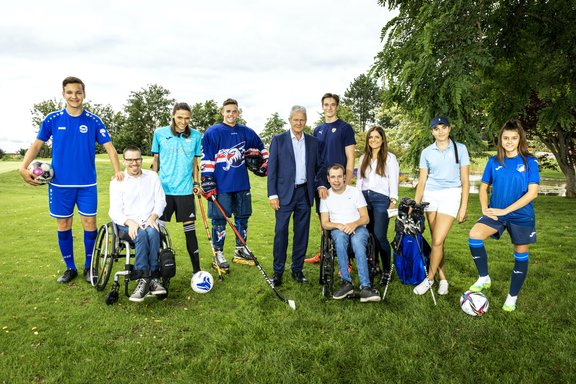
Hopp with athletes in a photograph published by his foundation. A sporting life has room for more than a league table.
Photo: Dietmar Hopp Stiftung.
Here the connection with his engineering career is an interpretation, but a useful one. Both the early software venture and the youth initiative bring activities into relation with each other. Accounting connects to materials. Training connects to education. A person can be interested in the links as much as the individual parts.
Nineteen invitations to go outside
Hopp established his foundation in December 1995, using SAP shares from his own holdings. Its geographical focus remained Rhine-Neckar. In September 2025, it marked thirty years and reported €1.4 billion distributed to charitable organisations and projects in the region.
A sum like that is difficult to picture. The alla hopp! spaces offer something more tangible. Nineteen movement and meeting areas were built between 2015 and 2017 for €45 million and given to municipalities. They are places to play, exercise and encounter other people, across generations.
The municipalities provide the land and take responsibility for maintenance. Visitors use the equipment free of charge. Those details are the difference between a ceremonial gift and a public facility with a continuing job to do. Someone must still look after it when the ribbon has been put away.
Built in 2015-2017. Municipalities maintain the facilities.
Public space provides a particularly direct test of philanthropy. People can walk into it. They can decide whether it suits them, return tomorrow or prefer somewhere else. A foundation’s intentions meet the stubborn reality of how a neighbourhood spends its afternoon. The users supply the verdict.
A golden ball, a different arena
Hopp’s sporting interests also found a home at Golf Club St. Leon-Rot. He hit a golden ball at its official opening on April 26, 1997, his birthday. Most birthday presents demand rather less land.
The club went on to host international competition, including the 2015 Solheim Cup. Youth development also became part of its identity. There is room in Hopp’s sporting world for both the tournament and the beginner, though they make very different demands on a course.
Nearby Sinsheim acquired another kind of gathering place when the foundation-backed Klima Arena opened in October 2019. It presents climate and environmental questions through exhibitions and educational activities. Visitors are invited to consider resources, energy and their own choices.
The venue extends the regional pattern into a subject that plainly exceeds regional borders. A learning centre needs a physical location even when its subject is planetary. Hopp’s projects repeatedly give broad ambitions a local doorway: a club, a course, a public space, a place to learn.
The next bell rings at school
In February 2026, the foundation announced up to €30 million over the following years for movement in everyday school life. The plan combines schoolyards with teaching and school routines. Its stated interest reaches beyond installing equipment: participating schools are asked to consider how movement belongs in the day.
The announcement brings the story back to institutions people use repeatedly. A school timetable is less glamorous than an opening ceremony. It is also where a programme has to earn its place. Equipment can be bought; changing a routine requires teachers, pupils and administrators to make it work together.
Hopp’s career leaves plenty to admire and plenty to examine. SAP’s reach, the foundation’s local concentration and Hoffenheim’s ownership debate belong in the same portrait. Success increased his capacity to act. It also increased the number of people entitled to care about the consequences.
The teenage striker once had a simple reward for scoring. The older founder’s arithmetic contains more people, more institutions and more disagreement. Follow those numbers and they lead, again and again, to the same region. He helped build software that travelled the world. He kept finding reasons to stay interested in home.