The trouble began with an alphabet. Miele, the appliance manufacturer, was extending a business application into the Greek market. Its printing arrangements suddenly looked expensive: adding memory cards to hundreds of Unicode-enabled printers would cost nearly €400 apiece. A language requirement had become a hardware bill.
- LRS manages the journey from business application to printed or electronic document.
- Its customers include manufacturers, healthcare organizations, and public pension systems.
- The buying question: how much does your current document delivery system cost to keep working?
Miele chose output-management software from Levi, Ray & Shoup. In the historical case study published by LRS, Miele reported fewer support calls and avoided conversion hardware. The software gave administrators a common view of jobs and devices. An apparently local printer problem turned out to have a system-wide answer.
01 / The €400 alphabet
The revealing part of that decision is where the expense appeared. Miele already had applications producing documents. Its own printing arrangements used operating-system facilities. International expansion exposed the limits of that approach. The company reconsidered the connection between application and device before buying upgrades for every endpoint.
More than €35,000 saved annually in that support category.
It is a useful way into LRS, because printing sounds like a peripheral business until an organization depends on the next document arriving.
02 / A product hiding in a consulting job
LRS began in 1979 with three consultants: Dick Levi, Roger Ray, and Bob Shoup. Their first office, according to the company’s retrospective, occupied 900 square feet above a bank in Springfield, Illinois. The furniture included three used desks and six used chairs. There was room for visitors.
One early engagement involved helping a manufacturer move from a Honeywell mainframe to an IBM system. Levi asked permission to use the customer’s machine after hours to expand a printing application he had written for another client. That work became VPS, the product that made output management a business of its own.
The transferable idea is straightforward: a consultant sees individual assignments; a product builder also looks for the same problem recurring across customers. LRS found one in the distance between a computer producing information and somebody receiving it.
03 / Follow the document
Consider a shipping label. A business application creates it. Something must capture the job, interpret its format, choose a destination, and report whether delivery succeeded. A network failure or unavailable printer interrupts the sequence. The application may have finished its work while the warehouse is still waiting.
VPSX Enterprise occupies that middle ground. It captures output, manages its processing and delivery, and can redirect documents when devices or networks have problems. LRS says one instance can serve thousands of printers from different manufacturers. Administrators get a common interface for an estate that otherwise contains many separate moving parts.
mainframe
route · recover
electronic destination
A simplified view of enterprise output management.
Security extends the journey. MFPsecure/Print holds documents until a user authenticates at a device, using methods such as a badge or PIN. Scanning products handle the reverse trip, bringing paper into digital workflows. The customer is buying control over movement, access, and failure.
There are other ways to buy printing software. PaperCut offers print management and secure release; Microsoft Universal Print provides cloud print management. LRS’s pitch emphasizes connecting enterprise application output with workplace printing across varied platforms. Buyers need to compare the actual document paths each product supports.
04 / The cloud still has a printer
An application can move into a cloud service while its destination remains beside a loading dock. That separation helps explain why LRS’s subject has survived successive computing fashions.
In October 2025, the company announced four SaaS offerings covering direct printing, authenticated release, scanning, and auditing. They use its Mission Control platform. The direct-print cloud service is a new multi-tenant offering with its own architecture, a distinction that matters when customers evaluate migration.
LRS also offers customer-controlled cloud deployments and managed cloud services. These arrangements allocate responsibility differently: who operates the environment, who configures it, and who handles trouble. Subscription revenue joins software licensing, maintenance, implementation, and service work in the business model.
The application may have finished its work while the warehouse is still waiting.Why the delivery layer matters
05 / Pensions, people, and a boatyard
Output management is only part of the company. PensionGold, from LRS Retirement Solutions, serves public defined-benefit retirement systems. Consulting Services supplies IT professionals. IT Solutions handles infrastructure and cloud work, while Web Solutions develops websites and applications. Small Business Tech Services supports regional networks.
Then comes Diversified Yacht Services, serving Southwest Florida. Even LRS’s division directory acknowledges the change of subject. A corporate portfolio can contain both document delivery and boat repair without requiring an elaborate theory to join them.
The more useful thread is sustained service. LRS’s stated values ask employees to communicate honestly and require the company to have working managers. Its mission explicitly includes making a profit. Those are practical commitments for businesses whose customers need implementation and continuing support.
06 / Count the handoffs
For a prospective buyer, the useful exercise starts with a document. Trace its route. Count the servers, device-specific fixes, support interventions, and opportunities for confidential information to be exposed. Then compare that operating burden with the cost of migration and the proposed service.
The arithmetic should include people as well as machines. A printer that consumes little electricity can still generate hours of troubleshooting. Conversely, removing a server does not automatically remove every support task. Ask who owns the remaining agents, queues, and device connections. Test an ordinary document, a sensitive document, and a failed delivery. A demonstration that ends with paper emerging from a healthy printer answers only part of the question. The more revealing demonstration starts by making something unavailable and watching what the system tells the person responsible for fixing it.
A small, uncomplicated fleet may offer little complexity to remove. A mixed estate needs careful checks of application integration, device support, identity controls, and outage behavior. Those requirements should shape the deployment choice.
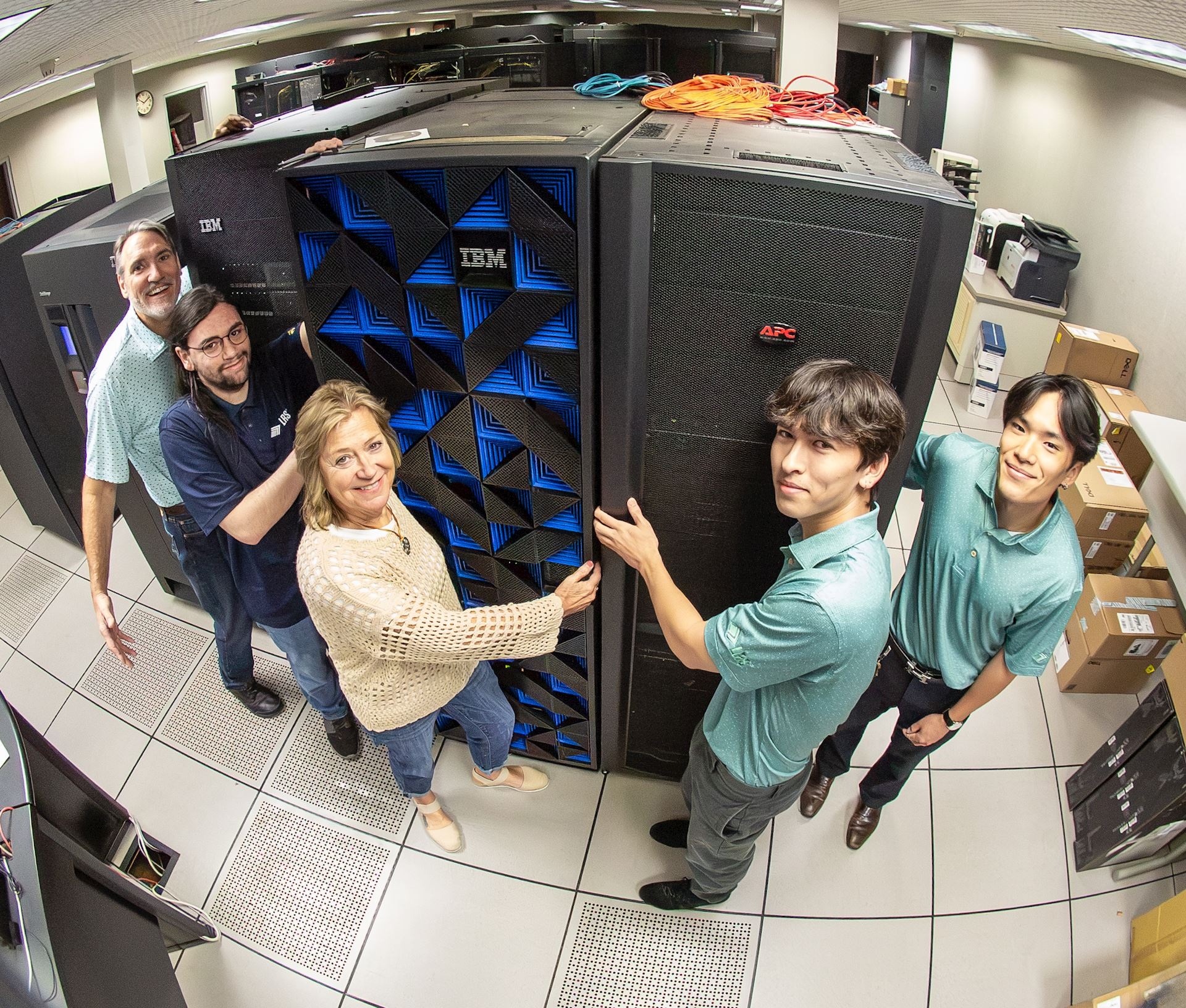
Behind glass in LRS’s headquarters atrium sits an IBM Z mainframe. The company continues developing its VPS family for that platform. The machine gives the story a satisfying physical presence: decades of computing change, and a business still attending to what happens after an application presses send.