Dhananja “DJ” Jayalath had a job waiting at Apple. He also had a university project involving gym clothes, a friend who wanted better answers about lifting weights, and a problem with a remarkably stubborn opponent: laundry. The job offered a recognizable beginning. The clothes offered a question he had already spent a good deal of time trying to answer.
At the University of Waterloo, Jayalath and Christopher Wiebe wanted to know what was happening during their workouts. Effort was easy enough to feel. Its distribution was harder to judge. Which muscles were doing the work? Were they getting much out of the time they spent there? A personal trainer exceeded the student budget. Engineering, conveniently, was already on the timetable.
The answer they developed became Athos, co-founded in 2012. Before it became a company, it was a fourth-year design project: the Muscle Activation Detection Suit. The name had the pleasing bluntness of something built to satisfy an engineering brief. It described a task, left fashion to worry about itself, and suggested that somebody would eventually have to make the thing comfortable.
In 2012, the project won two awards at the Ontario Engineering Competition, including an innovation prize. Jayalath graduated with a bachelor’s degree in electrical engineering that year. His next step could have been hardware engineering at Apple. Instead, he followed the prototype into a business where software, electronics and textiles would all have a vote.
A flight before the career began
The switch happened quickly. Three days after their final exams, Jayalath and Wiebe were talking to venture capitalist Chamath Palihapitiya. He had seen their project at Waterloo’s design symposium. He wanted them in Palo Alto immediately. They arranged to meet the following afternoon, booked an early flight and went back to the lab to reassemble the project they had recently taken apart.
The founders had discussed needing $250,000. At the meeting, Palihapitiya offered $500,000 and office space at Social Capital. Jayalath’s Apple plan gave way to Athos; Wiebe’s intended job at Analog Devices did too. A dismantled class project had acquired a rather different deadline.
Palihapitiya was a Waterloo electrical engineering graduate himself. That connection mattered materially: by November 2013, Athos had $3.5 million in seed backing from his firm. The sequence is a useful reminder of how a company can begin. A project creates something worth showing. A university provides a place to show it. Someone in the room has the means to keep it going.
For Jayalath, the work also demanded a broader range of skills than the degree title suggests. His personal biography describes experience across mechanical, electrical and software engineering, along with sewing. A circuit can be elegant on a bench and decidedly less elegant when somebody has to pull it over their head. Athos required both versions to make sense.
- 2012Waterloo degree
Athos co-founded - 2016Forbes
30 Under 30 - 2022Waterloo alumni
achievement medal - 2025Palmetto
app announcement
The washing machine gets a vote
Athos put sensors into compression apparel and connected them to a removable electronics module called the Core. The module sent information to a phone. The underlying technique, electromyography, measures electrical activity from working muscles. Jayalath and Wiebe were trying to make that measurement fit into clothes people would already wear to train.
The product’s appeal depended on a chain of ordinary actions. Put on the garment. Connect the Core. Look at the feedback. Later, take the electronics out and wash the clothes. Each step had to work without asking the wearer to become an electronics technician. A useful invention can lose its audience somewhere between the instruction manual and the laundry basket.
Jayalath discovered just how exacting that basket could be. “The washing machine is the most destructive thing I have ever had to come across,” he said in 2014. Early wiring containing Kevlar had been shredded in the wash. The domestic appliance was conducting a fairly uncompromising design review.
That story gives Athos a more interesting texture than the familiar picture of a founder having an idea and raising money. The garment had to tolerate friction, sweat, repeated handling and cleaning. Hardware development had to accommodate the expectations attached to clothing. Nobody buys a shirt hoping for a new weekend maintenance project.
By 2015, Jayalath described a team spanning software, hardware, data science, visual design, fashion, textiles and electronics. He was also thinking about the phone itself: increased processing power and Bluetooth Low Energy had made the experience more practical. His product lived at the meeting point of several disciplines, each capable of spoiling the others’ day.
A number has to earn its place
Jayalath’s explanation of Athos repeatedly returned to what a person could do with the information. In a 2016 interview, he described feedback that could inform changes between workouts, between sets or during a repetition. The timing was central to the proposition. A measurement delivered after the relevant decision has passed is a different sort of product.
The system connected a garment, a small piece of electronics and an application. That arrangement made the clothing an interface as well as something to wear. The phone translated signals into a view the user could interpret. The important design question was whether the entire arrangement helped someone make a choice they had previously been guessing at.
Athos attracted recognizable athletes. By early 2016, its apparel was being worn by football player Elvis Dumervil, baseball player Eric Hosmer and boxer Mike Lee. Jayalath and Wiebe were named to the 2016 Forbes 30 Under 30 list; Athos had also appeared in Inc.’s 2015 selection. The student project was now being discussed well outside the lab.
The engineering continued beyond those early headlines. A United States patent granted in November 2016 names Jayalath and Wiebe as inventors of a wearable architecture for performance monitoring, analysis and feedback. Even its title describes a sequence: collect information, make sense of it, return something useful. The feedback has somewhere to go.
Nearly 100 chances to learn
By the time Jayalath received Waterloo Engineering’s Young Alumni Achievement Medal in 2022, Athos had hired and mentored nearly 100 Waterloo engineering students through the co-op program under his leadership. That is a particularly concrete way of maintaining a relationship with a university. Students arrived with work to do, rather than simply a founder to admire.
His advice to young entrepreneurs put similar weight on people. Experiment early, speak to the audience and allow feedback to change the work. Recruit expertise and give colleagues room to question you. “Your team is your #1 asset,” he said in 2016. For a company joining apparel to electronics, that advice had an immediate practical application.
Waterloo’s medal recognized both his leadership at Athos and his support for future entrepreneurs. The connection had come full circle: a university project had helped launch his company, and the company had become a place for other students to develop their own practical skills. Mentorship, in this version, involved a working environment and real responsibility.
Jayalath also appeared among the judges at Hack the North in 2018. Returning to student builders placed him on the other side of the demonstration table. The person who once needed someone to take a prototype seriously was now helping assess what other people had made. It is a small change of position with considerable meaning.
Waterloo engineering co-op students hired and mentored at Athos under Jayalath’s leadership, as documented in 2022.
Sriracha, then an unreasonable bet
There are less ceremonial details. Asked in 2015 what he could not travel without, Jayalath listed noise-isolating earbuds, an iPad and Sriracha packets. The list moves efficiently from concentration to computing to dinner insurance. He also described doing bodyweight exercise during long airport layovers. Travel, apparently, did not automatically qualify as a day off.
When he returned to Waterloo for TEDxUW in 2023, his subject was taking unreasonable bets. The talk, published on YouTube in February 2024, set out five considerations: pursue a meaningful goal, learn to enjoy the work, take calculated risks, work with exceptional people and accept that outcomes remain uncertain.
That last condition gives the advice some weight. A founder can describe the decisions that produced a particular career without turning them into a guarantee for everybody else. Jayalath’s framework leaves room for uncertainty alongside effort. The Apple offer and the Athos prototype make a memorable opening; the years of building explain why the choice required more than an afternoon of courage.
“Always ask why and read your emails.”DJ Jayalath, 2022
From a training session to a utility bill
His career moved into energy. By August 2022, Jayalath was vice president of channel strategy at Palmetto Solar. The biography accompanying his TEDx talk later identified him as Palmetto’s vice president of product. The setting had changed from connected apparel to a company working on access to home energy.
In September 2025, he introduced work on the Palmetto app, describing a year of effort with his team. The app connected to a utility provider and offered personalized recommendations about energy use, with rewards that could go toward home upgrades. He framed the ambition around giving Americans more control over a household expense that often feels unavoidable.
His stated reason for joining Palmetto was to help millions of Americans make better decisions about energy use and its impact. Here, the connection with Athos becomes visible as an editorial reading of his work: both efforts try to make information useful in an existing routine. A person already trains. A household already consumes electricity. The product tries to improve the decisions inside that activity.
The two settings also put limits on what a pleasing screen can accomplish. A reading must connect to something a person understands and can act upon. The attraction of Jayalath’s career is in that recurring practical question. What would this information let somebody do differently? His work keeps bringing it back to everyday objects: a shirt, a phone, a utility bill.
Follow the work
Read, watch and listen to Jayalath on engineering, building products and taking a chance.
- Jayalath on LinkedIn ↗
- Personal biography ↗
- Facebook profile ↗
- Watch: Taking Unreasonable Bets · TEDxUW ↗
- Listen: Jayalath on The Twenty Minute VC ↗
- Read: His Palmetto app announcement ↗
- Read: Waterloo’s 2022 alumni awards ↗
- Read: The 2015 Athos founders interview ↗
- Athos website ↗
- Palmetto website ↗
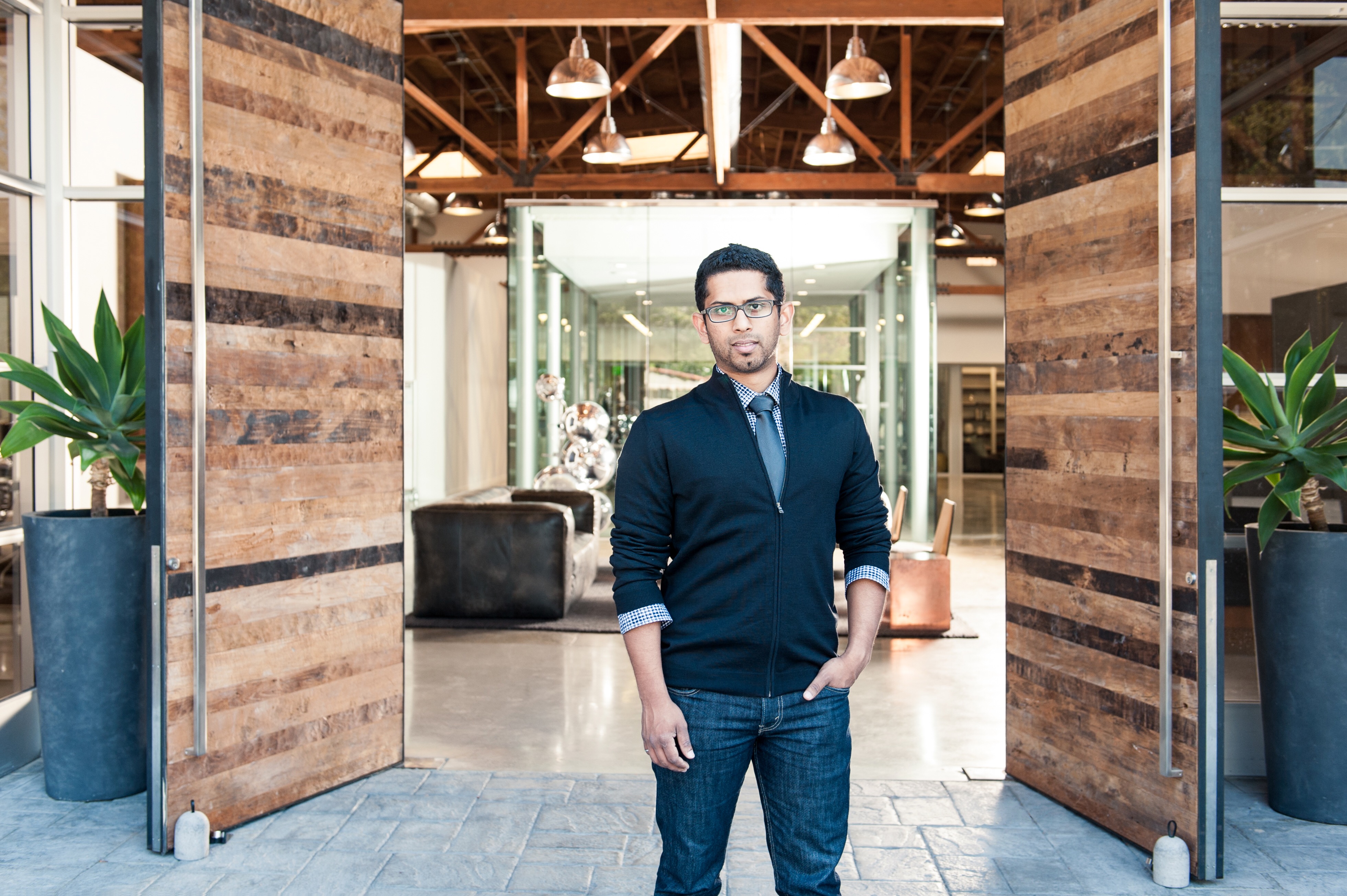
Photograph: published by A Nibble of Business, March 2016.