Desh Urs can be found in a photograph with an open picture book and two children leaning into the reading. One child is stretched across the chair; the other has secured a position beside him. Whatever the lesson on the page, the seating arrangement appears to have been settled without consulting a management framework. It is an apt introduction to an executive whose working life keeps circling back to people: what they need, what they understand, and what happens when a system forgets them.
Urs co-founded iBridge with his wife, Sadna, in 2004. Today he leads a business working across document processing, software, and digital transformation. The tools have changed over those years. A recurring concern has stayed recognizable: information has to become something a person can use, question, and take responsibility for. Owning a large quantity of data is a rather incomplete achievement if nobody knows what to do next.
Two careers, one different choice
The couple’s starting point was experience. Both had worked in corporate America; Sadna’s background was in aerospace and defense, Desh’s in technology. They describe founding iBridge in their forties, with careers already behind them and a family growing alongside those careers. Starting a company meant making another substantial commitment at an age when the obligations on the calendar were hardly theoretical.
Urs has described the arrival of their second child as a turning point. Long working weeks had made the relationship between professional ambition and family presence increasingly difficult. The business they imagined would have to make room for both. That intention gives the founding story a domestic scale: two people considering how they wanted their working lives to fit the rest of their lives.

In their account of the company’s history, the couple measure its progress through relationships, their children, and opportunities created for employees. They describe a business that began with outsourcing and managed services and expanded into technology services and software platforms. Their emphasis is revealing. The company is also the setting in which a considerable portion of their adult lives has happened.
A career on both sides of the diagram
Before iBridge, Urs had worked across the commercial and operational sides of technology. His professional biography lists senior sales roles at Qsent and Acxiom, and responsibility for global sales, services, and marketing at Silicon Graphics. At Think Tools and Brio Technology, he worked on business development and alliances involving business intelligence and decision management. Earlier still, in the late 1980s, he founded Indus Systems, which he later sold to a systems integration company.
That is a useful background for someone selling the practical use of information. A technical team has to make a system work. A commercial team has to understand why somebody would buy it. A service team then gets to discover whether the promised result survives contact with Tuesday afternoon. Urs’s experience crossed those boundaries. His later work at iBridge puts them in the same conversation.
A former Silicon Graphics colleague, Jaimini Bhatt, remembers his ability to communicate across organizational levels and bring engineering, marketing, finance, and management into balance. It is a colleague’s assessment, and a specific one: the skill being praised is coordination. Much of a technology executive’s job consists of getting people with different responsibilities to understand the same problem before they attempt different solutions.
The customer gets a vote
By 2018, when Urs discussed iBridge’s work with Oregon trial lawyers, his way of describing the business was strikingly direct. The couple had seen information as an underused asset. Their work became the task of reducing unwieldy collections into useful pieces for particular purposes. For legal clients, that included gathering, analyzing, and reviewing material while keeping costs and defensibility in view.
He also described the question his team used when a decision became difficult: whether it served the customer’s interests. That is an everyday test with inconvenient consequences. It asks a supplier to understand the customer’s purpose, rather than assuming that completing a technical task settles the matter. A perfectly delivered file can still fail to help the person who needed it.
His conversation with Dan Nestle in 2022 returned to the human being behind the customer label. They discussed curiosity, company culture, empathy, and leadership development. Taken together, those interests suggest a consistent management concern: keeping enough attention on the people involved to ask a useful question in the first place. A dashboard is considerably easier to consult than another person. It may also be less illuminating.
The difficult page has a name
A county records project makes the work tangible. In its account of a 2024 assignment for Snohomish County, Washington, iBridge reports capturing 649,533 images from 1,387 books over 46 production days. The records stretched from 1862 to 2002. Different bindings, oversized maps, and other physical complications needed different handling. History had declined to arrive in a convenient standard format.
The account includes 559 quality issues logged during production. Among the details is a marriage certificate identified as Book 119, Page 388, which required an on-site rescan. A record with a location that precise gives an abstract promise of quality a useful physical address. Somebody had to notice, identify, and correct the problem before calling the work finished.
That is the kind of detail that makes Urs’s business easier to understand. The customer needs a dependable record. Scanning is one part of producing it. Inspection, correction, and organization give the digital copy its practical value. The small exception has an unusually good view of the whole process.
Keeping a place for experiments
Urs has described allocating about 80 percent of resources to the dependable core business and 20 percent to experimental work. The proportions are his account of an operating approach, rather than a financial disclosure. They capture a recognizable founder’s problem: existing obligations need consistency while new ideas need room to be uncertain.
In March 2025, iBridge renamed its services group iBridge Smart Solutions. The announcement described combining AI with human specialists in document enhancement, extraction, and analysis. The business’s accumulated operational work was becoming the setting for new tools. Keeping people in the process was part of the stated method.
Later that year, speaking with Scott Shagory on The Disciplined Troublemakers, Urs discussed the movement from services toward products, customer relationships, and international expansion. A product changes what a company must keep learning. The team has to turn experience from individual engagements into something that can work repeatedly. That makes the relationship between reliability and experimentation a continuing management job.
A nonprofit comes to the design table
Another 2025 development brought a different kind of knowledge into that work. On April 15, the Urban League of Broward County and iBridge announced Impacful, a joint venture intended to develop technology for nonprofits. The partnership paired iBridge’s technical capabilities with the Urban League’s experience of community programs.
Its initial focus was an impact management system, with client intake, relationship management, case assignments, program tracking, and analytics. These are specific administrative jobs. Done well, they can help an organization understand what it is delivering and to whom. They also require an accurate picture of how the organization actually works. A software developer and a community organization each have something the other needs to know.
For Urs, the venture gives a practical setting to his stated ambition of making sophisticated technology accessible beyond large corporations. The ambition becomes easier to assess when it has partners, workflows, and people who will have to use the result.
Before the answer, a person asks
By 2026, his writing had become particularly focused on the decisions surrounding AI. In a July essay about human intent, he argues that the question itself carries assumptions, priorities, and context. The record of an AI-assisted decision therefore begins before the system produces anything. Someone has already chosen what to ask and what information to supply.
This is a useful continuation of his earlier work with business records. A prompt can preserve the reasoning that shaped an answer. His concern is that organizations may retain the output while losing the human choices that made it possible. In his view, explaining those choices belongs to the work of leadership.
“Running your own company strips away pretense and forces authenticity.”
Desh Urs
His August writing on AI agents takes the question further. When software can act across a workflow, he argues, an organization needs to understand the authority it has given the system and keep a record of what followed. In October, his essays returned to prompt preservation and the authority behind oversight. The emphasis is on responsibility that can be exercised in practice.
Someone needs the authority to stop
There is an interesting tension in Urs’s current position. He is selling technological change while insisting on the discipline around it. His stated expansion interests include Saudi Arabian partnerships with Three Lines and Transformative SA. He wants broader access to capable tools. He also wants organizations to know who owns the decisions those tools help produce.
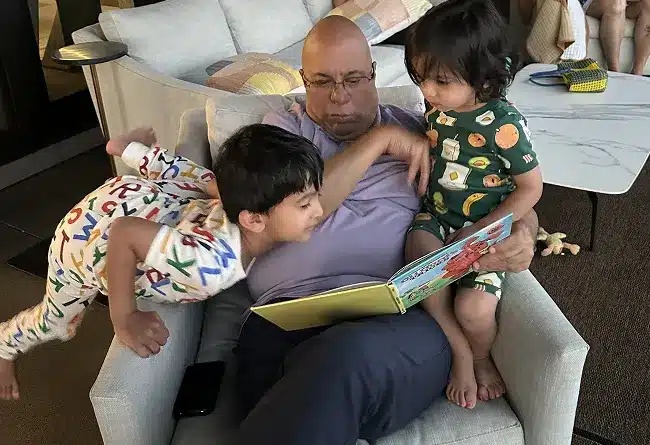
The picture book offers a gentler version of the same need for attention. There is a page, an audience, and a person helping make sense of it. Across Urs’s career, the scale of the information has grown enormously. His recurring questions remain close to the people at either end: what are we trying to understand, and who will take the next step?