Sabin Ephrem and Chris Staley had a problem worth bringing home from Seattle. Working on a Microsoft marketing automation project through McCann in 2003, they could see how easily creative ambition and enterprise technology pulled apart. On flights back to Minneapolis, they talked about the gap. Agencies could imagine the experience. Technology firms could build the systems. Getting those abilities to live comfortably together looked like a business.
Horizontal grew from that practical observation. Ephrem brought the computer scientist’s view; Staley brought experience in agency work. Jeremy Langevin, who initially helped Ephrem assemble technical support for the project, joined as the third partner in early 2006. Their opportunity sat between established specialties, in the work required to carry an idea from a presentation into something a customer could actually use.
It is a wonderfully unglamorous place to begin. The handoff rarely gets a launch party. Yet Ephrem’s career has returned to it repeatedly: between business and engineering, a client and a delivery team, an American headquarters and colleagues thousands of miles away. The vocabulary has changed. The need for people who can understand one another has proved durable.
A computer scientist learns another language
Ephrem’s education gives him a foothold on both sides of the conversation. He graduated from Northeastern Illinois University in computer science in 1989, earned a master’s in the subject at DePaul, and completed an MBA at Northwestern’s Kellogg School of Management in 2004. At Northeastern, he graduated cum laude and belonged to the President’s Honor Society.
His business studies included marketing, strategy, finance and entrepreneurship. Read beside the two computing degrees, the list suggests a useful combination of questions: how does the machinery work, who needs it, and what makes the investment worthwhile? Those questions do not automatically produce the same answer. A consultancy earns its place by helping a client work through the disagreement.
Before Horizontal took shape, Ephrem worked across consulting and enterprise software, including experience with Ernst & Young and Oracle. He moved into independent consulting in 1999. The work exposed him to systems that had to function inside existing organizations, with their own priorities, budgets and constraints. An elegant technical answer still needed somewhere sensible to land.
Three partners, fewer loose ends
The early partnership gave Horizontal several ways to understand a brief. Ephrem’s technical background, Staley’s agency experience and Langevin’s staffing knowledge addressed different parts of the same assignment. A client might need the whole project delivered. Another might already have a capable internal team and need particular skills. Horizontal made room for both arrangements.
Ephrem called the offering “a flexible engagement model.” The phrase is dry enough to survive procurement, but its appeal is easy to understand. Clients could buy help in a form that fitted the problem. A firm that understood design, implementation and staffing could have that discussion without forcing every request into the same contract.
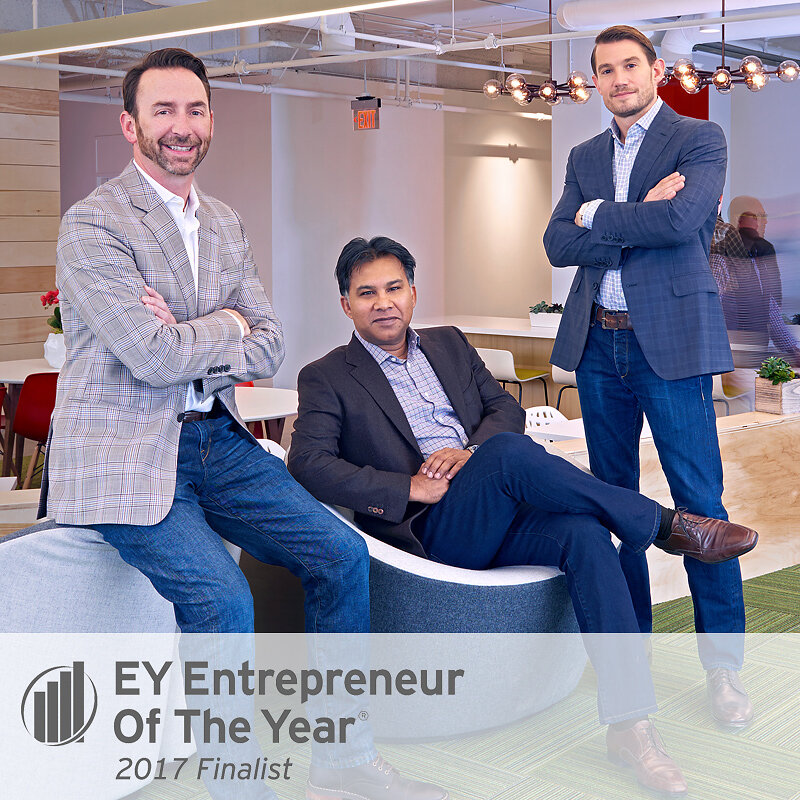
The division of responsibilities remained visible as the company grew. In 2017, Ephrem was president and CEO, Staley led the digital agency and Langevin led the staffing agency. Their EY Entrepreneur Of The Year Upper Midwest finalist recognition belonged to the three partners together. Ephrem’s response was collective too: “We owe our success to our passionate and dedicated team members.”
The partners’ different backgrounds also gave them something productive to disagree about. Early discussions forced them to learn beyond their original specialties. For a company promising to connect disciplines, that was useful practice. Integration has to happen among the people doing the work before it can happen in the work they deliver.
What growth asks of the founder
By 2016, Horizontal Integration reported $82 million in revenue. The business then included both digital services and staffing, a distinction that matters when reading the number. Its 2017 finalist profile listed 220 employees companywide, along with 550 active consultants. The structure was already more complicated than the small partnership that had begun with one project.
Repeated appearances on the Inc. 5000 provide another view of that expansion. Horizontal’s record lists twelve appearances between 2009 and 2021. Those are individual annual rankings, with different positions, rather than one uninterrupted claim to a particular place. Together, they show a business that kept returning to a national growth list over an extended period.
Numbers explain scale. They say less about how a founder behaves when there is ordinary work to do. Ephrem has contributed his own labor to office build-outs, alongside the financial commitment involved in bootstrapping the company. Somewhere in the history of this enterprise consultancy, the founder’s responsibilities extended to the office itself. Even the digital economy needs walls.
That detail is revealing without requiring a grand theory of leadership. In a service business, people notice who participates when a job is inconvenient. The formal chart assigns authority; the working day supplies further information. Helping with the physical space is one small, concrete way a founder can remain implicated in the enterprise he asks others to build.
The idea acquires a passport
Horizontal’s expansion carried Ephrem’s original problem into more markets. In January 2023, the company inaugurated a new Middle East and Africa headquarters in Dubai; it announced the opening that March. Ephrem linked the expansion to its Sitecore and Salesforce partnerships and to the company’s ambitions in the region. A larger local office made those commitments visible.
In May that year, Horizontal received Salesforce’s regional Marketing & Commerce Cloud Partner Award. Ephrem credited teams in the United Arab Emirates and India. It was a useful reminder that an office opening and the work behind it occupy different geographies. A client sees the delivered experience. Several teams may have helped make it possible.
His travel offered a more personal glimpse of those connections. Visiting India in 2023, he thanked colleagues across Bengaluru, Vadodara, Delhi and Jaipur. He recalled standing with teammates at the Taj Mahal and described their energy as a source of confidence for the business. The trip also included the Sitecore community’s SUGCON gathering in India.
Today the company lists offices across the United States, India, Britain, the United Arab Emirates, Saudi Arabia and Malaysia. A map makes that look orderly. Working across it requires habits: explaining a decision clearly, understanding a colleague’s constraints, and knowing when a conversation needs more attention. Those demands echo the original negotiation between creative and technical teams.
The discipline of staying useful
The partnerships have required sustained technical knowledge. In February 2026, Horizontal announced that 25 members of its team had received Sitecore MVP recognition. Ephrem earned his ninth recognition, in the Ambassador category. The list also included Staley and chief technology officer Sheetal Jain, placing the co-founders alongside specialists whose work keeps the consultancy’s knowledge current.
The useful distinction is between knowing a platform and remaining useful around it. Software changes. Clients reorganize. New possibilities arrive before the last implementation has become familiar. A consultancy has to keep translating that movement into decisions someone can act on. The accumulated experience matters because each new project brings conditions that resist a standard answer.
Ephrem’s more recent public argument centers on selection. In a Salesforce 80/20 Performance podcast conversation with regional managing director George Smith and host Matthew Lambert, he urged companies to “deliberately focus on fewer priorities.” The accompanying discussion connected focus with culture, trust and the ability to execute. An expanding business still has to decide where attention belongs.
“deliberately focus on fewer priorities”
Sabin Ephrem · on competitive advantage
That argument gains some interest from his own history. Horizontal’s early offer combined several disciplines. Combining capabilities, however, still leaves a choice about which customer problem deserves them. Breadth can help a team understand a situation; focus determines where it spends its effort. For Ephrem, the practical assignment has remained to make those two things work together.
A shorter road to school
Some of Ephrem’s attention goes to a journey with fewer enterprise systems attached. He has described Wings of Hope, an initiative in Vadodara that recognizes government-school students with bicycles. The annual program supports 50 students. His account connects it to the city’s contribution to Horizontal: local talent helped build the company, creating an obligation to invest in the next generation.
The bicycle is a satisfying detail because its purpose needs little explanation. A long trip to school becomes easier. A student gains time and independence. The intervention is modest enough to understand and specific enough to matter. It also gives an abstract commitment to opportunity a useful pair of wheels.
Ephrem helped establish Horizontal Cares in 2020 to support employee contributions of time and talent. In the introduction to the company’s first ESG report, he wrote that “change starts from within.” The report framed responsibility as work inside the company as well as work done for customers. For a founder, the same organization is the instrument for both.
There is a thread here, running from a conversation on a flight to a student’s road to school. Ephrem pays attention to the space between an intention and its completion. The obstacles differ. Sometimes the missing piece is a technical team, sometimes a clearer priority, sometimes transport. His career has been built around helping people get the next part of the journey done.
Continue the conversation
Explore the work and hear Ephrem in conversation.
- Horizontal Digital: company and leadership
- Sabin Ephrem on LinkedIn
- Watch: Salesforce’s 80/20 Performance conversation
- Watch: Sabin Ephrem and Nitish Verma interview
- Read: the argument for fewer priorities
- 2026 Sitecore MVP announcement
- The 2017 EY finalist announcement
- Northeastern Illinois University alumni profile