Deon Nicholas wanted more time for basketball. History homework had other plans. As a teenager in Toronto, he built a program that could quiz him on his notes, putting a computer to work on the unglamorous business of preparing for a test. The ambition was pleasantly concrete. Before he built a company, he wanted to get through an afternoon.
That small bargain between a person and a machine runs through his career. Forethought brought AI into customer support. After its acquisition by Zendesk in March 2026, Nicholas turned his full-time attention to Espa, an assistant for email, calendars and tasks. The problems have acquired larger budgets. They remain recognizably human: finding an answer, remembering a commitment, getting something done.
A computer in the family
His parents came to Canada from St. Lucia with his two older brothers. Nicholas and his younger brother were born in Canada. In a public recollection, he described parents determined to give their children opportunities they had not had themselves. His father was a car mechanic who liked to tinker, a builder whose interests extended from machinery to computers.
Father and son spent hours discussing technology, including how to assemble a computer and the companies behind the software. Nicholas’s childhood picture of Silicon Valley was wonderfully literal: a great dish in the middle of nowhere, flying cars overhead, Microsoft at the center. Geography would eventually disappoint that particular expectation. The technology held his attention.
In March 2023, those conversations gained an unexpected sequel. His father, an avid watcher of Bloomberg Technology, saw his son being interviewed on the program. Nicholas wrote about the pleasure of making him proud. Among the more formal milestones in a technology career, this one has a distinct scale: a familiar television show, a familiar face, a parent watching.
Games supplied another way in. The third of four boys, he made a little role-playing game called Dojimon, inspired by Pokémon and Digimon. A larger project, Dojiworld, pushed him to teach himself C++. He never finished it. The abandoned game left behind a programmer, which is a respectable consolation prize.
Thirteen places from the top
At the University of Waterloo, problem solving became a competitive pursuit. In December 2012, the university’s Black Team, including Nicholas, solved eight of nine problems at a regional programming contest. The result qualified them for the 2013 world finals in St. Petersburg. Here was a different kind of game: the problems were unfamiliar, the answers had to work, and other teams were trying to reach them too.
He returned to the International Collegiate Programming Contest world finals in 2015. Waterloo Black finished thirteenth in the world, third in North America and first among Canadian teams. His teammates included Geoffry Song and Volodymyr Lyubinets. Lyubinets would become part of his working life again, first at Forethought and eventually as Espa’s co-founder and chief technology officer.
Nicholas graduated in 2015 with a Bachelor of Mathematics. His work also moved through companies whose products reached far beyond a contest room. At Dropbox, he contributed to Inline Annotations and the Dropbox Badge. At Pure Storage, he helped build FlashBlade. These were practical engineering assignments: collaboration features, storage infrastructure, things that other people would depend on while doing their own jobs.
A recommendation from Facebook engineer Dhruba Borthakur adds a quieter detail. He credited Nicholas’s work on the RocksDB merge operator and MultiGet, including careful testing and validation. A competition result records where a team finished. A colleague remembering the tests says something about how the work got there.
Waterloo Black, 2012
Waterloo Black, 2015
University of Waterloo
A passed investment, a useful pivot
One early encounter with an investor produced a pair of missed connections. NEA tried to recruit Nicholas to Instabase. He did not join. The investor stayed in touch, and later had a chance to back his startup idea: software that read and summarized textbooks. This time the refusal came from the investor, who worried that the market was too small.
Months later, Nicholas returned with co-founders and a different application. They had moved toward customer support and enterprise search. The investor backed the company, then publicly reflected that he should have supported Nicholas earlier. It is an unusually candid account of how a useful relationship can survive an unsuccessful recruitment and a passed investment.
The episode gives the pivot some texture. Reading and finding information stayed relevant. The setting changed to an organization with customers asking questions and employees needing answers. A technical idea had acquired a more specific buyer and a place in the working day.
There was another refusal along the way: Y Combinator rejected him. Nicholas put the rejection letter on Twitter and kept working. He later described it as a catalyst. The letter makes an easy anecdote; the change in application tells us more about the company that followed. Continuing meant doing further work on the product and the problem it would serve.
“I wanted to code myself out of the problem.”
Deon Nicholas, recalling his early experiments
Three words that made the idea smaller
Forethought’s founding team brought together Nicholas, Sami Ghoche and Colm Doyle. Ghoche, originally from Lebanon, had studied computer science at Harvard. Doyle, from Ireland, brought experience in enterprise search and sales. They formed the company in 2017. It was a team with different backgrounds and a shared application to figure out.
Early investor Manu Kumar remembered a telling adjustment to the mission. Nicholas wanted to make everyone a genius. They added “at their job,” giving the ambition a boundary. Three words brought the conversation closer to a desk, a customer question and the information required to answer it.
The product had to fit into that desk’s existing work. Useful information could be scattered through documents and previous conversations. Retrieving it was only part of the assignment. It needed to arrive while the employee was handling the question, in a form the employee could use. Another place to search would also be another place to interrupt the day.
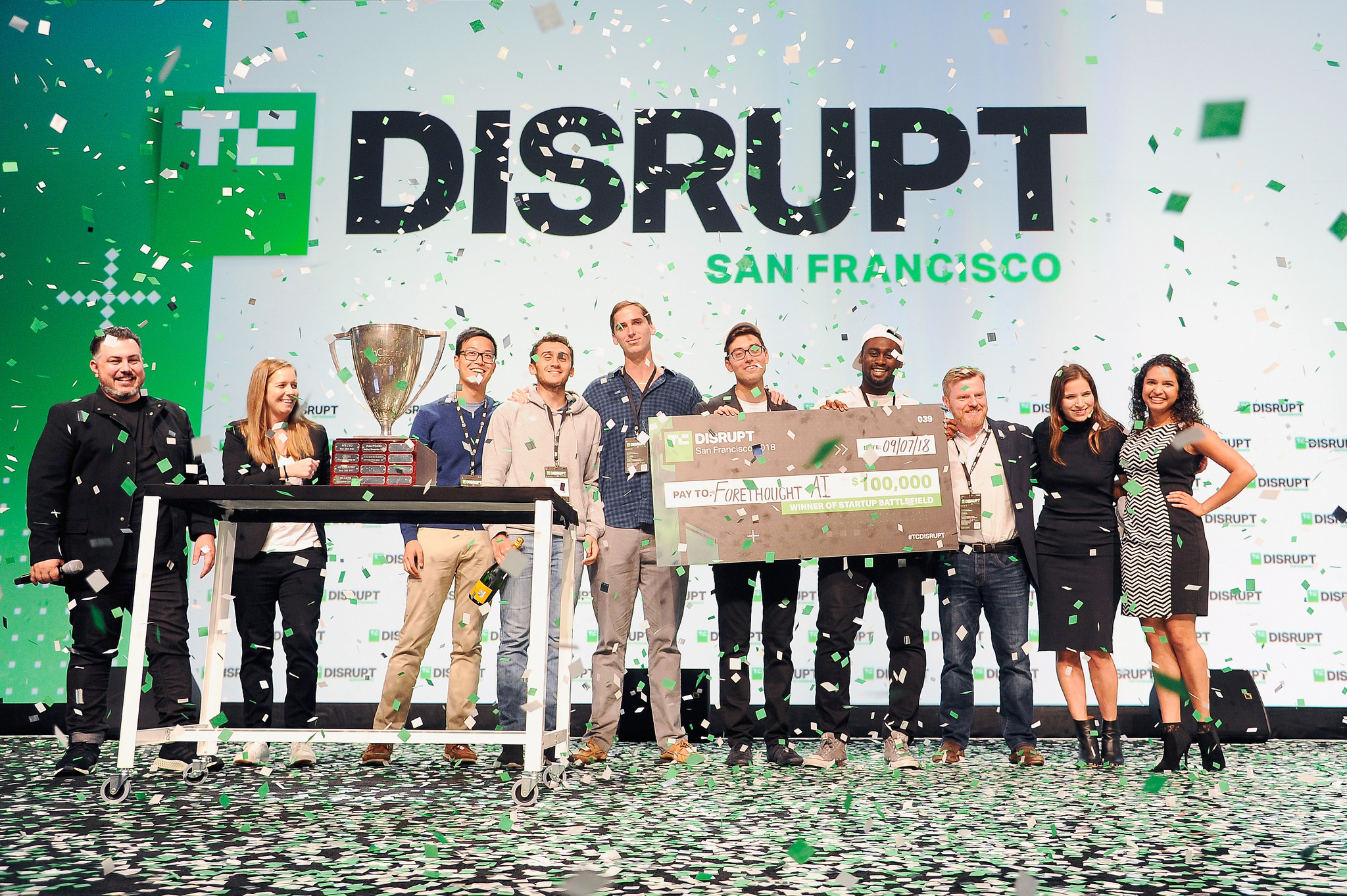
Forethought won TechCrunch’s Startup Battlefield in San Francisco in September 2018. The celebration supplied a trophy, an oversized check and enough confetti to give the cleaning crew their own operational problem. Public recognition made the young company easier to see. Behind the photograph was the less photogenic choice to give its software a particular job.
Go outside. Ask better questions.
Nicholas has described an entrepreneurship lesson that stayed with him: Steve Blank’s instruction to get out of the building. In his account, it means meeting customers where they work, learning when problems occur and understanding the people behind them. Research alone cannot supply that kind of familiarity.
For someone trained to solve difficult technical problems, this is a useful complication. A contest provides a problem statement. A customer may provide an interruption, a complaint or a workaround. Establishing what needs to be solved is part of the assignment, and the person explaining it may care very little about the elegance of the eventual algorithm.
The economics also demanded attention. Nicholas described the shift after the company’s 2021 financing: tighter spending in 2022 made efficiency more pressing, for Forethought and for its buyers. He had to think about building a business that could keep operating if another fundraise took years. A large financing round did not settle the question of how to run the company.
He applies a similar discipline to pitching. His advice to founders is to begin with a story before assembling the slides. The familiar headings of a presentation are the eventual structure, he argues; the initial work is finding the reason the business should exist now. The customer conversation and the investor conversation both require more than a technically correct answer.
A chairman, then another beginning
By 2025, Nicholas was serving as Forethought’s president and executive chairman, with Ghoche as CEO. When the acquisition was announced, Nicholas credited his co-founder’s execution and the customers who had trusted the company early. The transition belongs in the story: Forethought’s later years were also a partnership in which responsibility changed hands.
A 2025 growth round brought total funding to $115 million. The company reported serving more than a billion customer interactions a month. On March 26, 2026, Zendesk completed the acquisition. Nicholas’s current account of his work says he remains Forethought’s chairman, while his full-time focus is Espa Labs.
Espa publicly launched on May 7, with Lyubinets as co-founder and CTO. Its territory is the administrative accumulation familiar to anyone with an inbox: meetings to arrange, messages to send and follow-ups to remember. The stated ambition is to make executive-level assistance accessible beyond people who can employ a full-time assistant.
For Nicholas, the move connects work and family life. He has spoken about building Forethought while being a father and husband, and wanting practical support to reach more people. Espa takes instructions through formats such as texts, screenshots and voice notes. The standard is everyday follow-through: a meeting booked, a thread moved along, a commitment carried into the calendar.
The wrong turns stay in the notebook
There are other projects competing for space on Nicholas’s desk. He invests in startups and mentors founders, describing access to technology, education and entrepreneurship as part of what he wants to pass on. His technical interests continue into quantum computing and mathematical physics. He also writes about the costs of building companies under the title Sum of My Mistakes, an accounting system with unusually honest branding.
His algorithm project, Theory of Problem Solving, explains solutions by reconstructing how to reach them. Failed ideas remain in the account. For a reader wrestling with a problem, that is useful company: the polished answer comes with a record of the attempts that preceded it.
The homework project, the textbook pivot and the administrative assistant belong to different stages of his life. Each starts with a task someone has to get through. Nicholas keeps returning to the possibility that software could take some of it on. There is still a calendar to manage, still an answer to find, and somewhere in his unfinished projects, a multiplayer game waiting patiently for its programmer.
Keep following the questions
READ & WATCH
- His early games and study tool
- His father’s television moment
- The investor’s account of the pivot
- Customer conversations, in his words
- His engineering work and Waterloo recognition
- His 2023 conversation on building a business
- Forethought’s 2025 funding and scale
- Zendesk’s acquisition announcement
- Espa’s launch
- Watch: Deon Nicholas on AI optimism (YouTube)
- Watch: Espa on CNBC, May 2026