There is a strange gap in the American home. Nearly every one has a smoke detector on the ceiling, and a large share now carry a carbon monoxide alarm too. Almost none have a device that watches for the third obvious hazard piped into roughly 60 million U.S. households: natural gas. DeNova Detect exists to close that gap, and it is not a startup improvising its way there. It is the U.S. face of a company that invented the residential gas alarm in 1964 and has been refining the sensor ever since.
The brand belongs to New Cosmos USA, Inc., a subsidiary formed in 2018 and run out of Lisle, Illinois, in the Chicago suburbs. Behind it stands New Cosmos Electric of Osaka, Japan, a publicly traded manufacturer (Tokyo Stock Exchange: 6824) that has spent more than six decades building gas sensors and selling them by the tens of millions. The American operation is small - on the order of a dozen people - but the factory behind it is not.
01The problem hiding on the ceiling
Natural gas is methane, and methane is lighter than air. When it leaks, it rises and pools against the ceiling - the exact spot a smoke detector already occupies but was never designed to sense. Utilities add mercaptan, the "rotten egg" odorant, so people can smell a leak. That safeguard fails in predictable ways: while you sleep, if you have a diminished sense of smell, or if the leak is behind an appliance you rarely stand near. A carbon monoxide alarm will not help; CO and methane are different molecules requiring different sensors.
This is the case DeNova makes to homeowners and, more persuasively, to regulators and utilities. Its argument is not that gas leaks are common catastrophes - they are not - but that when they do happen, a dedicated alarm buys minutes that a nose and a smoke detector cannot.

02What the device actually does
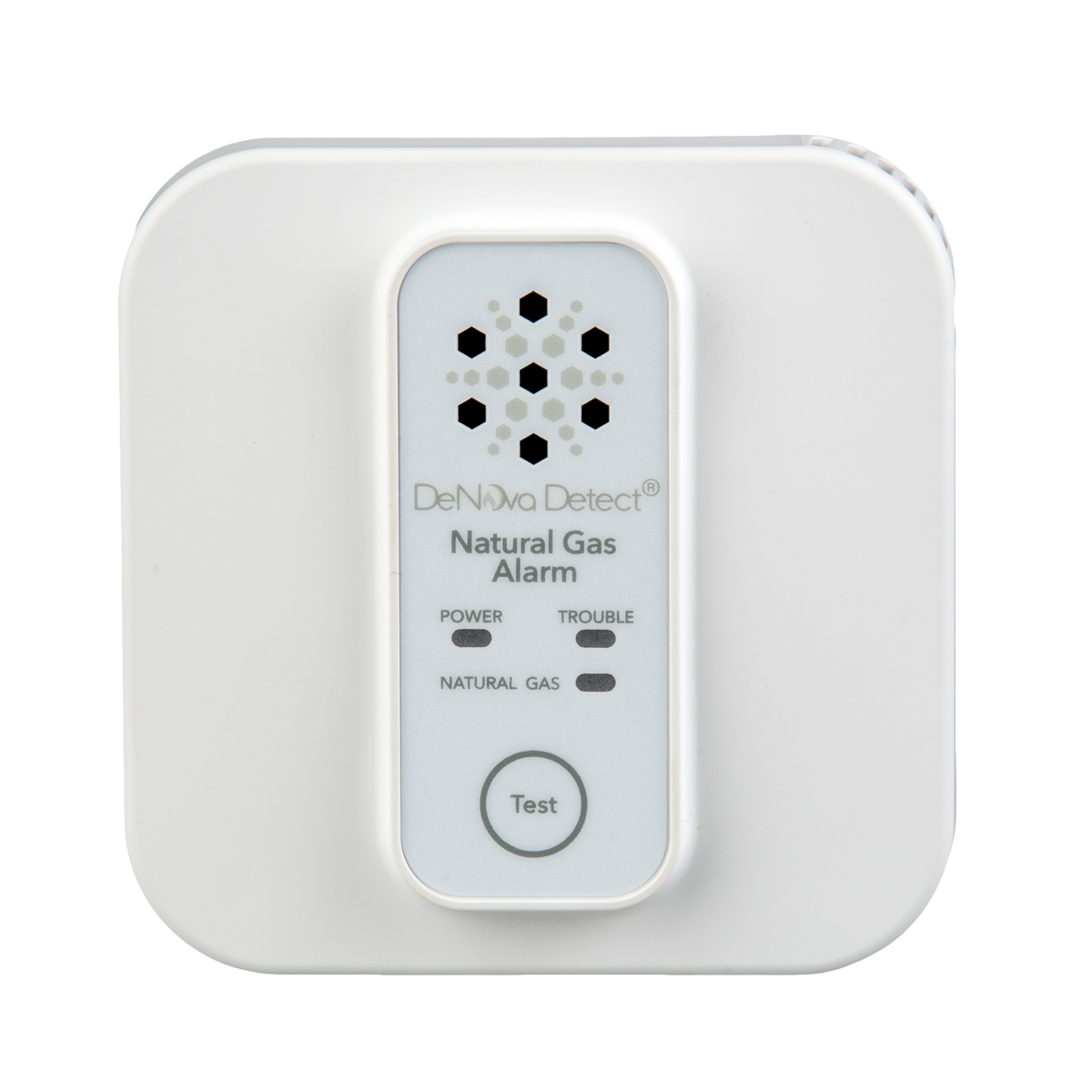
The flagship is the DD620NV, a 10-Year Battery-Powered Natural Gas Alarm. It is a small white puck, roughly 3.8 inches square, that mounts high on the wall with a single screw in about a minute - no outlet, no wiring, no electrician. Inside is New Cosmos's sensor technology, built on proprietary hot-wire semiconductor and MEMS (Micro-Electro-Mechanical Systems) designs sipping little enough power to run a decade on a sealed battery.
Two design choices do most of the talking. First, the alarm trips at 10% of the lower explosive limit (LEL) - the concentration at which gas becomes flammable. Many competing detectors wait until 25%. New Cosmos frames that lower threshold as roughly eleven minutes of earlier warning on average. Second, the DD620NV does not merely beep. At 85 decibels it announces, in English and Spanish, that gas has been detected and that you should evacuate and call 911.
There is a sibling too: the DD623NCV, a 2-in-1 unit that detects both natural gas and carbon monoxide in one battery-powered body, listed to the relevant UL standards and marketed as compliant with New York City's gas-alarm law. An older ML-series exists for buyers who want a plug-in or wired detector. Prices for the headline model sit around $99 to $115 at Ace Hardware, Lowe's, Amazon and the company's own store.
Who buys it says a lot about the product. On the consumer side it is homeowners and renters near an appliance that burns gas - a furnace, a range, a water heater, a dryer. On the compliance side it is landlords and property managers in cities that now require the hardware. And on the largest side, quietly, it is the utilities themselves, buying alarms by the hundreds of thousands to hand to their own customers. A device engineered to be foolproof for a first-time installer is, not by accident, also easy to deploy at that scale.
03Selling through the gas company
The most interesting thing about DeNova is not the hardware; it is the distribution. Rather than fight for shelf space and consumer attention one puck at a time, New Cosmos put its alarms in the hands of the utilities that pipe the gas. The flagship is Con Edison in New York. A pilot that began in 2018, after a Bronx gas explosion, scaled into a reported roughly $25 million program aiming for about 400,000 alarms - the first U.S. utility deployment to pair gas alarms with Advanced Metering Infrastructure for wireless leak monitoring.
It is a tidy loop: the company that sells you gas hands you the device that watches the gas. In 2022, New Cosmos returned the favor with its inaugural Natural Gas Safety Innovator Award, presented to Con Edison by parent-company president Yoshinori Takahashi in person. The utility channel now extends through network partners like Itron, whose Gen6 metering platform DeNova alarms interoperate with.
Pick a hazard buyers underrate. Build a device that installs in 60 seconds and lasts 10 years. Get it certified before the mandates land. Then let regulation - and the utility that already bills the customer - pull demand instead of pushing ads. DeNova is running all four moves at once.
04The regulatory tailwind
Carbon monoxide alarms did not become standard because shoppers demanded them; they became standard because laws required them. Natural gas alarms are early on the same curve. In 2023 the NFPA published NFPA 715, the first standard for installing fuel-gas detectors, giving codes and builders something concrete to point at. New York City's Local Law 157 went further, requiring natural gas alarms in residences with gas service by May 1, 2025. DeNova's battery design is tuned for exactly this: because it needs no outlet, it can sit within a foot of the ceiling where the standards want it.
05A small team, a big factory, one recall
That reliability starts in the sensor. New Cosmos does not buy the part that matters most; it makes it. Decades of work on hot-wire semiconductor and MEMS sensing let the company tune a detector that is sensitive enough to catch gas at 10% LEL yet stable enough to shrug off the false triggers - hairspray, cleaning fumes, cooking - that plague cheaper units. A sensor that cries wolf gets unplugged, which is the quiet failure mode every alarm maker fears more than the leak itself.
The parent's scale is real. New Cosmos Electric reported revenue of roughly ¥42 billion for the fiscal year ending March 2025 and employs on the order of 947 people, operating what it calls the world's largest gas-sensor manufacturing facilities, the Cosmos Sensor Centers. The U.S. arm leans on that depth while behaving like a young company chasing a new market - marketing during Fire Prevention Week, sponsoring safety advocacy, and, in 2026, collecting an Excellence in Innovation Award at HD Supply's Connect event.
The record is not spotless, and it is worth stating plainly. In early 2025 the company voluntarily recalled about 26,360 units of one combination model, the DD622NCV, because the alarm could enter a sleep mode after a short alert and then fail to catch a later leak. New Cosmos offered free replacements through the U.S. Consumer Product Safety Commission process; no injuries were reported. For a firm whose entire pitch is reliability, how it handled the flaw matters as much as the flaw itself.
06Where it fits - and who else is here
DeNova is not alone. Legacy alarm makers such as First Alert and Kidde sit adjacent to the category, and a scatter of plug-in methane detectors compete on price. DeNova's differentiation is specific rather than sweeping: the lower 10% LEL threshold, the 100% battery power that allows ceiling-height mounting, the decade-long battery, the bilingual voice, and - underneath all of it - a parent that makes its own sensors rather than buying them.
The bet is straightforward. If natural gas alarms follow carbon monoxide alarms from optional to expected, the winner will be whoever is already certified, already on utility contracts, and already on the shelf when the mandates arrive. New Cosmos has been building toward that moment since before most of its future American customers were born. Whether the U.S. market bends the way Japan's did is the open question - but DeNova is positioned for the answer either way.
