Before Deepak Anchala had a software product to demonstrate, he had a price to propose: $1,000 a month. He put the question to four or five entrepreneur friends. Would they pay for a service that helped them find buyers? Some declined. Some agreed. That was enough to begin. The first useful signal in the story of Slintel was a customer saying yes.
There is something pleasingly unceremonious about that beginning. No grand unveiling. A sales problem, a prospective bill, and people prepared to discuss both. Years later, after an acquisition, a book and another startup, Anchala is still concerned with the distance between what software offers and what a person actually needs to get done.
He co-founded Slintel, the buyer-intelligence business acquired by 6sense in October 2021. Today he is co-founder and CEO of Adopt AI, working again with Rahul Bhattacharya and, this time, with fellow co-founder Anirudh Badam. The new business asks software to shoulder more of the work. Following Anchala between the two companies reveals a persistent interest: making a complicated system useful to the person sitting in front of it.
The buyer who had already moved on
Anchala came to the problem through sales. His career included Tracxn and Eightfold AI, places where finding the right customer was part of the job rather than an abstraction in a presentation. His education had crossed disciplines too: electronics and electrical communication engineering at IIT Kharagpur, followed by an MBA in finance at IIM Indore. He also holds the Chartered Financial Analyst qualification.
The sales conversations bothered him. Reps would call prospects and run through familiar questions to discover whether there was any interest. Meanwhile, buyers expected the seller to arrive knowing something. A great deal of the purchasing journey could happen before the sales representative entered it. By the time the formal introduction occurred, the buyer might already have done substantial homework.
Slintel tried to move that knowledge earlier. It gathered clues about technology use, buying preferences, renewals and changes within companies, then combined them into a picture a sales team could act on. A list of names was only a beginning. Timing mattered. So did the reason a company might be looking.
For Anchala, delivery mattered as well as discovery. The information could surface in a dashboard, browser extension, Slack, email or a customer relationship management system. That detail makes the ambition easier to understand. Useful intelligence has to reach someone where the next decision happens. Otherwise it becomes one more place to log in, admire a chart and leave.
An editorial sketch of the path from buyer signals to a sales decision.
A crowded market, a narrower answer
Slintel did not enter an empty field. When Stellaris first spoke with Anchala in 2017, its investors thought the sales-intelligence space looked occupied. They met again in 2018 and 2019. The company had sharpened its focus on identifying prospects through inferences about buying intent, and Stellaris joined its journey in 2019.
That sequence gives the familiar instruction to find a market a less tidy meaning. There was a market already. The harder question was whether Slintel could offer a sufficiently useful answer inside it. Stellaris later wrote about the importance of proprietary information, difficult-to-replicate inferences and integration into customers’ work. The competitive problem extended beyond collecting another database.
Accel’s investment account also emphasized customer response and company culture. Those are two different kinds of evidence: whether people want the product, and whether the organization can keep producing it. In an intelligence business, a customer’s confidence depends on the work behind each result. The polished interface is the part the customer sees; the machinery underneath must continue earning its place.
Anchala and his early collaborators initially fitted the work around their jobs. The team went full time in 2018. By the time outside capital arrived, the problem had changed. Getting a company started and allowing other people to run pieces of it require different habits. A founder can become surprisingly attached to a task he spent months wishing someone else would do.
The difficult art of letting go
Hiring a sales team raised a particularly personal question for someone who had sold the product himself. In Anchala’s account, handing responsibility to new account executives required trust while expenses kept rising. Bhattacharya described empathy and understanding why someone was struggling as part of the response. The founders brought in leadership early and gave employees room to develop.
“Don't micromanage.”
Deepak Anchala, on advice to early founders
That advice has an unglamorous practical burden. Delegation creates a period in which the founder knows exactly how he would handle a conversation and has to allow another person to learn. The temptation to intervene is easy to understand. So is the cost: a business whose decisions all return to its founders has acquired employees without acquiring much independence.
The same preference for candour appeared during the sale of Slintel. Anchala recalled his first meeting with 6sense CEO Jason Zintak, who asked to hear the bad alongside the good. He appreciated the directness. Previous acquisition approaches had not felt like a fit; with 6sense, he saw a connection between the products and between the teams.
There was a commercial logic to that connection. Slintel supplied buyer information; 6sense helped revenue teams use intelligence to coordinate their work. Putting them together connected the question of whom to approach with the question of what to do next. For a founder preoccupied with making information actionable, the combination had a recognizable shape.
Slintel’s team goes full time.
6sense announces its acquisition of Slintel.
Anchala starts again, reuniting with Bhattacharya.
An exit with another chapter attached
On October 5, 2021, 6sense announced the acquisition. Its announcement described Slintel capturing more than 60 attributes across 15 million companies every week. Those were the dimensions of an operating data business, far removed from the initial conversations about a hypothetical service. The acquisition gave the work a place inside a larger revenue-technology company.
Anchala went on to serve as vice president of product and growth at 6sense. Slintel had reached more than 300 customers across 25 countries. The geographical spread is a useful reminder of the work’s audience: sales teams in different markets trying to interpret businesses they had yet to meet.
Then he began turning the experience into a book. He started writing Idea to Exit in mid-2022. A manuscript took about a year, followed by time for review and publication. For someone explaining how to start, scale and sell a business, publishing provided a modest additional lesson in schedules. The account was nearly two years in the making.
In announcing it, he thanked investors, mentors and members of the Slintel team by name. The book’s scope extended to life after an exit, an interesting place for an entrepreneurial manual to linger. A transaction closes. A person still needs something to do on Monday. By 2024, Anchala was announcing that he was starting again with Bhattacharya.
Fewer clicks, more consequences
Adopt AI emerged from stealth in May 2025 with a $6 million seed round led by Elevation Capital. Foster Ventures, Powerhouse Ventures and Darkmode Ventures also participated. Its initial proposition was to let applications perform actions through natural-language instructions, with tools for building and monitoring that experience.
The distinction between answering a question and completing a task runs through this second company. An interface can explain where a setting lives and still leave its user to traverse the menus. Adopt’s ambition was to let people express an intention and have software carry it out. Existing applications would gain that ability without requiring their owners to rebuild the whole technology stack.
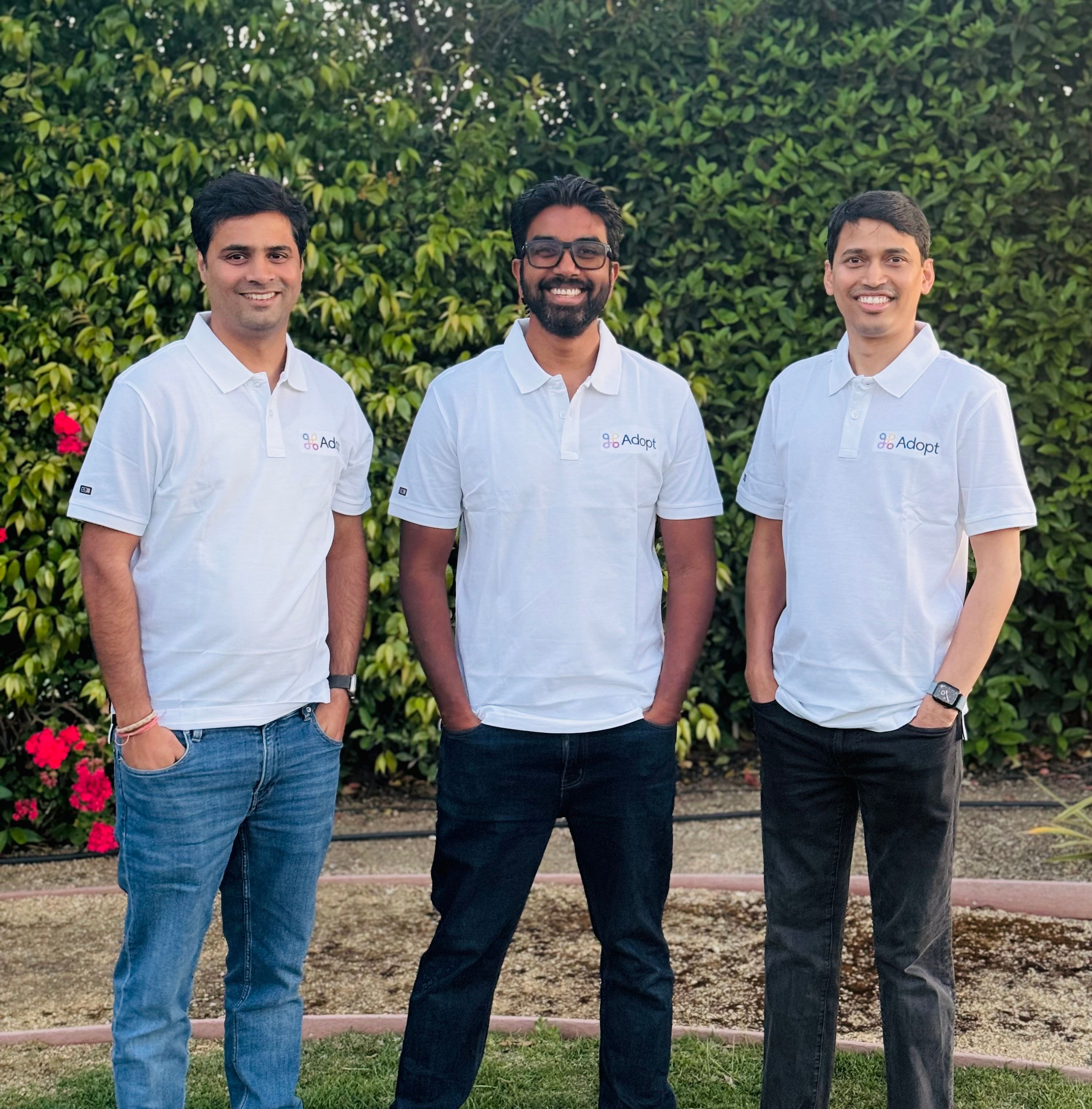
Badam brought experience from a decade at Microsoft. Bhattacharya brought the engineering partnership formed at Slintel and continued at 6sense. Anchala brought the experience of building, selling and then operating a product within a larger business. A second founding team arrives with memories as well as résumés.
By 2026, Adopt’s public offering had become more specific: accounting and bookkeeping work, including reconciliation, closing the books and reporting within existing tools. The setting gives the promise a demanding test. A completed action must fit an established process. A confident sentence on a screen cannot, by itself, reconcile an account.
The company describes an arrangement in which people approve the work. That places human judgment within the operating model. It also brings Anchala’s finance background back into view. Engineering, finance and enterprise sales are no longer just separate entries in his education and career; all three bear on the practical problem his company has chosen.
The work between the applications
In his recent public writing, Anchala has focused on the human effort that connects otherwise capable business systems. He describes accounting firms juggling clients, different configurations and recurring deadlines. The software may do its assigned job, while someone still has to gather exports, move information and remember the exceptions.
It is a concrete ambition for a founder whose first business tried to make sales conversations better informed. Slintel helped people decide where to spend their attention. Adopt asks which parts of the ensuing work software can perform. Read together, the two ventures suggest a recurring concern: how much effort stands between useful information and a finished job?
Anchala’s story now contains both a published ending and a fresh beginning. Idea to Exit supplies the title for one completed stretch. Adopt supplies a new set of customers, workflows and decisions. The early question about willingness to pay remains a good companion to all of it. Software can promise a great deal. Eventually, someone has to find it useful enough to say yes.
Keep the conversation going
Read, watch and follow Deepak Anchala’s work.