A scan begins as a field of gray. Meaning arrives through disciplined attention: a shadow compared with its neighbor, a border followed, a pattern recognized without forcing it. Deborah Mabin spent the clinical part of her career in diagnostic radiology, and her later work has demanded a similarly patient way of seeing. Only the field widened. It grew from an image to a region, from one decision to the machinery that allows thousands of decisions to be made.
Mabin's career has unfolded across a particular map. The Pas sits roughly 630 kilometres northwest of Winnipeg by road, a northern Manitoba community where distance is never an abstract planning variable. Selkirk, home to the Interlake-Eastern Regional Health Authority, sits closer to the capital but serves its own broad mix of communities. Between them lies a professional story built less around publicity than around continuity: practising, governing, teaching and keeping local institutions useful.
Her published credentials are dense - MBChB, FRCPC, FFRad(D), CCPE - but the sequence behind them is straightforward. She trained in medicine, specialized in radiology, earned recognition in physician leadership and took responsibility beyond the reading room. Manitoba records place her diagnostic-radiology registration in 1994. More than three decades later, she is listed as Associate Chief Medical Officer at Interlake-Eastern and as a lecturer in radiology at the University of Manitoba.
01 / A wider field of view
The specialist becomes a systems reader
By 2017, Mabin was Vice-President of Medical Services and Chief Medical Officer for the Northern Health Region. The title carried two vocabularies at once. Medical services required clinical credibility. The vice-presidency required budgets, staffing, policy, relationships and a tolerance for decisions whose effects would be dispersed across a large geography.
One board note from that year records Mabin and medical-administration executive Scott Hamel presenting a “Provider for All” strategy. The phrase is spare, but it points to the operational center of regional medicine: how to organize limited professional capacity so that a resident's location does not remove them from the system's field of view. The work is rarely cinematic. It lives in recruitment plans, schedules, shared standards, reporting lines and the patient accumulation of trust between sites.
In 2018, the frame widened again. Mabin represented the Northern Health Region in Manitoba's provincial clinical-operations planning. Regional representation is a subtle form of power: it gives distance, local capacity and northern experience a seat when a province designs common systems. It also makes the representative bilingual in an institutional sense. She must understand what a province wants to standardize and what a place cannot responsibly surrender.
Leadership, in this record, looks like the practice of keeping distant rooms in the same conversation.
02 / The rooms where standards are made
Governance without the spotlight
Mabin also served on the council of the College of Physicians and Surgeons of Manitoba. In the regulator's 2018 annual report, she appears as the Northman representative and as a member of its complaints committee. Minutes from 2019 show her participating in ordinary council business: adopting minutes, seconding motions, contributing to a governance process concerned with the public interest.
Committee work has a reputation for dullness because its product is restraint. A well-run professional body tries to make the right conduct routine and the wrong conduct addressable. The meeting ends; the standard remains. For a physician executive, this is not separate from operations. Governance defines the guardrails inside which organizations can move quickly without becoming careless.
Her name also appears on a province-wide clinical practice change endorsed by regional medical leaders. The document is procedural by design. That is part of its meaning. A provincial system becomes real when multiple authorities can agree on a practice, circulate it and expect it to travel intact. Mabin's signature in that chain is evidence of a career spent joining clinical judgment to institutional coordination.
The middle distance
Close enough to know, far enough to connect
Much of modern leadership celebrates either the front line or the sweeping vision. Mabin's roles occupy the less glamorous middle distance between them. An Associate Chief Medical Officer is close enough to clinical work to understand its language and far enough across an organization to see recurring constraints. A regional representative carries local experience into a provincial room, then returns with decisions that must work beyond the room where they were made.
That middle distance is where translation becomes a job. Clinicians, administrators, regulators and educators do not begin with identical incentives or identical clocks. Clinical decisions may be immediate. Policy moves through consultation. Governance asks what can be defended consistently. Teaching slows a practiced judgment down so a learner can see its parts. Mabin's public appointments place her across all four tempos.
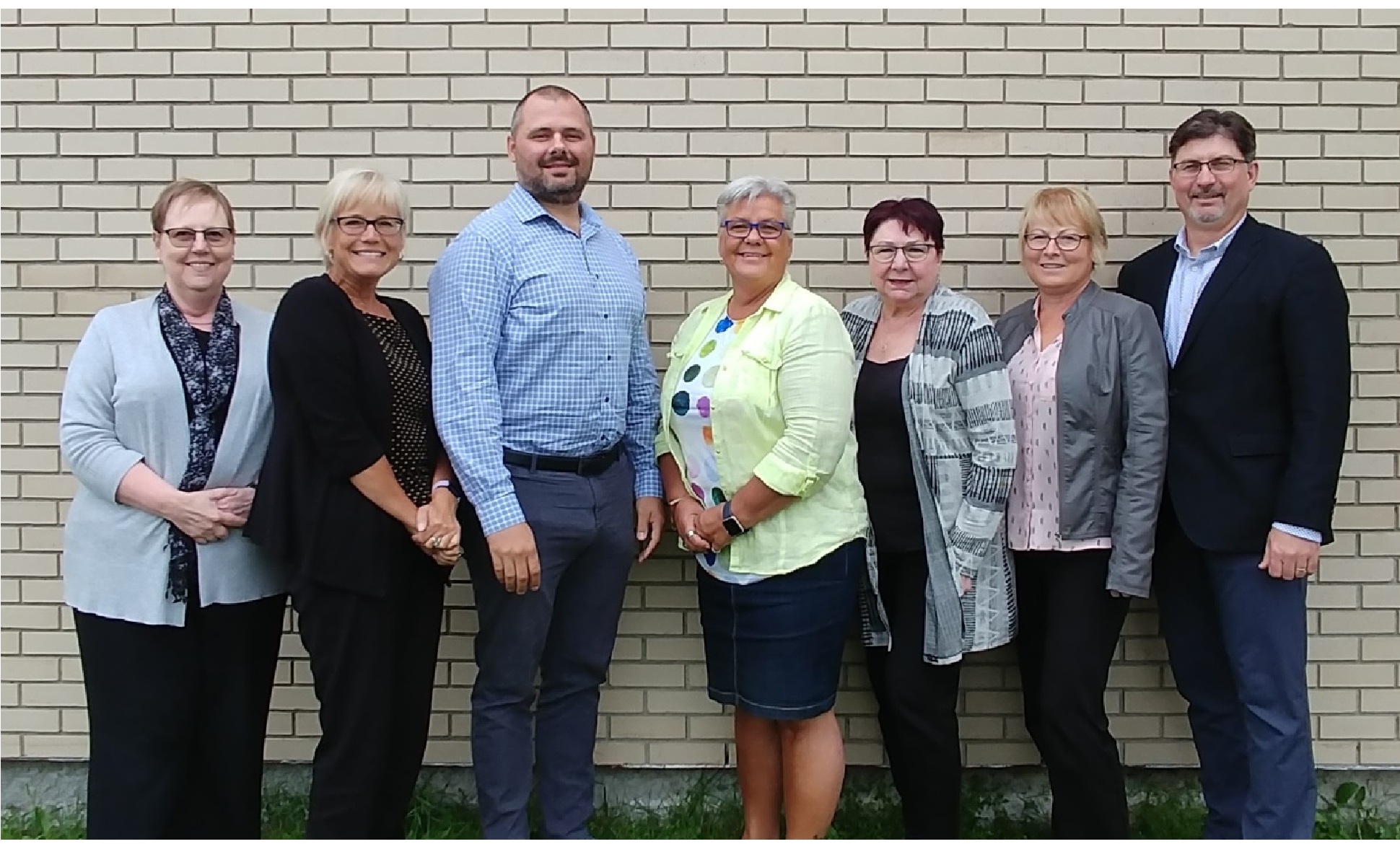
The group portrait from the Northern Health Region makes the point without ceremony. Seven executives stand shoulder to shoulder against a brick wall. The caption identifies medical services, clinical services, administration, finance, nursing and area leadership. No single function is the system. The photograph records a team because regional work has to be plural: expertise divided into roles, then joined again around shared decisions. Mabin's place at the edge of the frame is visually modest, but her medical portfolio sat inside that collective structure.
03 / The unexpected parallel
A music festival explains the executive
The most personal piece of Mabin's public record has nothing to do with radiology or formal governance. From 2009 to 2012, she served as president and chair of The Pas Music and Fine Arts Festival, an event founded in 1935. During her three-year term, the festival became financially secure. Support from local businesses, organizations and individuals helped provide awards and scholarships to young performers.
It is tempting to file volunteer service in a separate drawer from a medical career. Here, the resemblance is more interesting than the difference. A regional authority and a local festival both rely on networks that cannot be commanded into existence. Someone has to invite participation, protect the finances, translate goodwill into a durable program and make sure the platform survives its current leadership.
“It was a very rewarding experience, allowing me to give to my community and grow personally.”Deborah Mabin, on chairing The Pas Music and Fine Arts Festival
That sentence carries a rare first-person note in an otherwise institutional biography. The order matters: community first, personal growth second. The festival's outcome was not a plaque for its chair. It was solvency and scholarships, two conditions that let other people take the stage.
Read the whole field
A specialist notices the detail. An executive keeps the detail connected to the system around it.
Make support durable
Goodwill becomes useful when it is converted into finances, standards, scholarships or repeatable practice.
Leave a platform behind
The strongest evidence of stewardship is an institution that keeps serving people after the meeting ends.
04 / The work continues
Teaching the next set of eyes
Mabin's lecturer listing in the University of Manitoba's radiology department adds another circle to the career. Teaching a visual specialty is partly the transmission of knowledge and partly the training of attention. Learners have to discover which details deserve weight, how to compare competing explanations and when confidence has outrun evidence.
Those habits translate cleanly to leadership. A regional executive also works with incomplete views. A dashboard can be accurate without being complete. A policy can look consistent on paper while landing differently in The Pas, Thompson, Winnipeg or Selkirk. Judgment lives in the gap between the information available and the responsibility that cannot be postponed.
Her 2026 listing for the Canadian Conference on Physician Leadership suggests continued participation in that professional community. It fits the longer pattern: practitioner, executive, regulator, teacher, conference participant. Each role puts her in contact with peers who have to turn medical expertise into collective action.
There is no single dramatic pivot in this story. Its shape is cumulative. A doctor builds specialty experience. A resident of The Pas takes responsibility for a local cultural institution. A medical leader represents a northern region at a provincial table. A councillor helps maintain professional standards. A lecturer helps another physician learn where to look.
Seen together, those choices reveal a kind of ambition that does not need spectacle. The unit of progress is the strengthened institution: a festival with sound finances, a learner with sharper judgment, a region present in a provincial plan, a professional body doing its careful work. The career advances by enlarging the circle of responsibility while staying close to the practical question underneath it.
What makes Mabin's path worth studying is not that it offers a formula. It offers a posture. Look carefully. Respect the map. Notice who is outside the room. Build the connection that lets them enter. Then leave the structure strong enough for somebody else to use.