A map of Manitoba's Interlake-Eastern health region looks less like a service area than a dare. It begins at Winnipeg's northern edge, pushes east to Ontario, reaches north to the 53rd parallel and spreads across roughly 61,000 square kilometres. Some communities are reached by air, water or winter road. The year-round population is about 137,000, then cottage season arrives and the denominator gets lively.
Interlake-Eastern Regional Health Authority, or IERHA, is the public operator asked to make health care function across that map. It is classified as a company here, but forget the usual startup furniture. There are no founders pitching a seed round and no subscription tier. The authority was formed in 2012 by merging the former Interlake and North Eastman health regions. Manitoba funds most of the work. Residents use hospitals, clinics, long-term care, home care, public health, emergency response, mental-health and addictions programs - usually without paying at the door for insured services.
The closest thing to product strategy is access: who can see which professional, in what place, at what time, with how much trust. That makes IERHA interesting beyond Manitoba. Its recent work is a field guide for any organization whose users are dispersed, its skilled labor is scarce and its central office cannot wish geography away.
01 / The actual product
A network, not a hospital
IERHA operates more than 200 acute-care beds and 747 long-term-care beds, alongside primary-care clinics, community-health offices and an array of home, emergency and mental-health services. Its users are newborns in Selkirk, elders in personal-care homes, children from First Nation and rural communities traveling to pediatric appointments, people seeking addictions medicine and families trying to coordinate care without spending half a day on the highway.
That breadth is the differentiator. A private clinic can sell speed for one procedure. An urban tertiary hospital can concentrate rare expertise. IERHA has to connect the ordinary and the urgent across an entire geography: the nurse-practitioner shift that keeps a clinic open, the ambulance station, the home-care visit, the surgical slate and the bed where a medically stable patient waits for housing.
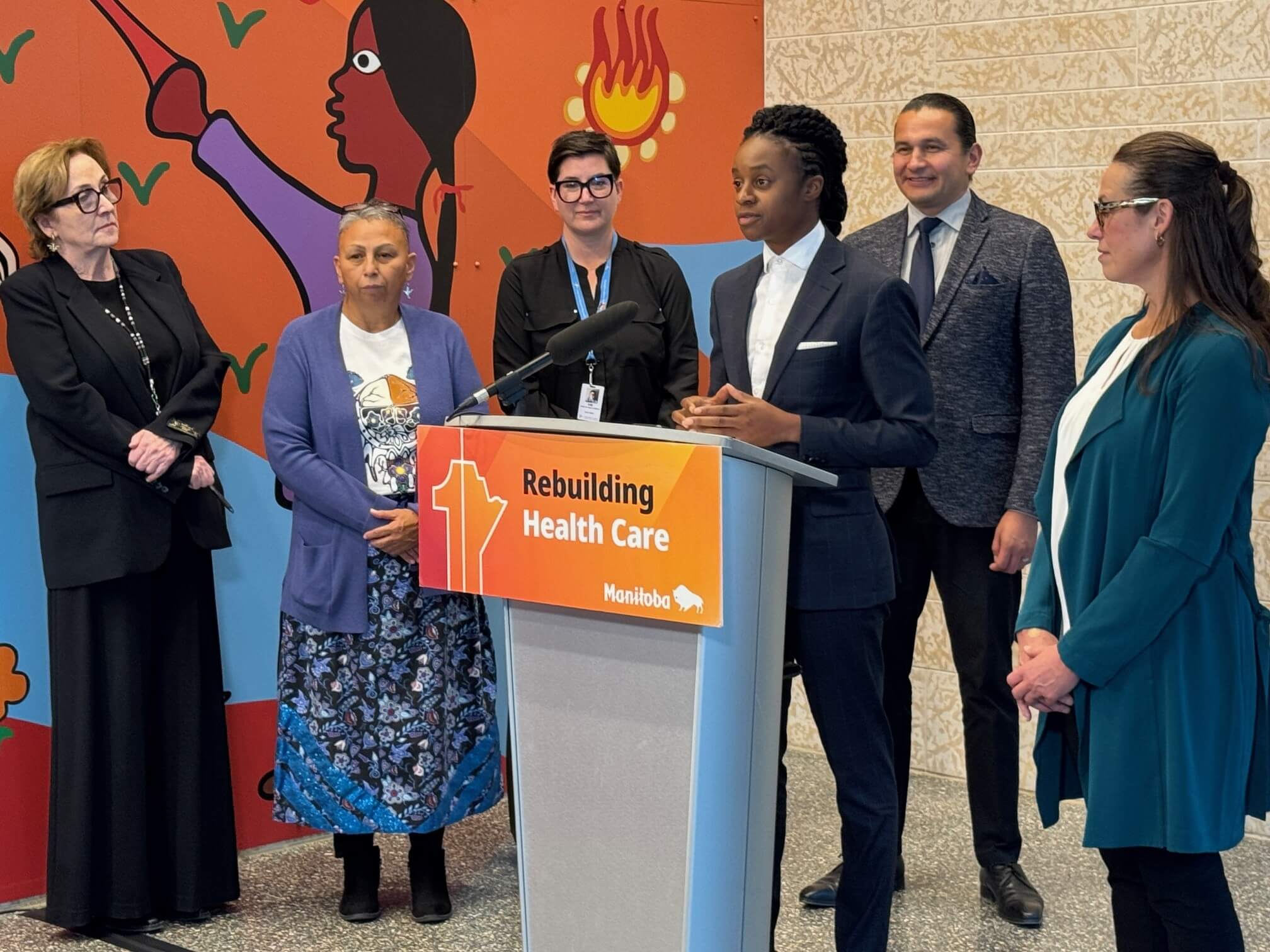
That line explains the customer problem better than a mission statement. A specialist appointment in a city is not truly available if reaching it means a long drive, missed work, fuel, child care and winter weather. Beginning in October 2024, a pediatrician held biweekly outreach clinics in Eriksdale and Pine Falls. Through March 2025, the program logged 21 clinic days and 172 appointments. In 2026, IERHA announced three pediatricians serving a wider set of communities. The product was not new medicine. It was medicine with fewer kilometres attached.
02 / What failed first
The staffing model hit the wall
Rural care usually fails in a sequence. A vacancy appears. The remaining staff absorb the load. Service becomes brittle. Patients travel farther. Recruitment gets harder because the job looks harder. In Pine Falls, the reported registered-nurse vacancy rate began at 100 percent in the 2023-24 baseline. That number is not a metaphor. It is the sort of operating constraint that makes every other strategy decorative.
Persistent vacancies changed the premise. Instead of treating recruitment as an HR advertisement aimed at a national pool, IERHA began treating it as a local supply chain. It expanded in-person health-care aide training, joined a provincial pilot to onboard internationally educated nurses, helped launch a rotating practical-nursing site with Assiniboine College and convened a Health Workforce Coalition. That coalition includes municipalities, school divisions, colleges, employment offices and economic-development groups - because a rural health job also depends on housing, family roots, training access and whether a partner can find work.
Workforce repair / reported 2024-25 outcomes
The first results were modest and concrete. Seventy-nine people completed local health-care aide training. Three internationally educated registered nurses completed a supported rural onboarding program and were working independently in Pine Falls. A seven-person casual nurse-practitioner float pool covered 177 shifts. Pine Falls' RN vacancy rate fell from 100 percent to 71 percent. That is meaningful movement, but 71 percent is still an emergency wearing a smaller hat.
The onboarding detail matters. The pilot did not simply recognize a licence and hand over a badge. It used classroom work, clinical experience and local nursing mentors to cover equipment, policy, communication and the Canadian health-care context. Other rural systems can copy the shape of that intervention. They should not copy the fantasy that hiring three people closes a structural shortage.
03 / What it cost
The ledger is public, the trade-offs are visible
IERHA reported C$337.7 million in total revenue and C$340.7 million in total expenses for fiscal 2024-25, ending with a C$2.48 million annual deficit. The authority does not publish a clean standalone price tag for its entire local-workforce strategy, so the honest cost is the operating portfolio around it. Acute care consumed 39 percent of program expenses before amortization, interest and accretion. Long-term care took 23 percent, home-based care 14 percent and community health 9 percent.
Where the care dollar went / share of program expenses
That mix explains why one clever pilot cannot transform the whole system. Buildings, beds and salaries dominate. Yet small operational changes can release capacity. A 15-bed transitional-care unit opened in July 2024 for medically stable patients waiting for home care, renovations, supportive housing or long-term care. It recorded 113 admissions and 98 discharges in the initial reporting period. In plain English: do not use an acute-care bed as an expensive waiting room for a housing decision.
The authority also doubled surgical slates at Selkirk and Beausejour, expanded endoscopy and reported 648 cystoscopy cases against a target of 612. The pattern is deliberately unromantic: move a bottleneck, inspect the count, then move the next one.
04 / Distance and trust
A digital door still needs a real room behind it
IERHA's virtual “Digital Front Door” lets people walk into Rapid Access to Addictions Medicine from a phone, tablet or computer. It recorded 56 visits in its reported period. The useful idea is narrow: make first contact easier. It does not claim that broadband replaces a clinician, medication, transport or a safe place to recover.
The same realism appears in mental-health crisis services. IERHA shifted adult and youth mobile-crisis hours toward peak referral times, expanded youth coverage to 12 hours daily and moved mental-health liaison nursing at Selkirk Regional Health Centre to 24/7. That liaison team reported no vacancies across 4.2 full-time-equivalent positions and an average assessment wait just under four hours.
Access also depends on whether patients trust the institution. Twenty-seven percent of the region's residents self-identify as Indigenous in IERHA's demographic snapshot, and the authority operates on Treaty Territories 1, 2, 3 and 5 and the homeland of the Red River Métis Nation. Its Indigenous Health team added an Elder/Knowledge Keeper and a Skaabe - an Ojibwe word for helper - at Selkirk. Their work includes cultural guidance, listening, mentorship and support for patients and families. The broader plan covers patient advocacy, smudging, traditional healing, Indigenous hiring and an anti-racism complaint process.
The distinction from a conventional hospital model is important. Cultural safety is not a poster in the lobby. It changes who can guide a patient, what practices have room inside care and how a complaint is handled. The authority has promised annual reporting on reconciliation. The test will be whether accountability keeps pace with intention.
The part worth stealing
- Publish the ugly baseline. “100% vacancy” creates more focus than “recruitment challenges.”
- Train beside the shortage. Local cohorts reduce relocation friction and reveal nearby talent.
- Recruit as a coalition. Schools, housing, municipalities and employers all shape retention.
- Move scarce expertise outward. A recurring outreach day can beat asking every family to travel.
- Digitize the first mile. Use virtual access to start care, not pretend to complete all of it.
- Measure operations in human units: shifts covered, appointments completed, beds released.
05 / Where the model breaks
Good conditions matter
The approach works when local training leads to recognized credentials and actual jobs; experienced staff have time to mentor; mobile teams can travel safely; communities help design services; and provincial funding survives beyond a pilot announcement. It is strongest when the service can be distributed without compromising quality - primary care, follow-up, selected specialist clinics, navigation and first contact are natural candidates.
More likely to work
Stable public funding, clinical mentors, nearby training, community partners, reliable connectivity and transparent outcome measures.
Less likely to work
No housing, no supervision capacity, one-off grants, unsafe travel, specialist procedures that require concentrated teams or virtual tools without downstream care.
It is weakest when the missing ingredient is not access but scale. Complex surgery, intensive care and rare specialties often need concentrated volumes. A remote video visit also fails if a patient lacks privacy, connectivity, transport for the next step or a clinician to receive the handoff. “Closer to home” is a design principle, not a promise that every service belongs everywhere.
IERHA occupies an awkward market position: a geographic monopoly that still competes fiercely for nurses, physicians, attention and public confidence. Its peers are Manitoba's other regional authorities. Its alternatives are Winnipeg hospitals, independent clinics, private home-care providers and, too often, delay. It cannot win through brand preference. It wins when the system feels present before a crisis and coordinated after one.
The next chapter is already less hypothetical. A new strategic plan runs through 2031. Midwifery launched with two full-time practitioners. Three pediatricians now circulate through communities. Ashern's expanded emergency department grew from five treatment spaces to 13. A new Selkirk laboratory opened with Dynacare. These are pieces, not a crescendo.
That may be the most useful observation. Rural health reform rarely arrives as one dazzling invention. It looks like 79 graduates, 177 covered shifts, 172 pediatric appointments, 15 transitional beds and three nurses who can finally work independently in Pine Falls. The map stays enormous. The trip to care gets a little shorter.