David Robertson’s career contains a smoothie-shaped detour. In 1996, the former investment banker founded Robeks in Los Angeles. The business sold juices and smoothies, a decidedly tangible product for someone whose other work would involve acquisitions, joint ventures, and debt financing. A customer could understand the proposition without opening a spreadsheet. They could simply order it.
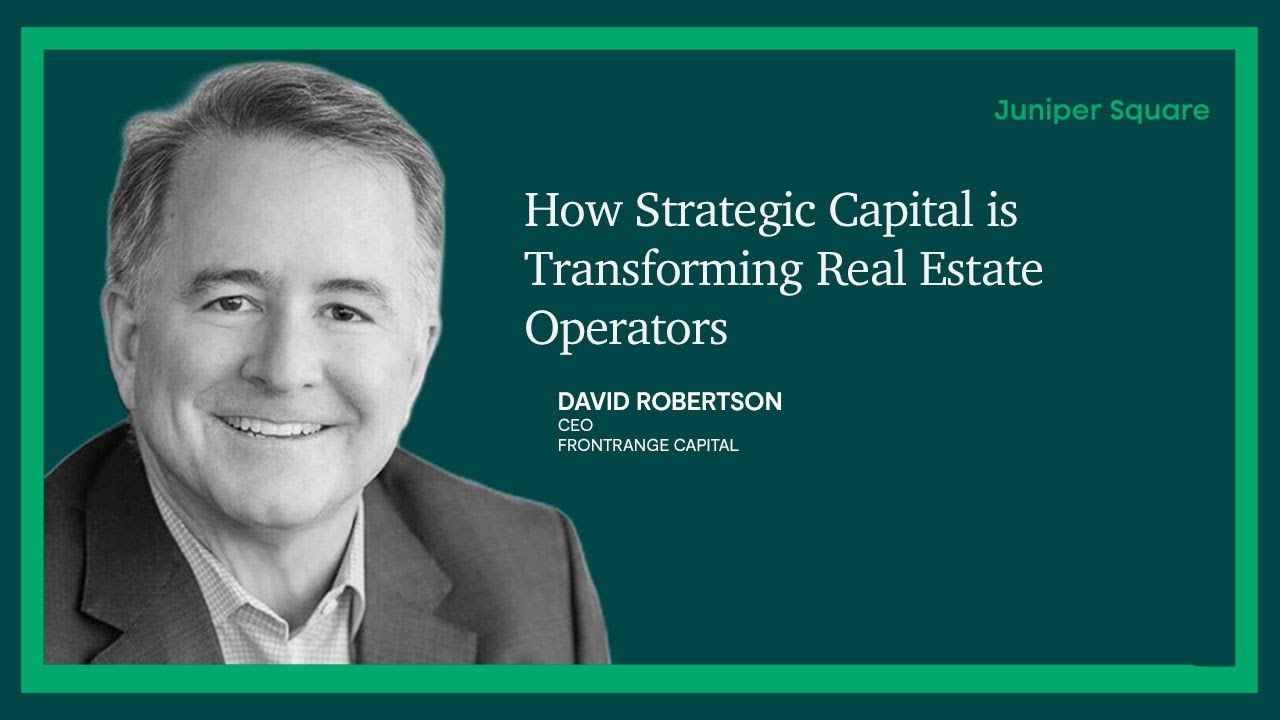
Three decades later, Robertson is the CEO and chief investment officer of FrontRange Capital Partners in Denver. His firm backs real estate companies and their properties. Between the two businesses sits a career at Apartment Investment and Management Company, better known as Aimco, where he served as co-president, chief investment officer, and chief financial officer. The sequence makes him an interesting guide to an easily overlooked subject: the business behind a building.
A finished apartment community presents itself as a physical fact. Windows, kitchens, parking spaces. Its existence also depends on a company capable of finding the site, arranging financing, managing construction, and running the result. That company has its own financial needs. Robertson’s work at FrontRange addresses that layer of real estate, where the ambitions of an operating team meet the limits of its balance sheet.
The Robeks connection adds a human scale to the story. Robertson has been involved in the enterprise at the counter as well as the enterprise in the capital markets. It would be too tidy to turn a smoothie shop into a theory of investing. Still, it makes the distance between financier and operator rather shorter than his current title suggests.
Burbank, business school, and a different kind of script
His early life took place around Burbank’s entertainment industry. In a November 2025 conversation with Brandon Sedloff on The Distribution, Robertson traced that childhood through Harvard Business School and into investment banking and real estate. It is an unexpected opening chapter for a career now expressed in the compact vocabulary of GP stakes and programmatic ventures.
His formal education followed an economics-and-business route. He earned a bachelor’s degree in economics from the University of California, San Diego in 1989, then an MBA from Harvard Business School in 1991. From 1991 to 1996, he worked in the investment-banking group at Smith Barney. Those years placed him on the financing side of business before his later responsibilities extended into running it.
Robeks began in 1996, and Robertson’s involvement endured. Aimco’s historical filings identify him as its chairman from February of that year. Robeks still identifies its founder as chairman today. For all the movement between institutions and investment structures, this is a conspicuous thread of continuity: a business he started has remained part of his working life.
The juxtaposition is pleasingly awkward. A retail brand must make sense to someone standing in line; an investment structure must make sense to someone committing capital. Both eventually confront the ordinary details of execution. The profile of a finance executive becomes more interesting when there is a counter somewhere in the background.
Smith Barney
founded
co-president
co-founded
The balance sheet gets a deadline
At Aimco, Robertson’s responsibilities grew beyond transaction work. He became executive vice president in February 2002 and president and CEO of Aimco Capital in October 2002. The apartment company’s 2003 annual report also placed redevelopment and construction services within his responsibilities. Older properties in good locations were being upgraded, with more than $70 million of redevelopment completed that year.
That work connects financial decisions to physical consequences. Redevelopment requires a judgment about a property’s future, followed by construction and operations that make the judgment real. It is a useful part of Robertson’s background for understanding why FrontRange pairs capital with operating support. A business plan eventually has to leave the conference room.
In February 2009, Aimco announced that Robertson and Tim Beaudin would become co-presidents. Robertson continued as chief investment officer and became chief financial officer effective March 1. Aimco was consolidating its senior management as it reduced the scale and scope of its activities. This was a promotion in a period when the practical business of financing demanded close attention.
By the second quarter, his public remarks concentrated on reducing refinancing exposure. Aimco had extended its revolving credit line to 2012 and reported selling $291 million of assets during the quarter. Further sales were under contract or in negotiations, with proceeds intended to repay term debt before its 2011 maturity. The subject was time: what came due, when it came due, and how the company would meet it.
Robertson described the quarter as a period of significant progress in reducing refunding risk. There is little glamour in that sentence, which is part of its appeal. A maturity date does not care how attractive the architecture is. His experience included managing the timetable that sits underneath the property portfolio.
Late in 2009, his departure from Aimco was announced, effective December 31. The stated aim was to seek an opportunity as a CEO elsewhere. FrontRange followed in 2010. The change took him from senior leadership inside a public apartment company to a private firm built around partnerships with other operating businesses.
“We made significant progress in reducing our refunding risk during the quarter.”
David Robertson · Aimco · Q2 2009
Financing the people who do the building
FrontRange’s specialty gives Robertson’s career its present shape. The firm supplies capital at the operating-platform, fund, and property levels. In plain English, it can support the company itself, help anchor a fund, or invest alongside an operator in property ventures. Each arrangement addresses a different place where an expanding business needs money.
The distinction matters because a property and its operator have different balance sheets. Financing a single development does not automatically give the operating company the liquidity to pursue the next one. A team can have a pipeline of opportunities while facing limits on the capital it can contribute. FrontRange’s platform investments are designed to build balance sheets, improve liquidity, and fund those contributions.
Robertson’s November 2025 interview with Sedloff explored how those requirements change as operators grow. It covered co-GP partnerships, GP stakes investing, and the importance of alignment and integrity in a long relationship. The vocabulary can sound like an alphabet holding a private meeting. The underlying question is accessible: how should an investor and an operator share the resources, responsibilities, and economics of expansion?
His role also places him in the governance of operating companies. Monday Properties lists Robertson on its advisory board. That connects the investor to an ongoing business, with decisions extending beyond one acquisition. In that setting, the usefulness of a capital partner can include the judgment and experience brought to later choices.
A pipeline is a collection of promises
Individual commitments make the model easier to see. In February 2023, FrontRange committed up to $25 million to a GP fund sponsored by Golub & Company. The mandate included ground-up development, value-add acquisitions, and distressed opportunities. Its target markets included Chicago, Denver, Atlanta, Nashville, and South Florida. The commitment backed a program of activity across an established operating platform.
In November that year, FrontRange made a $20 million co-GP commitment to a venture with Fountain Residential Partners. Fountain specialized in purpose-built student housing and planned to use the proceeds for its development pipeline. This was capital intended to help an operator pursue multiple projects in a field it already knew.
A different application appeared in April 2024. FrontRange and Concord Capital Partners formed a $20 million programmatic joint venture, with FrontRange committing $15 million. The focus was acquiring and repositioning workforce housing in markets including Dallas-Fort Worth, Denver, Phoenix, and Las Vegas. The targeted properties were existing Class B and C apartment communities, built from the 1970s through the 2000s.
The Concord venture anticipated capacity to acquire $500 million of communities once limited-partner capital and mortgage debt were included. Those figures describe different layers of financing. They do not say that a $15 million contribution had already produced $500 million of acquisitions. Reading the distinction carefully helps explain the work: a relatively small pool of sponsor-side capital can sit within a much larger property investment program.
Robertson also added experience inside FrontRange. Greg Moran joined in April 2023 after serving as chief investment officer of Ares Real Estate Income Trust. Scott Egarian arrived in May 2024 from Partners Group. In welcoming both, Robertson emphasized transaction experience, investment sourcing, and the additional perspectives they would bring. The hires put people alongside the financial commitments.
The partnership has another chapter
In June 2025, FrontRange announced a $150 million venture with O’Connor Capital Partners to develop triple net leased retail properties along the East Coast. O’Connor would handle site acquisition, development, and leasing. FrontRange would asset manage the investment vehicle. A FrontRange-managed fund with a single university-endowment limited partner committed the equity capital.
The plan called for 12 to 15 properties leased to nationally recognized retailers. Robertson’s comment focused on helping O’Connor expand its program: “We are proud to support O’Connor as they scale essential retail to meet accelerating demand.” The announced division of work is revealing. Each partner had a defined responsibility, and the venture brought those responsibilities together.
Then, in April 2026, FrontRange and Browning Real Estate Partners announced a co-GP partnership pursuing industrial and multifamily projects across Indiana, Ohio, and Kentucky. The intended mix was approximately 75 percent industrial and 25 percent multifamily. Two ground-up industrial projects in metropolitan Indianapolis were already committed. Browning brought development, construction, and asset-management capabilities to the arrangement.
Across these examples, Robertson’s work has moved through student housing, workforce apartments, retail, and industrial property. The common element is an operating partner with a program to execute. A building is the visible result; the continuing business makes another result possible. That is the part of the story his career keeps returning to.
There is a modest pleasure in remembering the smoothie counter at the end of all this. It brings an imposing title back to something recognizably human: someone starts a business, learns what it takes to keep one going, and spends years working on how businesses can grow. Robertson’s present work happens at a different scale. The operating company still occupies the center of the picture.
Follow the conversation
- FrontRange Capital Partners ↗
- David Robertson on LinkedIn ↗
- The Distribution: full interview ↗
- Watch on YouTube ↗
- Robeks: founder and leadership ↗
- Monday Properties advisory board ↗
- Aimco’s 2009 leadership announcement ↗
- Aimco’s Q2 2009 update ↗
- FrontRange and Golub ↗
- FrontRange and Fountain ↗
- FrontRange and Concord ↗
- The O’Connor retail venture ↗
- The Browning partnership ↗