David V. Mastran had already spent decades running a company when he encountered a rather different management problem. He could write songs. He could assemble a team. He could pay close attention to the details. But a musical required something his previous job description had never mentioned: knowing when a character ought to sing.
“I quickly learned I didn't know anything about writing a musical,” he said. There is an appealing lack of ceremony in that admission. A founder with a doctorate and a New York Stock Exchange company behind him had arrived at the arts and discovered the usefulness of being a beginner.
By January 2026, his project, One Step at a Time, was being previewed in Franklin, Tennessee. He described four years of work and help from consultants. Songs from QuaverEd’s school curriculum had been edited for the stage, alongside new material. A long professional life had acquired another round of homework.
Three degrees before the first company
The earlier chapters offer little warning of a musical. Mastran graduated from the United States Military Academy at West Point in 1965. A master’s in industrial engineering from Stanford followed in 1966. In 1973, he completed a doctorate in operations research at George Washington University. The sequence has the tidy progression of someone adding more precise instruments to the same toolbox.
Operations research concerns decisions inside complicated systems. That background matters here because Mastran’s career repeatedly returns to the distance between an institution’s intentions and what actually happens inside it. Governments have programs. Schools have lessons. Both depend on people doing something with the instructions.
His Air Force service lasted from 1965 to 1972. In Vietnam, he spent a year assessing the bombing campaign, serving in operations analysis with the Seventh Air Force. He later worked in the Air Force Operations Analysis Office at the Pentagon. The work involved evaluating what a large organization was accomplishing, rather than simply accepting what it hoped to accomplish.
In a 2014 oral history interview with fellow West Point graduate Fred Laughlin, Mastran looked back across those military, government and business experiences. The recurring occupation was analysis; the employers and settings changed. Before he became a founder, he had already seen institutions from several sides of the desk.
- 1965West Point
and the Air Force - 1975Maximus
begins - 2006Mastran
Music Group - 2026A musical
takes the stage
Government services, music education, theater. The work changes; the appetite for another assignment persists.
A business built around public work
In 1973, Mastran carried his systems analysis skills into federal civilian work. Two years later, he founded Maximus. The company provided consulting, program management and information technology services to government. Its customers were public agencies, a market in which a practical improvement also had to survive contracts, administrative rules and political scrutiny.
He remained chief executive until September 30, 2004. His presidency had ended in September 2003. The distinction matters: titles move at different speeds during a succession, and a founder’s departure is often a sequence of handovers rather than a single exit.
Under Mastran, Maximus appeared in BusinessWeek’s selection of 100 hot growth small companies for four consecutive years, from 1999 through 2002. In 2013, George Washington University inducted him into its engineering Hall of Fame. The recognition placed his business career back beside the technical training from which it had grown.
At his retirement, he offered a more personal measure of the enterprise: “I am pleased to have created an organization that will go on without me.” It is an unusually practical farewell. The organization’s ability to continue was part of the achievement. Lynn Davenport succeeded him, and Mastran was to assist with transition matters and special projects as a consultant.
“I am pleased to have created an organization that will go on without me.”
DAVID V. MASTRAN · ON LEAVING MAXIMUS, 2004
The privateer puts it in writing
Mastran gave his account of that career a deliberately provocative title: Privateer! Building a Business, Reforming Government. Published in November 2012, the 382-page book describes the construction of Maximus and argues for private companies taking on government programs. A pirate-adjacent noun is certainly livelier than “a few thoughts on procurement.”
Its subjects include growth, taking a company public, the responsibilities of division presidents and the complications of dealing with politicians, lobbyists and unions. The book presents a founder’s case for his business model, with the difficulties included in the telling. That perspective is useful to understanding Mastran’s ambitions; it remains his perspective.
Public work carries a particular tension. A company answers to its customers and owners; government programs also answer to citizens. Mastran’s career occupies the place where those obligations meet. His memoir’s subtitle makes clear that he saw the business as an instrument for changing how government worked.
Writing also gave him a way to revisit his military past. His 2016 book, Vietnam 1968: Turning Point, returned to his year in Southeast Asia. Former classmates discussed it alongside his business memoir and music venture. In their telling, the analytical officer, executive and author remained recognizably the same Dave.
A clue hidden in an old patent
The musical turn has an intriguing technical prehistory. In 1987, a United States patent named David V. Mastran as the inventor of a process for synchronizing computer video with independent audio. The application had been filed in 1984, and Maximus was the assignee.
The patent describes a low-cost personal computer displaying images that give the effect of animation in time with an audio program coming from outside the computer. Voice and environmental sounds were among its examples. This was a problem of timing: getting one medium to respond properly to another.
A patent is a narrow piece of evidence. It does, however, put sound and pictures in Mastran’s working life well before Quaver. The later interest in musical technology becomes less surprising when an earlier document already has him concerned with how a computer should accompany a recording.
His academic work offers another glimpse of that technical foundation. A 1976 paper in Operations Research examined how Bayesian methods could bring component tests and whole-system tests into the same reliability assessment. In 1978, he coauthored a paper with Nozer D. Singpurwalla on estimating the reliability of coherent structures. The titles are unlikely to be mistaken for show tunes. Their underlying concern, how separate parts contribute to a working whole, fits comfortably into a life spent assembling organizations.
A meeting at sea, a classroom on screen
Mastran and British pianist and educator Graham Hepburn met on a cruise ship in 2002. Their friendship led to musical collaborations. Mastran established Mastran Music Group in Nashville in 2006; Hepburn brought his experience teaching and performing. Their eventual audience would be considerably younger than the passengers.
In 2011, they launched videos featuring Hepburn as Quaver, a music shop proprietor introducing children to musical fundamentals. A standards-aligned music curriculum followed in 2013. The partnership gave the enterprise two useful kinds of experience: building a company and holding a classroom’s attention.
By the company’s current count, QuaverEd serves more than 10 million students in over 28,000 schools across 44 countries. Those are company-reported figures. Its Nashville operation occupies six buildings on Music Row and employs more than 200 full-time staff. Mastran remains president and co-founder.
The workplace photograph here catches him between West Point classmates John Pickler and Fred Laughlin during a 2015 visit. Three checked shirts, three smiles and a cartoon music sign make an agreeable ensemble. The military friendships had survived a considerable change of scenery.
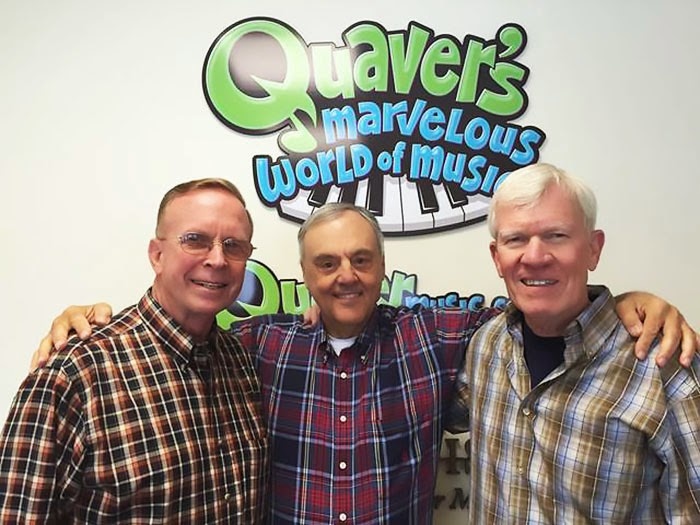
The 2026 production of One Step at a Time was advertised with 25 actors and a live orchestra. Quite a few moving parts for a former systems analyst.
Songs have their own method of travel
After retiring from Maximus, Mastran discovered he could play piano by ear. He went on to write hundreds of songs. The discovery gives his second career a pleasingly untidy origin. His degrees were complete; an ability he would use extensively was still waiting to announce itself.
One example of his songwriting reached country singer Marty Raybon. Mastran co-wrote “Daddy Phone,” inspired by a family member who used a mobile phone to keep in touch with a son living in another country. A small phrase from an ordinary arrangement became the center of a song about distance between parent and child.
For a songwriter, the telephone is a useful detail. It makes a large feeling concrete. The listener can picture the object without needing an explanation of the entire family history. That is a different kind of compression from an analyst’s model, but it also asks which details carry the most information.
At QuaverEd, music has a practical job in the classroom. Mastran has described children carrying messages away in songs, singing as they walk down the hall. His interest extends to the cooperation involved in making music: belonging to a group, performing in front of others and learning to rely on oneself. The lesson can keep moving after the lesson period ends.
The next draft gets a stage
The idea for One Step at a Time began in autumn 2021 as a way to demonstrate QuaverReady’s approach to school culture. Mastran read books about musicals, chose songs and wrote a plot. Feedback led to revisions. A March 2023 table read produced more than 40 suggestions. There is a particular economy to a table read: trouble that might later require scenery can first be discovered with chairs.
A New York workshop followed in November 2024. The project drew on theater professionals as well as Quaver colleagues; Brian Hull became director and Holly Shepherd producer. January 2026 previews in Franklin brought roughly 500 attendees and another opportunity to gather responses.
The production was subsequently scheduled for Nashville’s TPAC Polk Theater on June 30 and July 1, 2026. Its advertised form included 25 actors, 20 original songs and a live orchestra. The plot follows a family whose arrival helps change a struggling school. Mastran’s classroom material had become a story with people to cast and an evening to fill.
There is an appealing symmetry between the founder leaving a company able to continue without him and the songwriter handing characters to actors. Other people have to make the thing work. A score needs performers, just as an organization needs colleagues. Mastran’s second act has given that old dependency a new sound.
Follow the next note
Explore the work, the books and the conversations.
QuaverEd: the company and its founders ↗David Mastran on LinkedIn ↗Watch: his West Point oral history interview ↗One Step at a Time: music and trailer ↗Read about Privateer! ↗Inside the development of the musical ↗George Washington University: engineering honors ↗