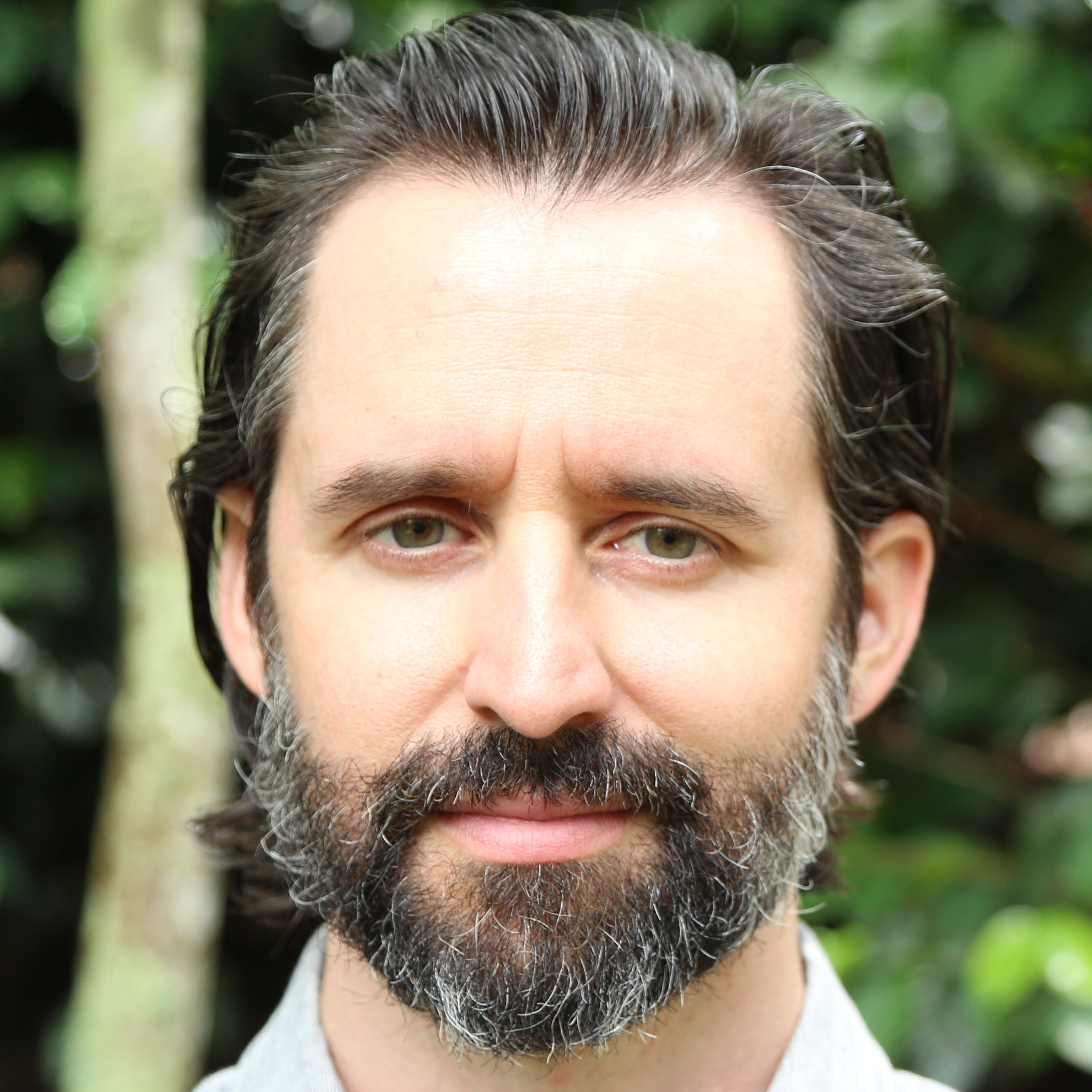
The Man Who Managed His Mind to Colombia
On May 31, 2004, David Kadavy wrote his first blog post from a cubicle in Nebraska. That post didn't go viral. It didn't change everything. But it started a chain reaction that eventually landed him in a cabin in the mountains outside Medellin, Colombia - with a 1953 Smith Corona typewriter, a mountain view, and 100,000 books sold in 13 languages.
The name is KAD-uh-VEE. The career is harder to pronounce. Graphic designer who became a UI/UX consultant. Consultant who mentored startups at 500 Startups. Startup advisor whose portfolio company Google acquired. Author who reverse-engineered Renaissance typography for software developers. Podcaster who quit publicly after 308 episodes. Independent publisher who posts his exact income every month, including the down years.
What connects all of it: a conviction that most people are trying to solve the wrong problem. Time management, Kadavy argues, is a distraction. You can't Pomodoro your way to a breakthrough. What actually matters is which mental state you're in when you do the work - and whether you've protected the conditions that produce that state.
His book Mind Management, Not Time Management is the thesis statement for this career. It maps seven mental states of creative work and argues that when to do something matters more than scheduling it efficiently. Kirkus called it "an exhilarating but highly structured approach to the creative use of time." It has earned $178,000 in revenue on its own. Not bad for a book about slowing down.
The Hacker News gambit: Before Wiley called, Kadavy had no book deal and no agent. He wrote two blog posts specifically engineered to hit the Hacker News front page - "Why You Don't Use Garamond on the Web" and "Why Monet Never Used Black." Both landed. Editor Chris Webb at Wiley reached out unsolicited. Design for Hackers debuted at #18 on Amazon.
The design book arrived in 2011, at the precise moment when every developer was trying to build a product and nobody had hired a designer. Kadavy's pitch was elegant: you don't need art school, you need first principles. Color theory, proportion, typography, composition - explained not as aesthetic taste but as systems. The book sold 100,000 copies and has been translated into 13 languages. The companion site, designforhackers.com, still runs.
But the most interesting story from that era isn't the book. It's what happened between books.
The Week of Want That Paid Off
In 2013, Kadavy ran an experiment on himself. He abandoned his to-do list entirely for a week and followed pure curiosity. During that week, he wrote a blog post about mind management. That post caught the attention of Timeful, a calendar app co-founded by behavioral scientist Dan Ariely. Kadavy became an advisor.
In May 2015, Google acquired Timeful. The feature Timeful had built - intelligent scheduling of goals into your calendar - became Google Calendar's Goals feature, now used by hundreds of millions of people. Kadavy's advisory shares gained value. He'd turned a week of deliberate aimlessness into a piece of a Google acquisition.
He also learned something that shaped his next decade of work: the productivity tools Silicon Valley was building were still organized around time. Not attention. Not cognitive state. Not the difference between a morning when you're sharp and a Thursday afternoon when you're functionally a golden retriever. The product was good. The paradigm was off.
"No matter how fast you move, a computer can move faster. Your edge as a human is in thinking the thoughts behind the doing."- Mind Management, Not Time Management
The Timeful chapter cemented what Kadavy already suspected: creative work doesn't respond to optimization the way factory work does. You can't schedule insight. You can't Gantt-chart your way to a great sentence. What you can do is understand your own cognitive rhythms well enough to protect them.
He moved to Colombia in 2015. The move wasn't escape - it was architecture. Lower cost of living, lower friction, fewer reasons to take meetings. The cabin outside Medellin wasn't chosen for the mountain views (though those exist). It was chosen because it makes the work easier to protect.
Fun Fact
Kadavy studied ancient typography in Rome as part of his BFA program at Iowa State. His TEDx talk at DePaulU was titled "The New Literacy of Design." He later spoke at the New York Public Library, the Museum of Contemporary Art Chicago, and streamed to 50,000 people from Mexico City.
A 1953 Typewriter and Barf Drafts
Ask Kadavy how he writes and he'll describe a process that sounds inefficient but isn't. First draft on a 1953 Smith Corona Super typewriter - a physical tool that can't connect to the internet, can't send notifications, and definitely can't open Twitter. He calls these "barf drafts": the goal is not to write good sentences. The goal is to write terrible sentences at speed and generate enough raw material to work with.
Then he rewrites from memory. Not from his notes. Not from the typed pages. From what he can recall - on the theory that if a thought survives memory, it was worth keeping.
This is not precious. It is not performative minimalism. It is a systematic attack on the blank page problem, which Kadavy frames as fundamentally a fear problem. "Perfectionism," he wrote in The Heart to Start, "is the strongest force preventing us from starting." The typewriter is a technology for outrunning perfectionism before it catches you.
He is, by his own description, a Perceiver type - "hopelessly curious" - which means his productivity problem isn't motivation. It's finishing. Which is why his next book is called Finish What Matters. A preview edition launched in late 2025. The irony is not lost on him.
The Transparent Ledger
ANNUAL GROSS REVENUE - KADAVY, INC. (PUBLIC INCOME REPORTS)
Source: kadavy.net/blog/archive/income-reports/ — published monthly since January 2018
The income reports are unusual. Most independent authors treat revenue as private. Kadavy publishes the numbers every month - gross, net, by title, by channel. The 2025 report shows revenue down 37% from 2024. He attributes this entirely to writing Finish What Matters instead of releasing new titles. The transparency is a demonstration of his own thesis: he's managing his attention toward the thing that matters, not the thing that pays best this quarter.
His Walt Disney operating principle: "We don't make movies to make money. We make money to make more movies." Swap "movies" for "books" and you have the business model.
The Podcast He Quit on Purpose
Love Your Work launched in 2016. For nearly eight years it was the intellectual engine of Kadavy's public presence - a place where he talked to David Allen, Seth Godin, James Altucher, Dan Ariely, and a hundred others about the mechanics of creative careers. By episode 308, it had become something else: a schedule. A commitment. A thing that had to happen regardless of whether he had something worth saying.
So he stopped. Episode 308 was titled "Why I Quit Podcasting." He published it on August 10, 2023, and that was it. The archive lives at kadavy.net. The lesson is the same one he teaches about writing: finishing something matters, but so does knowing when to stop performing and start making again.
The newsletter, Love Mondays, continued. 300 consecutive weekly issues by early 2024. 11,369 subscribers by year-end. It runs on the Substack as "Thinking is a Thing" - a title that telegraphs what the newsletter actually is: a twice-monthly reminder that cognition is the craft, not the content.
"We dream of building a fortress when we should be starting with a cottage."- David Kadavy, The Heart to Start
The barbell strategy runs through everything. Kadavy is not a risk-chaser or a hustle apostle. He's a systems thinker who structures his life to take small, asymmetric bets: write a blog post targeted at Hacker News, advise a small startup, publish a short book on Zettelkasten. Most bets return nothing. A few - the Wiley deal, the Timeful acquisition, Mind Management - compound.
Jeff Goins, a Wall Street Journal bestselling author, calls him "an underrated thinker." That might be the most accurate thing anyone has said about Kadavy. The work doesn't seek attention. It builds it slowly, methodically, through a system that looks almost boring from the outside and reads, from the inside, like a master class in patience.
"Perfectionism is the strongest force preventing us from starting."
The Heart to Start"Becoming your true self means finding your art and making it real."
The Heart to Start"Your edge as a human is in thinking the thoughts behind the doing."
Mind Management, Not Time Management"If you want guaranteed success, go to HVAC school. What you're trying to do has no guarantees."
Love Your Work PodcastHe spoke in eight countries. SXSW 2012, to 800 people, on the design of white space. TEDx at DePaulU. The New York Public Library. The Museum of Contemporary Art Chicago. His design work appeared in Communication Arts. His writing ran in Quartz, Inc., Huffington Post, McSweeney's. He was a guest on 80+ podcasts between 2013 and 2024.
None of this is mentioned on his homepage. His website design is deliberately minimal, almost aged - a philosophical statement about prioritizing content over aesthetics. The man who wrote the book on design chose not to showcase it.
The Books
Typography, color theory, composition, and proportion - explained as systems for developers who need to think like designers without going to art school.
#18 Amazon • 13 languagesThe three laws of creating: fighting the resistance to start, staying motivated through obstacles, and building the habits that sustain a creative practice.
4.16 on GoodreadsSeven mental states of creative work and how to match them to tasks. The book that made the philosophical case Kadavy had been building since Timeful.
$178K+ revenue • Kirkus reviewedA first-principles guide to adapting the 16th-century note-taking method to digital tools. Short, direct, and unusually practical.
1,665 Goodreads ratingsA suite of practical short-form books on writing habit, passive income for creators, and the craft of finishing what you start.
12+ titles totalPreview Edition launched late 2025. The next evolution of Kadavy's creative-system thinking - from someone who has built a career on not finishing things until they're ready.
In progressThe career reads like an argument conducted across a decade of books. First you learn to see design. Then you learn to start. Then you learn to manage the mind doing the work. Then you learn to take notes. Then - coming soon - you learn to finish. The bibliography is not a backlist. It's a curriculum.
What Makes Kadavy Different
He once offered $100 to a random retweeter to test whether Twitter engagement actually worked. His conclusion: it only works for content with universal appeal (free money) or extreme niches. Everything in between is noise. He published the results.
This is characteristic. Kadavy doesn't just have opinions about creative productivity - he runs experiments on himself and shares the data. The income reports. The Twitter test. The "Week of Want." The public announcement that the podcast was ending. He treats his own career as a laboratory and writes up the findings for anyone who wants to read them.
What he is not: a hustle evangelist. Not a "wake up at 4am" guy. Not a "morning routine" aspirant. His framework is explicitly anti-grind: if you're using willpower to do creative work, you're doing it wrong. You're working against your cognitive grain instead of with it. The goal is to understand your own mental states well enough that creative work becomes the path of least resistance, not the obstacle you have to overcome every day.
The cabin in Colombia is the proof of concept. Lower cost, higher clarity, fewer meetings. The typewriter is the proof of concept. No Wi-Fi, no distractions, no way to check your email between sentences. The transparent income reports are the proof of concept. No mythology, no inflated claims, just the numbers - including the down years when he was writing instead of selling.