David Helgason’s contribution to the early Unity enterprise included bringing home food. While the team worked on its game technology in a Copenhagen basement, he also held a job at a local café. Software might eventually pay the bills. Supper required a more immediate arrangement.
Nicholas Francis and Joachim Ante had begun collaborating on engine technology; Helgason joined as the third developer. The ambition was to make games. They kept improving the equipment required to make them. Anyone who has bought an elaborate notebook instead of writing a novel will recognise the temptation, though few stationery purchases have produced a listed company.
Their early notion of taking turns as chief executive did not survive contact with practicality. They even advertised for someone to run the business. Eventually the job fell to Helgason. There was no immaculate succession plan, merely people learning what their project needed. Early Unity customers, often hobbyists and small developers, helped shape it by sending feedback. The team earned attention by responding quickly.
A computer, three subjects and a useful detour
Born in Iceland, Helgason moved to Denmark at ten with his journalist mother and two brothers. Her computer became an object of fascination. He used it whenever he could, and the attraction developed into an interest in programming. The career began with access to a machine and the desire to discover what it would do.
His education was less tidy than the conventional founder biography might prefer. Between 1997 and 2001 he studied physics, Arabic and psychology at the University of Copenhagen. His own investment company describes him as a dropout from several subjects, including Middle Eastern studies. A completed degree would have made a shorter sentence; curiosity has given him a longer one.
Before Unity, his projects included Panmedia, a technology business, and iCover, which explored digital-album experiences resembling CD covers. These were experiments in working with technology and making businesses around it. The later engine company grew out of that practical, exploratory world. Its founders were also its first demanding users.
- 2004Co-founds the company that becomes Unity
- 2005GooBall and Unity 1.0 reach the public
- 2014Hands over the chief executive role
- 2021Becomes a founding partner at Transition
- 2026Transition closes its $150m second fund
The game was called GooBall. The business became Unity.
The company, founded in 2004 as Over the Edge Entertainment, released GooBall for the Mac in 2005. The game did not become the success its creators might have hoped for. The engine underneath it offered a different future. That June, Unity’s first public version arrived; the founders presented the technology at Apple’s Worldwide Developers Conference.
The distinction mattered. A game asks an audience to enjoy one particular invention. A development tool asks other people to bring inventions of their own. Unity could travel into projects its founders would never have conceived, provided it was flexible enough and understandable enough for somebody else to use.
Francis later described abandoned racing, flying and other game concepts that had forced the engine to accommodate different demands. Even the discarded ideas had left something useful behind. Flexibility was being acquired through repeated changes of mind, a development method that would look much less respectable printed on a business-school slide.
For independent developers, building an engine could consume time and expertise before the game itself took shape. Buying existing technology could be expensive. Unity offered another route into the work. The proposition depended on lowering those barriers while still producing software people could trust.
“We got a reputation for fixing issues and adding new features quickly.”
David Helgason, reflecting on Unity’s early customers, 2009
When someone else’s livelihood runs on your software
Helgason’s explanation of Unity’s finances in 2012 reveals a sober streak beneath the enthusiasm. Although the company was generating cash, it had raised outside capital. A tools business, he argued, needed reserves because customers depended on its continued existence. A developer committing years to a game needed confidence that its engine supplier would still be there.
That is a less glamorous justification for fundraising than conquest, and a more revealing one. He also acknowledged the difficulty of growing the organisation: Unity then had 170 people spread across offices and small outposts. Communication, trust and time together were part of the work. So was learning to fit opportunities into a manageable set of patterns instead of chasing each one separately.
By 2015, he was talking about the next difficulties developers faced after making a game: finding an audience and earning enough to continue. Analytics and advertising had become part of Unity’s offering. He illustrated the appeal through Crossy Road, where optional advertisements could help support a game enjoyed by people who did not otherwise spend money.
The examples he enjoyed were unusually various. My Summer Car, with its elaborate car-building premise, interested him alongside Monument Valley and Year Walk. The pleasure was in seeing unconventional games become viable. A toolmaker’s reward includes encountering evidence that customers have stranger imaginations than the product roadmap.
He had already handed the chief executive role to John Riccitiello in October 2014, becoming executive vice president for strategy and communications. Explaining the change, Helgason said he preferred engaging with developers and the industry to the organisational mechanics of running a large company. Stepping aside created room for the work he liked doing.
The next job was to help other founders
Unity listed on the New York Stock Exchange in September 2020 under the symbol U. Its offering was priced at $52 a share for 25 million shares. The basement experiment had acquired the formal vocabulary of prospectuses, underwriters and public shareholders, a substantial change of scenery from café provisions.
Helgason’s roles changed on their own timetable. He worked as a partner at Nordic Makers from 2016 to 2021. He became a founding general partner at Transition in 2021. He also served on Unity’s board after his executive years; that chapter ended on February 5, 2026. The founder label endures, but the operating job belongs to an earlier period.
Climate investing took shape through a recognition about where he could be useful. In a 2023 conversation, he described enjoying angel investing and learning from scientists, while questioning whether small individual cheques made the difference he wanted. His experience was in helping companies grow. A venture firm offered a way to apply it with more purpose.
His brother Ari, an investor with experience at Index Ventures, also wanted to work on climate. Together with their colleagues, they built a specialist firm operating across the Atlantic. Helgason’s stated reasoning was practical: concentrated expertise and networks could help them understand businesses and then support their development.
Foobar, his long-term investment company based in Reykjavik, gives another view of his interests. It focuses on technology, decarbonisation and resilience. The pattern across these activities suggests a founder increasingly interested in the conditions that allow somebody else’s company to become useful at scale.
A $150 million bet on the world outside the screen
In May 2026, Transition closed a $150 million second fund, taking assets under management above $300 million. The new fund places energy, computing and industrial systems together. AI needs electricity, chips and physical infrastructure; those requirements have become part of the firm’s investment territory.
The portfolio gives that territory some texture. Olix works on computing with photonics. Applied Atomics is developing nuclear power for industrial customers. Seneca builds wildfire-suppression drones. Upway deals in refurbished electric bicycles. These are different businesses with different engineering problems, gathered under an interest in changing how physical systems work.
Transition’s current remit spans pre-seed, seed and Series A investments, with initial cheques of $1 million to $8 million across Europe, the UK and the US. It describes itself as a climate and deep tech fund. The combination calls for evaluating hardware, software and the commercial realities that connect them.
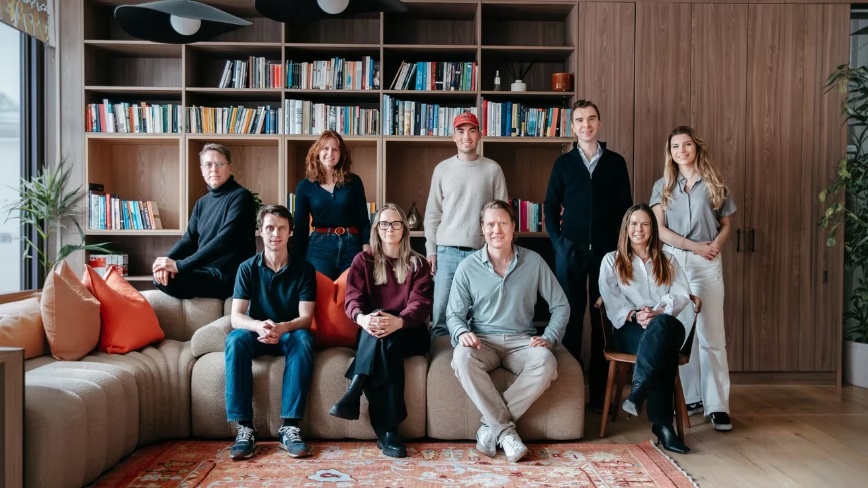
The team includes Ari Helgason, Kristian Branaes, Clara Ricard and other investors and specialists. David is listed as a partner based in Reykjavik. His biography adds a detail missing from a portfolio spreadsheet: he is a father of four. Alongside company building, it makes room for poetry.
There is a family resemblance between the two phases of his career, even though their technologies differ. At Unity, other developers needed tools that made their projects possible. At Transition, founders need capital, technical judgement and help turning engineering into a business. The recurring question is where assistance will change what somebody can actually build.
Photonics computing
Nuclear power
Wildfire suppression
Selected portfolio companies. Categories describe their work; they do not represent fund allocations.
The collar stays up. The questions get bigger.
For all the strategic vocabulary, Helgason has retained a willingness to be faintly ridiculous. Asked in a 2014 podcast about his popped collar, he explained that he liked the look, had become recognisable for it and still thought it looked cool. A personal brand can involve consultants; his account involved a collar and persistence.
His film tastes offer another small escape from the investor biography. In 2015 he picked Emir Kusturica’s Underground among his most-watched films, alongside Peter Greenaway’s Prospero’s Books, an unconventional treatment of The Tempest. He also enthused about the recent Mad Max. The interests range from elaborate cinematic oddity to a very energetic drive.
Gaming still intersects with his newer work. He is co-founder and chairman of Cleanplay, a project concerned with the carbon footprint of games. He has backed the Sustainable Games Alliance and argued for common tools to understand the industry’s emissions. His criticism is pointed: a successful industry should bring more ambition to reducing its impact.
He has described himself as a “glass one-tenth full” optimist. The fraction is nicely chosen: enough water to justify getting to work, too little to encourage complacency. His career has already made room for a game becoming a tool, a programmer becoming a chief executive, and a chief executive finding a different use for his experience. The next projects will have to work in a world with rather fewer undo buttons.