In the summer of 2009, David Belt helped turn a Brooklyn junkyard into a swimming club. The pools were dumpsters. There were cabanas, places to sit, and the pleasing suspicion that someone had misunderstood the assignment. A container meant to take things away was now giving people a reason to stay.
The joke was good. The experiment was more serious. Belt and his collaborators were testing an idea for vacant shopping centers: could places that people had stopped using become places they wanted to visit? A rented lot in Gowanus was a relatively small way to find out. The pools attracted attention on their own, which is what happens when your development proposal comes with a diving end.
Seventeen years later, Belt is co-founder and CEO of Newlab, where founders work on technologies that require equipment, industrial partners, and considerable patience. His route there runs through construction sites, a bottle-smashing installation, a theater, and a shipbuilding warehouse. The connecting question is surprisingly domestic: what could we do with this place?
The country club with a loading hook
The pool idea had a precedent in Athens, Georgia, where musician Curtis Crowe had made one. Belt brought the experiment north with collaborators including Alix Feinkind and Jocko Weyland. Macro Sea, his development company, gave the project a practical setting and a larger purpose. Empty retail property was the problem under consideration; swimming was the invitation.
These were working pools, with liners and filtration equipment. Their unlikely containers supplied the conversation. The project offered a small lesson in how people assess a place: change what happens there, and an unpromising address can acquire an entirely different meaning. A junkyard could host an afternoon rather than merely store the things left over from someone else's.
In 2010, the experiment arrived outside Grand Central for the city's Summer Streets program. Macro Sea adapted the design into mobile, code-compliant pools at the invitation of the mayor's office and Department of Transportation. Park Avenue had acquired an amenity few property brochures would have thought to promise.
For Belt, these projects created relationships with people in art and city government. They also supplied evidence that an odd proposal could survive contact with actual users. That mattered to a developer who would soon be asking people to imagine a much larger transformation.
A career assembled on site
Belt's professional vocabulary came from building things. He worked as a laborer, then moved through carpentry, estimating, and project management. He tells the progression with little ceremony: each job revealed another job he would rather be doing. In his telling, dissatisfaction supplied some of the promotions.
A touring punk band was part of his early route to the San Francisco Bay Area. By 1999, he had moved to New York to work on the Bear Stearns headquarters. The distance between those two settings is amusing, though construction offers a plausible bridge. Both touring and building require getting people and equipment to the right place, usually under conditions someone would prefer to change.
He founded DBI in 2002. The firm worked on development and project management across the United States and Europe; in 2020, he sold it to its employees. Alongside that business, Macro Sea became a vehicle for projects whose appeal could be harder to express on a conventional property listing.
That combination helps explain the apparent contradictions in his work. He could participate in substantial building projects while testing something temporary and strange. There was experience behind the playfulness. A developer who understands how a project gets built can afford to ask a more peculiar question about what should occupy it.
“I need them as a guiding principle or guiding image to help tell a narrative.”
David Belt, on architectural renderings, 2017
Recycling, with a little more noise
In 2010, Macro Sea made Glassphemy!, a steel structure where participants could throw bottles toward people protected behind glass. Belt shared concept, design, and direction credits with John Wischman and Paul Maiello. The discarded bottles became material for further use. Recycling had acquired a theatrical department.
The installation brought an abstract process within reach of an arm. People could see and hear the transformation of a familiar object. Its project credits also reveal how many collaborators such an apparently simple provocation required: fabrication, lighting, site management, glass work, even an in-house DJ.
There is a useful clue here to Belt's later work. He was interested in arranging an encounter, with the physical setting doing part of the explaining. You could spend an afternoon discussing material reuse. You could also build something that made people curious enough to turn up. The latter approach suited Macro Sea.
The shipyard needed another future
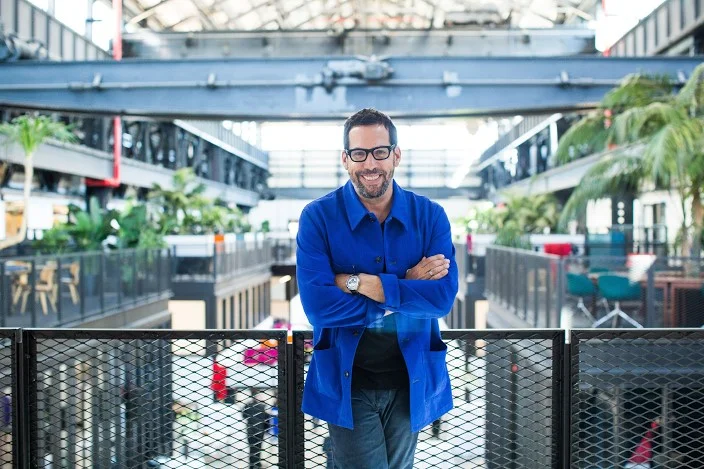
When Belt visited Building 128 at the Brooklyn Navy Yard, its former industrial purpose offered a starting point. The building had been a place for advanced manufacturing. He wanted to give that idea a contemporary use. With co-founder Scott Cohen, he developed Newlab as a home for engineers, inventors, and entrepreneurs.
The Brooklyn flagship opened in 2016, occupying 84,000 square feet. Macro Sea led development, DBI handled construction management, and Marvel served as lead architect and architect of record. Turning the building into a functioning workplace required the patient coordination that an evocative rendering can leave conveniently out of view.
The interior also required choices about mood. Belt and design director Nicko Elliott wanted to avoid familiar technology-office styling. Early-1970s ideas about the future helped inform the colors and furnishings. Some furniture was designed and made in Brooklyn; auction-bought chairs were refurbished. The result gave the old structure company without pretending the machinery had never left.
The membership had a purpose as specific as the design. New York offered support for software businesses, while companies building physical products needed tools and facilities that were harder to assemble. A shared metal shop or prototyping machine could make a difference that another meeting room could not.
Early coverage described electric, wood, and metal shops, together with a large 3D printer. Companies could work near peers while accessing equipment that would be difficult to justify individually. The building was part of the proposition. So was the person nearby who might already have wrestled with a similar manufacturing problem.
This made selection consequential. Newlab's founders were choosing a group whose work could benefit from proximity. An attractive workspace alone could not do that job. The aim was to help companies realize products, and the social arrangement had to serve the work being done inside it.
Keeping the workshop close to the factory
Detroit gave Belt another city with industrial experience to draw upon. In 2023, Newlab opened in the restored Book Depository at Michigan Central, with 270,000 square feet devoted to work on technologies including mobility and energy. The location put founders in a region where manufacturing knowledge already had deep roots.
By July 2025, Newlab was helping activate a dedicated section of The 23rd, a 380,000-square-foot manufacturing campus in Southwest Detroit. The distinction matters: Newlab's initial work there involved part of the larger site. With 23rd Street Holdings and member company Beacon Manufacturing, it was addressing the next problem after a prototype begins to work.
Companies need room to produce, along with power, loading access, logistics, and suppliers. The campus offered industrial infrastructure and flexible space for that transition. Belt's stated ambition was for founders to manufacture at scale while remaining in the city. A successful company should be able to grow without immediately outgrowing its local address.
In May 2025, Newlab announced its expansion into Louisiana. The planned New Orleans hub brought the story back to a former naval site, this time in Bywater. Its initial priorities included industrial power, carbon management, and shipping. Partners included the state, city, LSU, Shell, and regional economic-development organizations.
Belt's argument for Louisiana began with what was already there: industrial infrastructure, energy projects, and a technical workforce. That is a recurring feature of his approach. The existing place supplies constraints, but it also supplies people who know how complicated physical systems behave.
A place for the people who make things
Belt's connections to Brooklyn's cultural life continue alongside the technology business. He serves on the boards of St. Ann's Warehouse and Pioneer Works. His work through DBI on St. Ann's helped build relationships that connected him to the Navy Yard. A theater and a hardware company have different requirements, yet both need a setting where other people can encounter their work.
His later interviews still return to the relationship between old structures and new ideas. History supplies character and useful constraints. The ambition is to give people room to try something whose outcome remains uncertain, with enough practical support to make the attempt worthwhile.
Seen together, the pools and workshops suggest a particular kind of curiosity. Belt keeps finding places whose next use is open to argument. He gathers collaborators, gives the proposal a shape, and tries to make it habitable. Sometimes the result needs industrial power. Once, memorably, it needed a swimsuit.