A customer says they are leaving. Somewhere in the same social feed, a competition attracts applause, a stranger cracks a joke and another customer asks how to open an account. A dashboard can count all four. The harder job is deciding which desk each message belongs on. DataEQ has built its business around that distinction: interpreting the conversation well enough to give somebody useful work to do.
The company combines artificial intelligence with paid human reviewers to label customer feedback. Its clients use the resulting data to investigate friction, prioritise service requests and spot conduct risks. Banks and insurers figure prominently, alongside telecoms, retailers and other organisations with large customer populations. The commercial proposition is refreshingly specific: understand the complaint, identify its importance and get it to a team equipped to act. Its product family connects those steps.
The machine needed a second reader
DataEQ’s starting point was online reputation monitoring. Founded in South Africa in 2007 as BrandsEye, the business helped organisations follow what people said about them. Its current advisory board includes founder Craig Raw, who also founded the Bitcoin wallet Sparrow. Nic Ray is chief executive. The company now describes a reach across Europe, the Middle East and Africa, with particular expertise in financial services, telecoms and retail. That history gives its AI business a distinctly customer-facing upbringing.
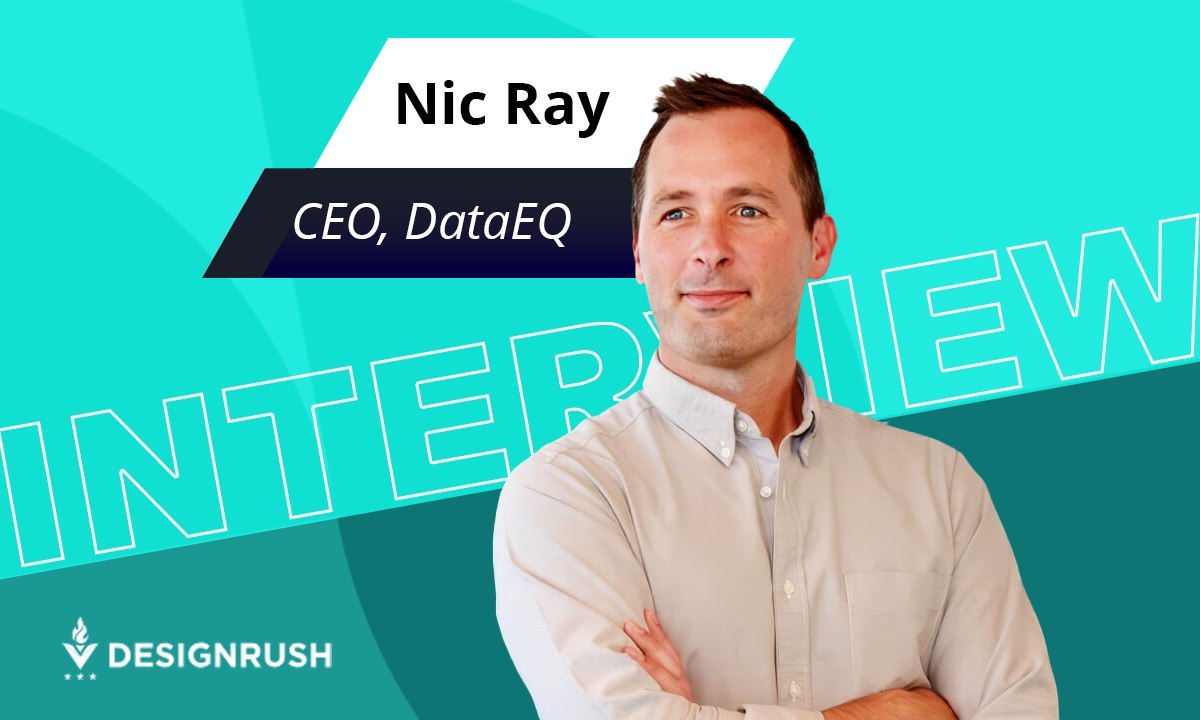
The original technical weakness, in Ray’s account, was interpretation. Automated systems struggled with the context that makes a complaint intelligible: tone, local usage and the difference between praise and sarcasm. In a 2025 interview, he described those shortcomings as the reason for developing the hybrid EQ Engine. The intervention was to put human judgment inside the process that produces the data, before managers start treating the output as evidence.
“AI alone struggled with context, sentiment, and nuance, elements critical for decision-making.”
Nic Ray, CEO · 2025 interview
By February 2022, even the name had become restrictive. Ray’s rebrand announcement explained that BrandsEye no longer described the enterprise uses customers were buying. Campaign reporting had expanded into service, experience and compliance work. DataEQ was the new name for that broader job. The logo became a tilted Venn diagram, an unusually literal illustration of humans and machines meeting in the middle. The announcement even noted that Crowd contributors were then paid mostly in bitcoin.
Four words that change the queue
The company calls its distributed human workforce the Crowd. Contributors are trained and vetted, with local-language knowledge brought to short texts that need checking or categorising. Its public recruitment platform advertises flexible work and rewards tied to accuracy. That arrangement makes human interpretation a recurring part of production. It also makes the quality of training and review consequential: a human label still has to earn its place in the dataset. The Crowd operates through its own platform.
The EQ Engine combines machine learning, generative AI and human labelling. Data can be structured by sentiment, topic, channel, journey stage and other attributes. Four priority labels provide a particularly clear explanation of the business: Risk, Purchase, Cancel and Service. A threat to leave and an enquiry about joining both matter, but for different reasons. DataEQ’s structuring process preserves that difference.
Customer
feedback↓02
AI + human
labelling↓03
Insight +
service action
These labels travel into Analyse, the insights and benchmarking tool, and Engage, the social customer-service platform. The important design choice is shared logic. Reporting and routing can use the same interpretation of a message, rather than leaving an analyst and an agent to invent separate definitions of urgency. Priority labelling is designed to connect alerts, service queues and escalation. A useful queue is already a small management decision.
Thirteen hours is a customer’s afternoon
Absa supplies a concrete example. In DataEQ’s published case study, the bank’s service problem was finding conversations that needed attention amid irrelevant social traffic. After three months with Engage, average response time to customers seeking a reply on Twitter improved by 13.6 hours. The reported response rate to prospective customers rose by 17%, while the tool surfaced 20% more cancellation conversation from indirect mentions.
Improvement in Absa’s average Twitter response time after three months with Engage, according to the published case study.
The distinction between direct and indirect conversation matters. A frustrated customer need not tag a bank’s official account to describe a problem worth addressing. Finding that conversation expands what the service team can see. Absa also used Analyse to investigate complaint themes by business unit. The case study describes both faster responses and closer examination of recurring pain points. These are reported operational results, rather than a controlled test isolating software from staffing or process changes.
A newer case study brings the argument into insurance claims. Miway began working with DataEQ in 2023, combining Analyse with Engage. In results covering 2024 and 2025, claims-related customer-service response time improved from 4.6 hours to 2.9 hours; the response rate increased by 12 percentage points. Claims-process Net Sentiment moved from -1.6% to 6.8%. The April 2026 account describes a feedback loop between customer conversation and operational action.
Less waiting for a reply
A popular campaign can hide an unpopular service
One of DataEQ’s more useful distinctions separates operational feedback from reputational conversation. A brand can generate enthusiasm through marketing while customers complain about the actual service. Combining both into one score can flatter the business and frustrate the people trying to fix it. DataEQ illustrates the problem with UK telecoms: in its example, Vodafone led overall Net Sentiment despite having the weakest operational performance.
Net Sentiment compares positive and negative sentiment. Its value depends on what goes into the comparison and how the result is broken down. Topics help explain whether people are reacting to price, an app or support; channel analysis shows where those experiences happen. DataEQ’s operational-versus-reputational split makes the scoreboard more informative. The useful management question becomes which experience produced the score, and who owns improving it.
Industry research extends that approach beyond individual clients. DataEQ publishes banking, insurance and telecoms indices, among others. PwC has collaborated on South African telecoms research, while KPMG worked with DataEQ on UAE banking sentiment. Such benchmarks put a company’s results beside its peers. They also demand careful reading: the KPMG report covering 2021 used public tweets, with a sample analysed for detailed concerns. That is evidence about observable conversation, not a census of every customer.
Complaints acquire a compliance audience
The move into conduct monitoring follows naturally from the data. A complaint about a financial product may concern more than an unhappy interaction. DataEQ’s 2021 Market Conduct launch described mapping social conversation to Treating Customers Fairly outcomes, developed in consultation with South Africa’s Financial Sector Conduct Authority. The intended uses included early warnings and internal or regulatory reporting. Consultation explains the product’s development; it does not make every subsequent output a regulator’s judgment.
In August 2026, DataEQ also outlined its vulnerability solution: identifying signals in customer text and routing structured information to insight and service teams. That is a demanding use for classification, because the intended next step involves people who may need particular care. Separately, the company announced ISO/IEC 27001:2022 certification for the information-security management system supporting Analyse, Engage and Good Outcomes. Vulnerability detection and security governance address different requirements of selling customer-data systems into large organisations.
The bill includes more than software
DataEQ sells enterprise software and data services through individually specified agreements. Its public terms put the fee in the order form and describe GBP pricing unless otherwise indicated, excluding applicable taxes. The commercial unit is the agreed service scope. For a buyer, a useful cost comparison therefore needs the same dataset, outputs and operating requirements on each side. A headline response-time improvement alone cannot establish financial return.
The offering now stretches into the work needed to prepare that data. A dedicated Consulting division, announced in August 2025 under Aimee Malan, covers integration, custom labelling, curation, analysis and model-related work. Its services include LLM training and fine-tuning. The launch formalised expertise developed around DataEQ’s own products; the consulting team also works with clients’ existing data. Publish adds the more familiar job of planning, approving and scheduling social content across platforms. Its approval workflows target marketing teams and agencies.
There are plenty of neighbouring products. G2 lists Brandwatch, Meltwater, Emplifi, Hootsuite and Sprinklr Social among alternatives. That comparison spans several overlapping software categories. DataEQ’s specific pitch centres on human-validated interpretation connected to operational workflows. A buyer should test that proposition on their own difficult messages. Accuracy on local language, routing usefulness and the ability to investigate an answer are more revealing than another polished dashboard demonstration.
Copy the handoff, then measure what happens
The practical lesson is to define which conversations require action, make those definitions shared across teams and assign ownership of the response. Measure whether priority requests receive replies, how long replies take and which problems recur. Keep campaign enthusiasm separate from service performance. Those are transferable practices, even for organisations that never buy DataEQ.
The company’s own 2026 telecoms research gives the approach useful boundaries. Across four South African subsectors, it classified between 29% and 78% of conversation as addressable by AI, with difficult billing disputes and cancellation threats requiring human judgment. The study covered more than 811,000 mentions. Its findings argue against a uniform automation target. The operating implication is straightforward: a better label helps only when the receiving team can do something with it. The customer waiting for a disputed bill to be corrected still needs somebody who can correct the bill.
Follow the conversation
Website · LinkedIn · Twitter / X (BrandsEye) · Instagram · Facebook
News & analysis · Industry reports · Nic Ray interview
Watch: US Elections spotlight with BBC · Watch: CNN’s US Election feature with BrandsEye