A convenience store is an unlikely place to look for a theory of media. People have come for coffee, a snack, perhaps the one thing they forgot elsewhere. Darren Mann helped put television into that errand. Years later, his work at The ARIA Network would bring augmented reality into shopping malls. The equipment changed. The interesting part of his career is how often the location stayed close to the cash register.
In 2009, Mann was co-CEO of Digital Display Networks, the company contracted to create 7-Eleven TV. Its proposition was disarmingly practical: show people something while they are somewhere they can buy it. There would be entertainment, weather, news and promotions, all arranged around the rhythms of the store. Advertising had found an audience with both a reason to be there and a wallet within reach.
That commercial instinct connects several chapters of Mann’s working life. Hotel visitor television, convenience-store screens, digital collectibles and a conversational shopping assistant can look like unrelated businesses. Follow the customer through them and a pattern appears: useful information, placed where an immediate decision might follow.
The hotel room before the checkout
Mann’s background includes founding City Explorer TV, an advertiser-supported visitor information business. Explorer TV’s early market was Southern California; its hotel networks subsequently reached audiences in the United States and Europe. A visitor information channel has a particularly agreeable assignment. Its viewers are already away from home and deciding what to do next. A restaurant advertisement arrives in the company of a genuine question: where shall we eat?
By 2009, the Explorer TV operation was described as serving more than 150,000 hotel rooms, alongside cruise ships, airports and visitor information centers. Digital Display Networks was formed by Explorer TV’s principals. The move into convenience stores took that experience in place-based programming into a much quicker encounter. A hotel guest might browse. A convenience shopper is liable to leave before the second act.
Those settings give Mann’s career a useful scale. His business has involved the production of content, the installation of delivery systems and the sale of advertising around them. A screen on a wall is only the visible portion. Someone must keep the programming relevant, sell the inventory and persuade the venue that the arrangement earns its space.
Two screens, a very short audience
The announced 7-Eleven plan called for two high-definition LCD monitors in each participating store, with directional audio aimed at the people in front of them. Programming would change through the day. The rollout was intended to cover more than 6,200 stores in the United States and Canada, with completion then expected in late 2010. These were deployment plans, rather than a count of completed installations.
The technical undertaking was substantial. Harris supplied the network backbone under a ten-year agreement valued at $75 million. DDN supplied content production and advertising sales among its services. A 500-store pilot preceded the wider rollout. Behind the familiar convenience-store setting sat scheduling software, monitoring and support. Even a brief encounter with an advertisement required a surprisingly elaborate backstage.
Mann’s pitch emphasized the shopper’s proximity to a purchase. The value of the network depended on that proximity, rather than simply on putting another television somewhere people might glance at it. Coffee at breakfast and a snack later in the day could call for different programming. The timetable belonged to the customer’s errand.
Across Mann’s ventures, the next action keeps returning: choose a destination, find a product, redeem an offer, make a purchase.
By August 2012, the network was operating in about 4,400 stores when Premier Retail Networks became its exclusive advertising sales representative. That reported footprint offers firmer ground than the earlier national projections. It also reveals the second job of building a media network: after assembling the audience, somebody still has to sell it.
Then the screen moved into the shopper’s hand
ARIA extended Mann’s work into augmented reality. He and Rebecca Jonah were identified as co-CEOs in the company’s earlier public announcements. Their backgrounds brought different experience to the same business: his in brand integration and media networks, hers in financial restructuring. The live company team page now lists Mann as CEO and Jonah as President.
In July 2021, ARIA’s agreement with Brookfield Properties introduced a phrase that sounds as though a property lawyer had been given a science-fiction assignment: virtual air rights. The agreement covered common spaces at more than 100 malls across 42 states and more than 150 million square feet. Brands would be able to place digital experiences in physical shopping environments, accessed through visitors’ phones.
The attractions included digital directories, directions and immersive advertising. The corridor could remain a corridor while a phone supplied an additional layer of content. For Mann, this represented another route to the moment of purchase. The store no longer had to install every screen a customer would use. Shoppers brought their own.
A detour through the collectible cabinet
ARIA’s public arrival also included ARIA Exchange, its digital-collectibles business. In 2021, the company announced relationships involving basketball, baseball and hockey alumni organizations and the Roberto Clemente estate. Its proposed “living” NFTs could receive additional content over time. The aim was to make the relationship between a fan and a collectible continue after the initial transaction.
The Clemente project made that ambition concrete. ARIA announced an exclusive NFT series with the baseball player’s family, connecting a collectible with the telling of his life and legacy. Mann also discussed the appeal of ongoing participation in secondary sales for athletes and other rights holders. These were the company’s proposed commercial benefits, rather than a guarantee of future returns for buyers.
His public enthusiasm came with a reservation. During the NFT rush of 2021, he questioned whether gimmicky releases would endure. It is a useful sentence to encounter from someone selling digital collectibles. Novelty can get a person to look. The harder assignment is giving that person a reason to care next week.
“I don’t think some of the gimmicky drops are going to have sustainability.”
Darren Mann, 2021
By June 2022, ARIA Exchange was advertising upcoming athlete partnerships and planning access keys with different membership benefits. It also described accepting familiar payment methods, including cards and mobile wallets. Whatever the technology underneath, the purchasing experience was intended to be accessible to people outside the existing crypto audience. An elaborate collectible still needed a usable checkout.
A treasure hunt with a till at the end
The mall business offers a less abstract example of Mann’s approach. In a public account of ARIA’s work with Klarna, he described a 60-day sponsorship and an augmented-reality game launched at 25 properties. Players completed the experience and received in-store offers from participating brands, including Sunglass Hut and Forever 21.
The mechanism involved collecting virtual coins through a phone camera and exchanging them for retailer discounts. It gave the technology a task that could be explained without a glossary. There was something to find, a reason to walk and somewhere to redeem the result. The treasure, with admirable retail discipline, led back to a shop.
Mann’s announcements frequently name the people involved. His account of the Klarna work thanked colleagues and the Brookfield and 8th Wall teams. In 2025, his ICSC update again credited a group of collaborators. Those acknowledgments are a recurring feature of his public business voice: even when describing a technology rollout, he makes room for the people doing the work.
- 2009Store television
Timed programming - 2021Mall AR rights
Phone-based experiences - 2025Shopping assistance
Discovery and directions
The question a directory could never answer
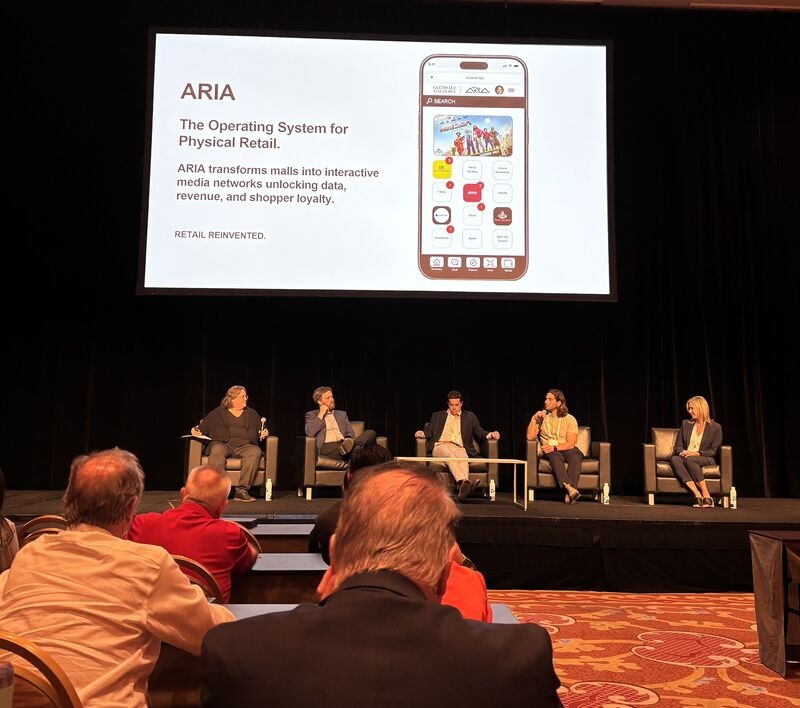
In May 2024, Mann was listed as a speaker at ICSC Las Vegas on a panel about technology-driven retail experiences, alongside JLL’s James Cook and Coresight Research’s Deborah Weinswig. By May 2025, he was discussing a national rollout and meetings about international expansion. His public emphasis had turned toward an AI assistant connecting shoppers with inventory, offers and creator content.
The distinction between announced ambition and achieved scale matters here. International meetings describe an aspiration. A national rollout describes work in progress. They belong in the story as Mann’s stated direction, without becoming a finished itinerary. His aim was to extend ARIA’s system into more retail environments and connect engagement more closely to purchases.
By September 2025, he was describing web access through a QR code, with opt-in consent, shopping assistance and retailer redemption. The latest company presentation carries that direction forward, emphasizing conversational discovery, virtual try-on and wayfinding. It describes a launch across 160 Brookfield malls. The promise is that a shopper can ask a question and move toward an answer nearby.
A directory can tell you where a shop is. Mann’s successive businesses have pursued the more commercially interesting territory around that answer: what catches your attention, what makes you interested and what happens when you arrive. From the hotel room to the convenience store to the mall, his career keeps returning to the small distance between seeing something and deciding to go get it.