In Darren Lucia’s arithmetic, nine noes can be a productive morning. Early in his career as a stockbroker, he worked from a ratio: speak with ten decision-makers and one might become a lead. Most people would count the refusals. Lucia counted the distance to the next yes. “I never chased leads. I chased the No’s,” he later wrote. It is a hard little sentence, equal parts sales tactic and philosophy. It also explains much of what came after.
Lucia is now the New York-based co-founder and CEO of Rampd, a consultancy and coaching business for early-stage founders learning how to sell. The company’s clients are often technical teams. They can build the product, explain the architecture, and debate a roadmap down to the hour. Then a buyer asks why the problem must be solved this quarter, and the room becomes curiously quiet.
Rampd occupies that silence. Its work turns the improvisation of early sales into a visible process: generate leads, qualify the problem, tailor the demo, agree on the proof, and earn the close. Lucia’s contribution is less a bag of clever lines than a way of making customer conversations inspectable. Calls are recorded. Objections are examined. Confidence is allowed to arrive late.
The useful discomfort
Founders have understandable reasons to avoid early selling. Product work is absorbing and, within limits, controllable. A feature either compiles or it does not. A prospect can admire the demo, praise the team, promise to circle back, and leave behind no usable verdict. The polite maybe is far more expensive than the plain no.
Lucia asks teams to enter that ambiguity sooner. Sell while building. Name actual companies and actual people in the ideal customer profile. Describe the pain in the buyer’s language. Ask for a decision before the product feels finished. A purchase is evidence, but a well-examined refusal can be evidence too. It may reveal a weak problem, the wrong persona, poor timing, fuzzy positioning, or a product that is merely pleasant rather than urgent.
Founder led sales is not a knowledge problem. It’s a repetition problem.
This distinction is central to Lucia’s view of the craft. Reading books and downloading templates can create the sensation of progress without the bruises of practice. Real calls are untidy. Founders lose deals they expected to win, discover that their favorite feature means little to the buyer, and rewrite their message for the tenth time. Lucia treats these events as the curriculum.
The directness comes from experience rather than posture. He has publicly described feeling insecure early in his career around peers with polished university and corporate credentials. His response was to learn, endure, and improve. That memory now informs how he coaches technical founders whose brilliance in one domain can make sales feel like foreign terrain. The aim is competence built through reps, with confidence following behind.
From finance to feedback loops
Lucia spent his first professional chapter in wealth management and portfolio management at Maxim Group. In 2012, he moved into technology at Main Street Hub, the social-media marketing company later acquired by GoDaddy for $125 million. He helped build the sales operation there, including a four-month stretch in which he says he interviewed six to ten sales and customer-success candidates every week while doing the work of building the machine.
The volume sharpened his eye for an enduring startup problem: an excellent interview can conceal an indifferent operator. Lucia began looking for evidence. Could candidates explain, step by step, how a sales process worked? Could they account for a rep hitting quota? Had they stayed through difficult stretches long enough to adapt? Track record, tenure, grit, problem-solving, and cultural fit became the useful categories.
He later led sales at the property-technology business known as Nestio, now Funnel Leasing. By late 2017, he had started Rampd. The new company gave him a place to turn accumulated sales knowledge into a coaching framework for founders who had no sales leader to translate the terrain.
By 2023, Lucia wrote that Rampd had worked with 133 clients that year and that those companies had collectively raised more than $400 million. His published Founder-Led Sales Playbook drew on work with more than 250 startups at that point. The number has continued to grow. In early 2026, he said Rampd had worked with 534 early-stage teams, six of which had become unicorns.
A system with three verbs
Rampd’s learning loop can be reduced to three parts: theory, application, and feedback. Theory gives a founder a route through the sale. Application means taking real calls rather than rehearsing forever. Feedback means reviewing what happened closely enough to make a precise correction. Then the loop starts again.
Know the stage, its objective, and the question that advances the deal.
Take real calls. Put the method under pressure while the stakes are real.
Review the recording. Keep the evidence and correct one thing at a time.
The individual stages are similarly practical. Lead generation creates enough conversations to learn. Discovery identifies the use case and whether the problem is qualified. The demo connects what the buyer said to what the product can do, avoiding the familiar parade of unrelated features. A scoping call defines success for a paid proof of concept. Closing is then the consequence of the prior steps being executed cleanly.
The scoping step reveals Lucia’s dislike of vague momentum. Before a pilot begins, buyer and seller agree on the result the product must prove. This gives the experiment a finish line. The practice also changes the close from a dramatic final maneuver into the natural resolution of work already done. It is sales with fewer trapdoors.
Listen until the pitch gets smaller
Lucia’s public writing returns often to listening. He describes selling as education: understand where a prospect’s knowledge and process have gaps, identify why the issue matters now, and help the person make a decision. The seller’s fluency is measured by the quality of the questions and by how little irrelevant product must be shown.
This is especially useful for technical founders, whose demos can become guided tours of everything the team has built. Lucia advises a narrower route. Refer back to the pain expressed in discovery. Show how the product changes that specific condition. Keep the software portion brief. Less product can produce a more persuasive demonstration because every visible feature has a reason to be there.
You need many “at bats” to make the corrections and find indications of PMF.
The baseball metaphor matters. An at-bat is finite, observable, and followed by another. It discourages the melodrama that can attach to one lost deal. In Lucia’s system, the important question is what the founder can carry into the next conversation. Did the buyer recognize the problem? Was there a deadline? Did the right stakeholder attend? Which sentence caused attention to sharpen? Which slide invited confusion?
This habit makes a pipeline into more than a revenue forecast. It becomes a research instrument. Repeated objections can edit positioning. A pattern of enthusiasm without budget can expose weak urgency. A successful pilot can define the use case around which the company grows. The market is allowed to speak in full sentences.
A public classroom
Lucia extends the coaching through a newsletter, a long-form playbook, LinkedIn posts, and Rampd’s training programs. His style is conversational and frequently blunt. He writes about missed pitches, weak pipelines, bad hiring, and the temptation to keep building. He also makes room for the interior work of sales: rejection, uncertainty, accountability, and the difference between reading about confidence and earning it.
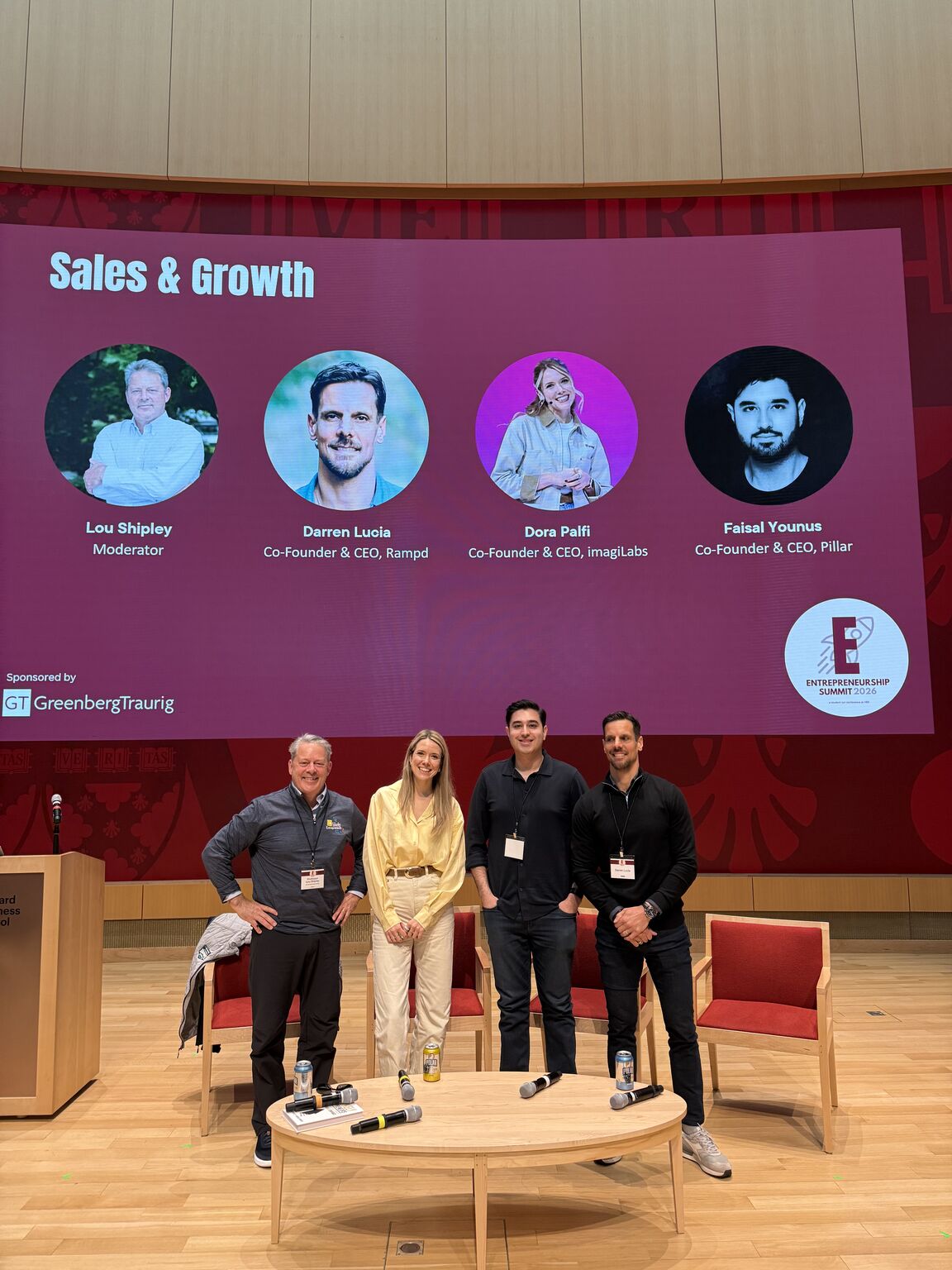
In March 2026, that classroom acquired oak paneling. Lucia appeared at the Harvard Business School Entrepreneurship Summit on a Sales and Growth panel with founders Dora Palfi and Faisal Younus, moderated by Lou Shipley. The discussion centered on first customers and early go-to-market playbooks. Lucia later noted a pressure felt by many founders in the room: product differentiation, especially in AI, was compressing, while distribution and sales execution were becoming more consequential.
The observation fits his career. Features travel. A practiced understanding of buyers is slower to copy. It lives in the recorded calls, the language a team learns to use, the discipline to disqualify a weak opportunity, and the patience to make the buying journey obvious without pushing. Rampd’s product, in this sense, is judgment made repeatable.
The next useful no
Lucia’s stated ambition for founders is concrete: build a predictable customer-acquisition process, find product-market fit, and reach the first million dollars in annual recurring revenue. The number makes a fine headline. His actual subject is the less glamorous machinery underneath it.
That machinery begins before the polished case study. It begins when a founder calls someone, risks a clumsy explanation, and hears an answer that cannot be edited in a planning document. It improves when the call is replayed without vanity. It becomes a system when the next call is different for a specific reason.
The nine noes return here. They are neither badges nor wounds. They are information with a pulse. Lucia’s gift is to make them countable, discussable, and occasionally funny. A founder may still prefer the clean companionship of a product sprint. The market, inconveniently, is waiting on the phone.