The word was “turnover,” and for several baffling minutes in a London office it appeared to mean opposite things. Dario Ambrosini’s manager kept talking about turnover as if more were better. Ambrosini, hearing the American shorthand for employees leaving, wondered why anyone would celebrate. His manager meant revenue, the ordinary British usage. Two colleagues, one language, no shared meaning.
It was the sort of harmless misunderstanding that earns a laugh and disappears by lunch. Ambrosini kept it. Years later, when a younger colleague ran into the same confusion with an Australian customer, he retold the story. The moment had become a compact theory of marketing: familiar words can conceal incompatible ideas, and fluency begins when you stop assuming that your audience hears what you intended.
That theory is useful in Ambrosini’s current job. As chief marketing officer of Propel Software, he has to explain a cloud platform spanning product lifecycle management, quality management and product information management. Engineers, quality specialists, product leaders, supply-chain teams and commercial executives may all touch the same product record. They do not walk into the room with the same vocabulary. Ambrosini’s work is to make the larger story legible without flattening those differences.
“Through it all, the marketing fundamentals remain the same: know your buyer, know their pain, and speak their language.”Dario Ambrosini, 2025
The finance guy walks toward the customer
Ambrosini did not begin as a marketer. He studied finance at the Haas School of Business at the University of California, Berkeley, then entered corporate development at a company buying other businesses. He led a small acquisition team that got close to operations, marketing and customer service. The transaction was supposed to be the center of gravity. His attention kept drifting toward strategy and the customer.
“Marketing was a better calling for me,” he later said, because he enjoyed that deeper engagement. An MBA in marketing at UCLA Anderson gave the instinct a formal home. At American Express, his finance background became an asset rather than abandoned luggage. A new division needed a marketer who could also understand profit-and-loss statements. He could speak both dialects.
At Yahoo, he worked in marketing and product management. Then came the stretch through early-stage software companies that has occupied much of his career: the travel and loyalty platform Switchfly, the small-business platform Manta, and, since 2019, Propel. The industries changed from points and bookings to local businesses to bills of materials. The operating question stayed recognizable: what does the customer need to understand before a complicated system becomes useful?
The progression also explains one of Ambrosini’s more useful bits of executive advice: run toward finance. Marketing and finance are often written as natural antagonists, one arguing for possibility and the other counting the cost. Ambrosini calls finance “the steward of the business.” When budgets tighten, he advises an honest conversation with finance and sales about buyer behavior, runway and returns. Fighting the spreadsheet does not make it disappear.
Seventy-five percent certainty, twenty-five percent curiosity
His budgeting method reflects the finance training but leaves a window open for surprise. Ambrosini has described placing roughly 70 to 80 percent of marketing spend behind things that have worked recently and still show a promising trend. The remainder goes toward emerging strategies. An experiment should be small enough that failure is tolerable and meaningful enough that success can be scaled.
The Ambrosini test portfolio
A visual midpoint of his stated 70–80% known-spend range. The exact mix changes with evidence and circumstance.
Use recent performance and direction of travel, not last year’s win alone.
Give a useful experiment enough room to prove it deserves more capital.
He has applied the method to AI tools for content, research, outbound dialing and real-time coaching. Small tests that worked moved into a full-year budget. Paid marketing gets a different kind of scrutiny: cheap keywords and obvious audiences can produce good early returns, then expansion grows progressively more expensive. A channel’s history matters less than the slope of its results.
Ambrosini is candid about where the numbers end. Brand awareness resists clean attribution. Data can be incomplete. At some point, even a numbers-oriented marketer must make an assumption and decide whether a return is plausible. His approach is less worship of measurement than a careful separation of what is known, what is estimated and what is being tested. The spreadsheet gets a vote, not a throne.
One of his better campaign stories began with a decidedly unromantic asset: leftover budget. Another division’s marketing team had money it had not used. Ambrosini’s team did too. They pooled the funds and had to invent a campaign valuable to both groups. The constraint produced a stronger message for their shared customer, better returns for both divisions and an expanded joint effort the following year. Organizational seams, like linguistic ones, can hide useful connections.
Selling the query before answering it
Propel presents a particularly knotty version of that problem. The company connects three established software categories, yet buyers still search for the categories individually. A quality leader may begin with QMS. An engineering leader knows PLM. A commercial team thinks in product information. The marketing task is to welcome each person through a familiar door, then show why the rooms belong to the same house.
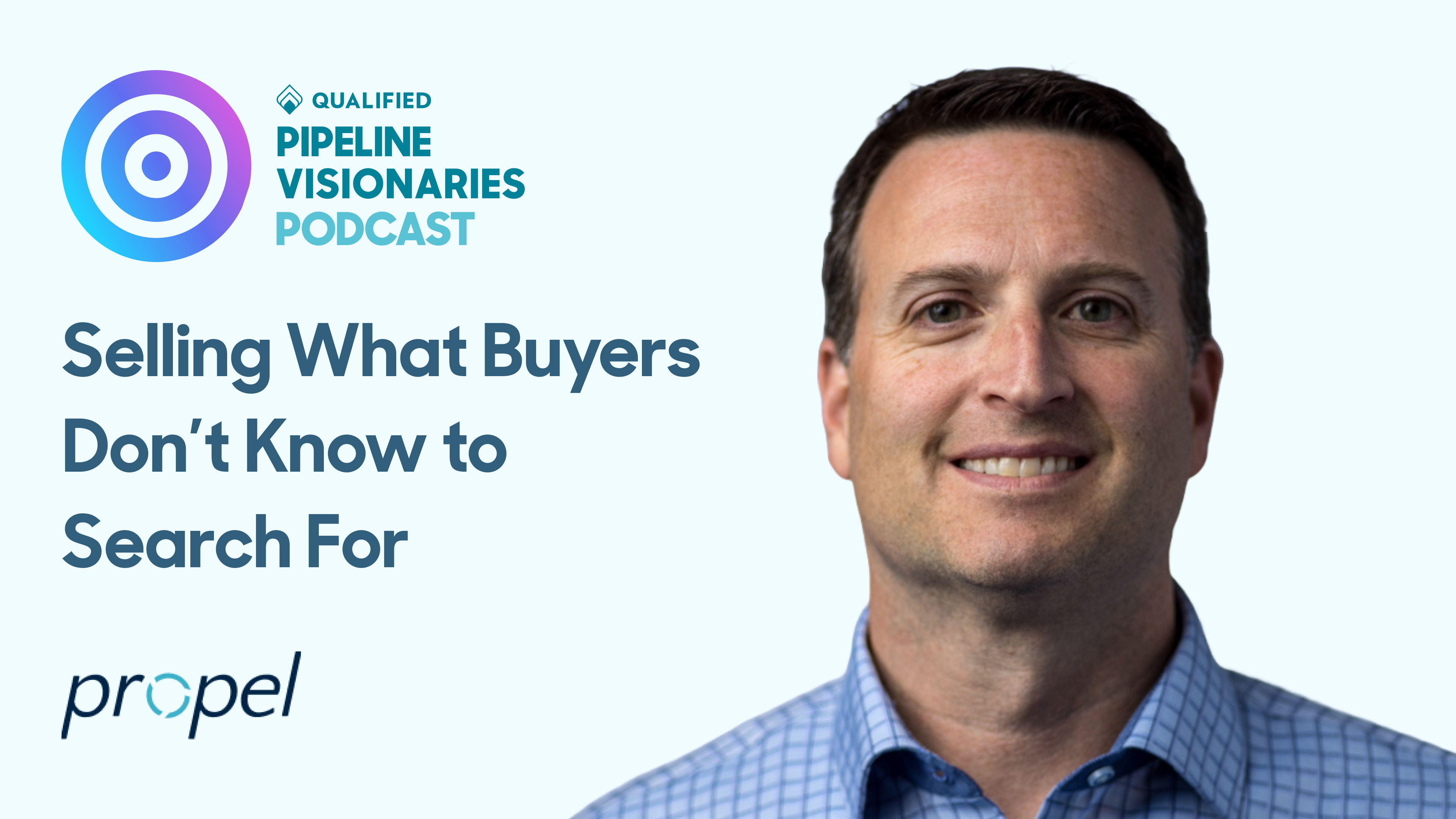
On the Pipeline Visionaries podcast in 2025, Ambrosini spoke about the challenge of “selling what buyers don’t know to search for.” His three protected investments were revealing: inbound and SEO, account-based marketing, and partnerships. Inbound creates the path for a buyer already looking. Account-based campaigns adjust the message for divisions with different pains. Partners transfer trust by making the introduction.
Generative AI complicates the first path. Buyers increasingly ask a model to summarize the market instead of assembling a view from a page of links. Ambrosini’s concern is practical: content now has to shape the systems that shape the shortlist. Yet his answer is not to replace human understanding with machine-readable volume. It is to carry buyer knowledge into a new discovery channel.
This concern meets his product story in a neat loop. Ambrosini argues that useful industrial AI depends on connected, governed product data. If information is scattered among engineering, quality, supply-chain and commercial systems, even a capable model begins with a partial view. Propel’s pitch is that a unified product thread gives people and AI a more coherent foundation. His marketing thesis and product thesis share the same suspicion of fragmentation.
A host who prefers people in the room
From 2022 through 2023, Ambrosini hosted 25 episodes of The Platform Rules, talking with manufacturing and technology operators about supply-chain disruption, customer success, enterprise design, no-code tools, product information and transformation culture. The title promised rules; the format produced conversations. Guests included Salesforce executive Alexa Vignone, author Geoffrey Moore and leaders working inside product companies.
His first in-person appearance on another podcast came later, almost by accident. Pipeline Visionaries host Ian Faison lived nearby, so they recorded together. Ambrosini loved the change. He found the conversation more fluid and valued learning about the person across the table, not only the professional subject. In a business fond of efficiency, physical presence turned out to have its own return.
That preference fits the more personal ambition he has described. Asked what movement he would start, Ambrosini chose walking a mile in someone else’s shoes. Workplace frustration, he observed, often grows from a mistaken story: someone seems to be ignoring you when they may simply be overwhelmed. Understand that pressure and the next response might be an offer to take something off their plate.
“In business, and in life, we need to have this cycle of understanding.”Dario Ambrosini, 2024
There is a pleasing continuity here. The finance graduate learned that numbers require context. The American in London learned that words do too. The software marketer learned that buying committees can share a goal without sharing a language. The podcast host found that a room changes a conversation. Ambrosini’s career has moved through distinct industries, but its central habit is remarkably stable: look for the hidden mismatch, then bring the people and information close enough to resolve it.
AI may alter how a buyer discovers a company and how a manufacturer reads its product data. It does not retire that habit. Someone still has to define the problem, understand the audience and decide what a useful answer means. For Ambrosini, modern marketing returns to an old social skill: listen carefully enough to notice when everybody is saying “turnover” and nobody is talking about the same thing.