A high-visibility vest is an unlikely object around which to tell a family-business story. It has very little interest in ancestry. It needs to do its job, survive its working life and, increasingly, have somewhere useful to go afterwards. Yet the vest is a good place to begin with Daniel Ellman, whose professional world joins a long-established investment group to the rather immediate business of making and moving things.
In November 2024, Ellman celebrated Beeswift’s Sustainability Innovator of the Year award. The workwear company had been developing Envirowear, a range designed around recyclable garments. His response was brief and pleased: “Super proud of our multi-year project”. The pride belonged to a team and to work that had taken time. Both details matter in the career of a chief executive who arrived at a family company’s helm several generations after its beginning.
Ellman became CEO of Gerber Goldschmidt Group in 2018. He was the fourth generation. The group’s businesses span food, industrial products, financial services, commodities and commercial property. There is considerable distance between a family succession and the specification of a work jacket. His working life occupies that distance, where ownership has to turn into decisions about people, products and the places a business needs to operate.
A surname beside a century
The names above the door are Gerber and Goldschmidt. The chief executive’s name is Ellman. A family company can keep its identity while its family tree acquires new branches; here, the nameplate and the leadership have travelled together without becoming identical.
The group’s origins reach back to Meyer Hirsch Goldschmidt, who left Hamburg for Southern Africa in 1907 as a trading-house representative. During the First World War, internment brought him together with George Griesbach and Jacob Gerber. They planned a postwar trading venture. The registered business dates to 1920.
Daniel’s father, David Ellman, joined in South Africa in 1978 and opened the San Diego family office in 1987. Daniel took the chief executive role in 2018, two years before the centenary. That sequence gives his appointment a particular scale: one leadership change inside a story already measured in decades.
For a successor, history supplies a starting point. It cannot choose the next manager or redesign a product. Those tasks belong to the present. The tension makes family succession interesting: the business carries an inherited identity, while its customers remain free to judge what it does today.
The warehouse version of commitment
Beeswift brings Ellman’s role into focus. He became a director on 2 July 2012. In 2021, he was identified as its executive chairman when the company moved from West Bromwich to a new Birmingham headquarters. The reported facility covered 120,000 square feet. A building is a particularly literal way to give a growth plan somewhere to live.
The company reported turnover of £97.1 million for the year to September 2020, compared with £53.6 million a year earlier. Its pre-tax profit rose from £1.9 million to £15.1 million. These are Beeswift’s figures, a snapshot of one operating business rather than a measure of Ellman’s personal wealth or the entire investment group.
Financial years ending 30 September. Historical figures, reported in July 2021.
“Continually reinvest in the business and its associates for the long term.”DANIEL ELLMAN / 2021
Ellman’s comment attached the facility to a longer commitment. The phrase is modest enough to survive outside an anniversary brochure. A warehouse, after all, has to be staffed and stocked. It asks for the ordinary, repeated attention that makes an investment useful to the people running a company.
That is the practical appeal of this episode. The idea of patient ownership becomes something with doors, storage space and a working address. The family story has found its way onto the shop floor.
Who gets the next set of keys?
In 2023, Beeswift appointed Darren Washbourne as CEO of its UK and Netherlands businesses, effective from 1 October. He had spent more than 35 years in the safety-products industry, served on both boards since 2017 and previously held the chief commercial officer role. This was an appointment grounded in a substantial operating history.
Ellman’s accompanying comments emphasised teamwork, integrity, passion and work ethic. The announcement also described a three-year growth plan, a forthcoming Netherlands relocation intended to double capacity, and development of the Envirowear, Flex and Deltic brands. People, premises and products appeared together. Each depended on the other two.
There is a useful distinction between the chairman’s seat and the chief executive’s job inside an operating company. The appointment put Washbourne in charge of Beeswift’s next phase, with GGG committing continued support. Ellman’s part in the announcement was to explain the choice and the qualities the board wanted carried into the business’s future.
A similar concern with continuity appeared in his January 2025 announcement for Gloe & Zeitz in the Netherlands. Ed Meijboom became managing director and a board member. Theo Jongmans, whom he succeeded, would stay as a director, working on commercial activity and special projects. The handover made room for a new leader while preserving a place for an experienced one.
Succession is often presented as a single moment. Here it looks more like an arrangement: who takes responsibility, who remains involved, and how the company keeps working while titles change. For a fourth-generation chief executive, that is a familiar subject at a different scale.
A jacket’s second career
Envirowear adds a product question to the ownership story. Beeswift describes garments made from post-consumer waste according to mono-fibre principles, designed for recycling through Project Re:claim. The approach considers a garment’s next use while specifying its first one. A work jacket gets a career plan of its own.
material→Mono-fibre
design→Working
life→Project
Re:claim
Beeswift received its 2024 award in Birmingham on 8 November. Ellman’s public celebration of the project fits the longer reinvestment theme, but the mechanics deserve attention of their own. Recyclability depends on the way a garment is designed and on a process that can handle it afterwards. A label cannot perform that work by itself.
In December 2025, Beeswift announced the acquisition of Plan B International after several years of collaboration, including on Envirowear. Plan B would sit within Beeswift Circular Solutions, directed by Andy Moulding, one of its original founders. The announcement also described the continuing relationship with Project Re:claim and the Salvation Army Trading Company.
The sequence is concrete: collaboration, product development, recognition, then an acquisition that brings design expertise into a new division. It concerns a company where Ellman serves as a director. The designers, managers and recycling partners have their own roles in that sequence, which is precisely why the story is more interesting than an individual victory lap.
The group photograph
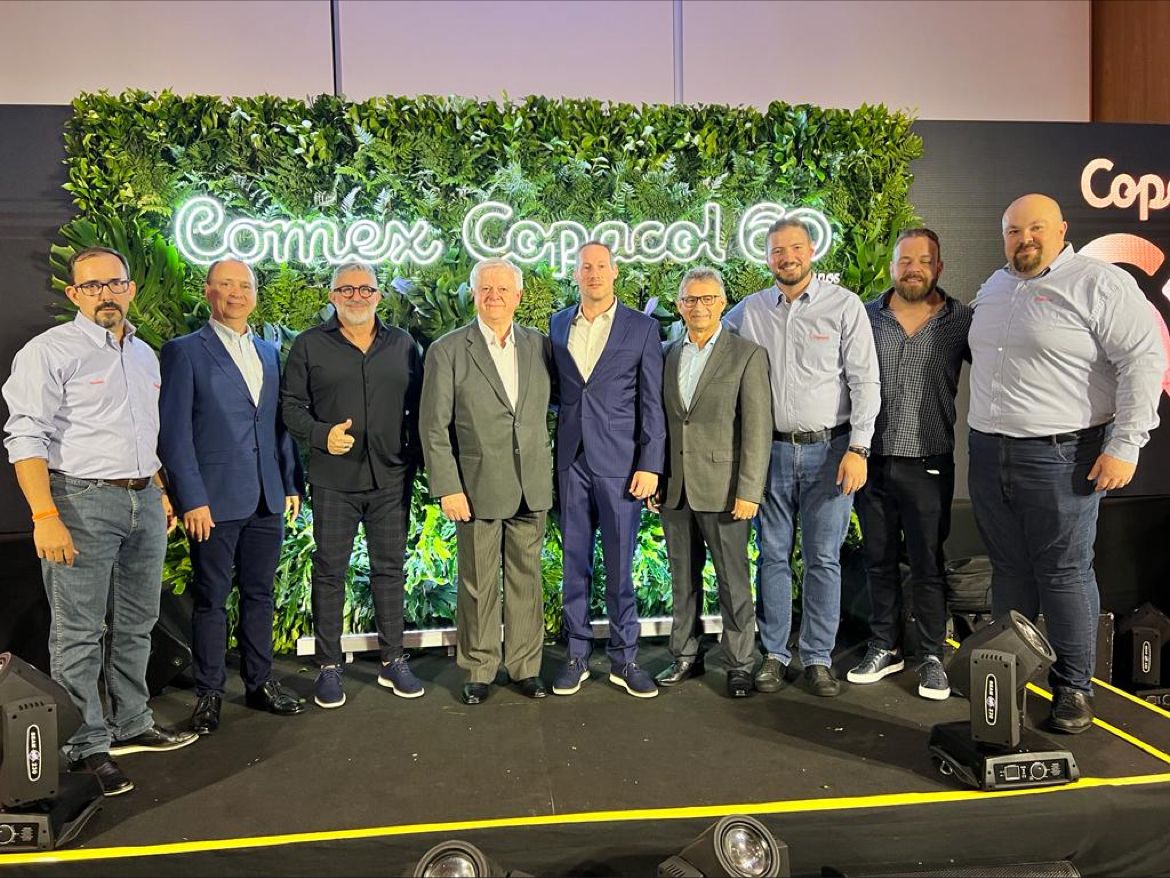
Another glimpse of Ellman’s work comes from Brazil. In 2023, he joined Gerber Agri colleagues at Copacol’s 60th-anniversary celebration. His post named Anderson Oliveira and Alisson Leigus and praised the partner’s values and ethics. It was a celebration of someone else’s milestone, with the relationship itself taking a place in the foreground.
Gerber Agri sources and sells meat products internationally, working with producers and customers and offering financing capabilities. Gloe & Zeitz imports and distributes preserved foods in the Netherlands. These are different businesses, joined within a group whose portfolio includes the movement of goods as well as the provision of capital.
The photograph supplies the human scale. Eight people stand together beneath the anniversary display. A global partnership becomes a room, a gathering and an occasion people have taken the trouble to attend. Ellman’s post looks towards more celebrations together. In a trading business, that is a fairly plain expression of wanting the relationship to continue.
His response to entrepreneur Saj Sulaiman after a meeting in 2024 had a similar warmth. He praised Sulaiman’s entrepreneurship and drive and looked forward to the possibilities between their organisations. The exchange offers a small, public example of how he talks to a business counterpart: personally, with attention to the person’s own story.
What gets carried forward
GGG describes an active investment approach, working with management teams and supporting businesses through advice, financial guidance and international connections. Its services include acquisition support, corporate structuring and financial planning. Behind those categories are recurring decisions about how a company can keep functioning and where it has room to grow.
Ellman’s public career makes those decisions visible in pieces. A director appointment. A warehouse move. A management handover. A garment designed for another cycle. A photograph at a partner’s anniversary. The pieces do not need to become a legend to explain the scope of his job.
There is room for both preservation and revision in that record. An experienced executive can remain involved after a handover. A longstanding supplier relationship can support a new product. A familiar garment can be reconsidered from its fibres upwards. Continuity has several practical forms, and some require changing what a business has done before.
Ellman inherited a place in a long company history. The work described here concerns what happens to that history when it reaches the next appointment, the next facility and the next product. A family business may have an old name above the door. Someone still has to decide what goes through it.