A pallet of siding is an unpromising place to look for a personal story. It has no ambition, requires no encouragement and offers little conversation. Yet the business of getting it to a contractor explains a great deal about Dan Watkoske. Across a career that began with paper and eventually arrived at the outside walls of American homes, his work has stayed close to a practical question: what does a customer need a distributor to do?
In January 2025, Watkoske became chief executive officer of Alside. The responsibility came with more than 100 supply centers across the United States and a business being given a clearer identity within Associated Materials. For a leader whose early job title was sales trainee, it was a substantial change of scale. The distance between a conversation with a buyer and the machinery required to honor it had become his professional territory.
A career that started on the sales side
Watkoske joined International Paper in 1989 as a sales trainee at Nationwide Papers, a business that later became part of xpedx. His subsequent roles included sales, commission sales and management. These are useful details because they put the beginning of his career near the transaction itself. Before the national responsibilities, there were the jobs of selling products and managing the people who sold them.
He later became vice president of national accounts at xpedx. From January 2008 to January 2011, he served as group vice president for its Metro New York Group. Then came the appointment to executive vice president of sales and a place on the senior leadership team. By that stage, his responsibilities had moved from individual accounts toward a much wider commercial operation.
Mary Laschinger, then xpedx president, praised his leadership in the Metro New York business when announcing the promotion. Her endorsement specifically connected his sales record with the company’s plans to grow across North America. It was an early public assessment of the qualities for which he was being promoted: experience with customers, followed by responsibility for a larger organization.
His education included a bachelor’s degree from Wilmington College in Ohio and a master’s degree in business administration from the University of Michigan. The geography of his working life widened too. The 2011 appointment placed him at xpedx headquarters in Loveland, near Cincinnati. Later came Atlanta, where his public professional profile places him today.
Nationwide Papers
xpedx
Veritiv
Alside
When paper required more than paper
In July 2014, the combination of International Paper’s xpedx distribution business and Unisource Worldwide created Veritiv. Watkoske became senior vice president of print. Joining the leadership of a newly combined distributor meant working inside an organization bringing together established businesses, customers and systems. Its products were familiar; the company around them was new.
His public explanation of Veritiv’s position emphasized scale, logistics and the experience of its sales force. He also pointed toward digital and wide-format printing as areas for growth. The emphasis is revealing. Even when discussing paper, he was talking about the network around the product and the expertise that could make buying it more useful.
“Our scale, logistics capabilities, and experienced sales team”
Dan Watkoske, describing Veritiv’s competitive strengths in 2014
That argument had to operate in an unforgiving market. By 2019, Veritiv was describing a structural decline in print and publishing demand, alongside efforts to maintain profitability and cash flow in those businesses. This was the commercial setting of Watkoske’s print leadership: a distribution category having to respond to customers whose habits were changing.
His remit also expanded beyond print. From October 2016 through January 2019, he additionally served as senior vice president of Veritiv Services. The new services segment was intended to develop value-added offerings. His career was moving further into the work surrounding a purchase: the arrangements, capabilities and support that make a supplier harder to replace.
In 2017, Veritiv was selected as a Top 100 third-party logistics provider by Inbound Logistics. Watkoske’s response credited the team and highlighted transportation services and supply-chain technology. The recognition belonged to the business and its people. His comments nevertheless show a consistent professional interest in the connections between a sale, the movement of goods and the customer’s ability to operate.
A 2020 agreement offers a concrete example. Veritiv obtained exclusive Canadian distribution rights for coated board from Asia Pulp & Paper’s China division. Watkoske described the combination of the producer’s products with Veritiv’s sales expertise, warehouse space and sourcing relationships. Different organizations brought different pieces; the distributor’s job was to make the pieces useful together.
Three addresses in a new industry
Watkoske announced his intention to leave Veritiv in March 2023 and remained through March 31 to support the transition. By May, he was speaking publicly as Alside’s division president. The change took him into exterior building products, with a new cast of customers: remodelers, builders and the professionals responsible for getting work done on homes.
That month, Alside announced supply centers in Conway, South Carolina; Greensboro, North Carolina; and San Antonio, Texas. The Conway facility served the Myrtle Beach area. It carried Alside siding and windows alongside other materials, including fiber cement siding, doors and decking. Watkoske’s explanation stressed convenience, product availability and service for customers in those markets.
Room to serve the next job
The details of those branches make the strategy tangible. Showroom areas allowed customers to examine samples. Staff could help with specifications and installation questions. Order fulfillment and delivery connected the warehouse with the job site. A supply center earns its place in that sequence through several small acts of competence. Square footage gives those acts somewhere to happen.
It would be easy to turn three openings into a sweeping verdict on a new executive. They are more useful as an early view of his stated priorities at Alside. His comments linked a bigger distribution presence to the everyday convenience of buying materials. The proposed benefit was close enough to the customer to be tested on the next order.
The range at Conway also matters to this story. A branch offering several kinds of exterior materials can participate in more of a customer’s purchasing decisions. It needs staff able to discuss those choices and an operation able to supply them. Watkoske’s language about convenience therefore carried an operational requirement: the broader offering had to remain manageable for the person buying it.
A familiar name gets a different assignment
Alside carries a history much older than Watkoske’s tenure. It began in 1947, when Jerome Kaufman developed residential baked-enamel aluminum siding after observing paint on wartime aircraft. Decades later, the business opened its hundredth company-owned supply center in 2012. Watkoske inherited a brand with both a product history and an established distribution footprint.
The January 2025 reorganization sharpened the assignment. Associated Materials would operate through three distinct businesses. Associated Materials Innovations, led by Frank Natoli, took the manufacturing role. Gentek Building Products continued under Philippe Bourbonniere in Canada. Watkoske became CEO of Alside, the American distribution business. James Drexinger remained chief executive of the parent company.
Manufacturing
Distribution
Manufacturing + distribution
Three businesses. Dedicated leadership. Alside’s CEO: Dan Watkoske.
For Alside, the announced opportunity was to expand its supplier network and offer more products and brands. Watkoske paired that ambition with technology and closer sales support. Giving distribution its own leadership made a particular responsibility visible: choosing and assembling an offering around the needs of the people purchasing it.
“more personalized support through a focused sales team”
Dan Watkoske on Alside’s direction, January 2025
Read alongside his earlier comments at Veritiv, the emphasis has a familiar shape. The material changes from paper to windows or siding. The commercial argument continues to depend on selection, expertise and access. His career suggests a portable discipline: understanding what happens around the product, then organizing a business to perform that work.
Today, Alside’s website presents products alongside tools for the buying process. Its visualizer lets users explore siding and window changes on a home. The site also directs professionals toward technical literature, warranties and a distributor locator. These services belong to the wider organization; their presence helps explain the scope of the customer relationship its chief executive leads.
There is a useful distinction between announcing that ambition and delivering it. Broader selection brings choices about suppliers and inventory. Personalized support depends on the people handling the account. A technology offering needs to help with a task the customer actually has. These are the practical tests implied by Watkoske’s stated direction, and they give the next part of his career something concrete to answer to.
The national business, seen at human scale
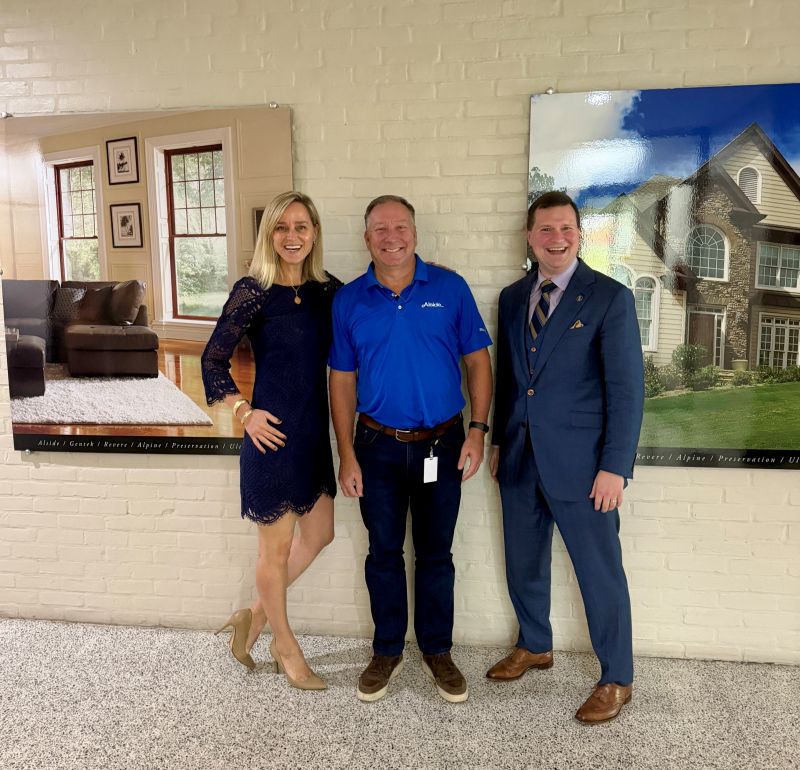
A photograph shared by the National Association of Wholesaler-Distributors’ Dan Schuberth puts Watkoske between visitors, wearing a blue Alside polo. Behind the group are large pictures of homes and interiors. The setting is an apt reminder of the end of this particular supply chain: the materials eventually become someone’s rooms, windows and outside walls.
Schuberth praised the visit and the discussion of Alside’s business transformation. Natasha Wells, commenting on the same visit, emphasized local relationships, category expertise and services for contractors. Those are assessments by visitors, rather than a measurement of results. They also describe the same ground Watkoske has occupied through successive roles: national resources meeting a customer’s particular requirements.
The career that began in 1989 now has a different inventory and a CEO title. Its continuity is easier to see from the loading dock. A promise to a customer travels through salespeople, suppliers, warehouses and delivery arrangements before it becomes useful. Watkoske’s next chapter at Alside rests on how well that journey works, one local order at a time.