Dan Roark’s career can be read as a collection of machines waiting for their software to catch up. First came laboratory instruments and the automated choreography of drug discovery. Then genomics, sample storage, and the formidable scale of the Human Genome Project. Now comes pathology, a field where the microscope still commands the desk and where a glass slide may have to travel before expertise can meet it. Roark, a biochemist and chemical engineer who grew up in Spokane, has spent decades looking at these handoffs. His businesses begin where a skilled person loses time to a stubborn system.
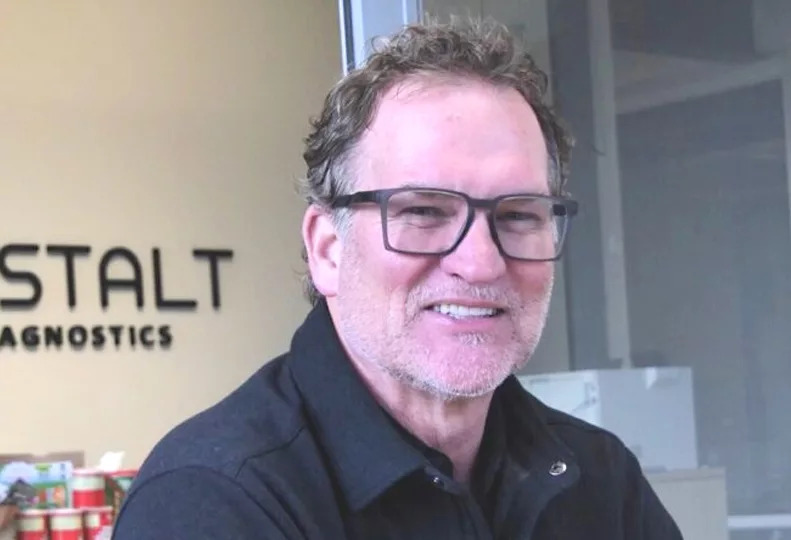
At Gestalt Diagnostics, the Spokane company he leads as founder and chief executive, the stubborn system is the traditional pathology workflow. The specimen is physical. The information about it may live in a laboratory information system. The image, once scanned, may sit in another application. An algorithm may come from a third vendor. A specialist may be in another city. None of these facts is dramatic on its own. Together they produce the familiar corporate comedy in which every tool is excellent and no two tools enjoy speaking to each other.
Gestalt’s answer is PathFlow, a vendor-neutral platform designed to place whole-slide images, case information, collaboration, and artificial-intelligence tools in one working environment. The phrase “vendor-neutral” has the glamour of a printer manual. It is also the point. Laboratories own different scanners and systems; the future cannot reasonably demand that they discard everything at the door.
The useful thing hiding behind the impressive thing
Roark studied biochemistry at Whitworth University and chemical engineering at Washington State University. It is a tidy pairing for his later work: understand the science, then build the system that lets the science operate at scale. He began his career at Tecan, working around laboratory products, applications, and commercialization. In the 1990s, he co-founded CCS Instruments. After the company was acquired by Packard BioScience and folded into PerkinElmer, he moved into vice president and general manager roles.
He then founded Matrical Bioscience, which made tools for drug discovery and biological sample management. Matrical was acquired by Brooks Automation in 2013, and Roark stayed on to lead business development and strategic growth. The résumé contains two exits, global markets, and a role in laboratory automation connected to the Human Genome Project. Roark has said that last contribution, however small in the size of the entire undertaking, is the professional accomplishment that gives him particular pride. He remembers world-class engineers working toward a shared, consequential goal.
There is a useful distinction in that memory. The Human Genome Project was the impressive thing. Automation was the useful thing hiding behind it. Grand scientific ambition required thousands of exact, repetitive actions. A machine did not diminish the scientists; it made their work possible at the required scale. Roark now makes a similar case for digital pathology and AI. The software is there to extend the reach and attention of specialists, not to turn their judgment into a decorative accessory.
“I surround myself with good people, and mentor and provide encouragement for others.”Dan Roark on continuing to grow as a leader
A digital desk for an analog profession
In a 2025 regional-radio conversation, Roark described a field still centered on the microscope even as radiology and cardiology had spent years moving medical images into digital systems. His comparison is revealing. Gestalt is not pitching digitization as a novelty. It is arguing that pathology is arriving at a transition neighboring disciplines have already made.
The transition begins with scanning a slide, but a scan alone is only a large image. It becomes useful when it arrives beside the right patient and case information, opens reliably, can be shared securely, and accommodates the tools a laboratory already uses. That is why the workflow matters. It is also why Roark talks about interoperability so often. An AI model that performs brilliantly in isolation still needs a route into an ordinary working day.
What the connected workflow is trying to do
A 2021 engagement with BioReference Laboratories gave the young company a visible customer and a chance to work alongside scanner maker Leica Biosystems and AI company MindPeak. Roark called digital pathology an industry in the early stages of adoption. He regarded the collaboration as useful proof for other laboratories considering the same move. The language was less conquest than apprenticeship: earn a customer, add features, keep learning, and let the working product make the next conversation easier.
Funding buys a longer to-do list
Gestalt announced a $7.5 million Series A round in April 2025, backed by Cowles Ventures, TVF Funds, Inland Imaging Investments, KickStart Funds, and Pacific Northwest angel investors. The stated plan was practical and demanding: broaden adoption, expand the company’s customer base, strengthen AI capabilities, increase profitability, and pursue clearance from the Food and Drug Administration.
Roark described PathFlow as a unified way to view cases digitally and collaborate with experts in real time without shipping specimens. He also pointed to biomarker scoring and the research value of combining images with structured data. The ambition is not merely to replace a microscope eyepiece with a screen. It is to make the case portable, searchable, shareable, and ready for carefully evaluated computational tools.
The patents offer a glimpse of how grounded that ambition can become. Roark is listed with Gestalt engineering leader Roopam Kakoti on applications and granted design patents involving digital pathology interfaces, slide panels, interactive status icons, and animated graphical elements. Patents sound lofty. Status icons do not. Anyone who has waited for a file, a colleague, or a missing piece of information knows that status is often where a workflow either breathes or quietly expires.
The algorithm gets the applause. The handoff decides whether the algorithm gets used.
The founder away from the dashboard
Roark’s published leadership advice avoids the heroic-founder pose. Building companies requires sacrifice, he says, including a great deal of travel to keep the goals of customers and partners aligned. Employees need support and encouragement. Teams make the products that change markets. Work-life balance matters precisely because startups make it difficult.
He says he develops as a leader by surrounding himself with good people, mentoring, reading the accounts of industry builders, reflecting, and trying to be intentional and level-headed. His favorite motto comes from basketball coach John Wooden: “If you aren’t making mistakes, you aren’t doing anything.” It is a forgiving line with an operator’s edge. Errors are permitted; idleness is suspicious.
Away from work, the machinery gives way to geography. Roark spends time with his family at Lake Coeur d’Alene. He golfs, bikes, skis, hikes, reads, and fly-fishes. He has three children and four grandchildren. The image suits his approach better than a glossy futurist stage: a patient person reading water, aware that effort and control are not identical.
A conversation with Dan RoarkWatch the Ignite Northwest founder interview on YouTube
The long conversion
The history of technology is full of supposedly sudden revolutions that took years of patient integration. Digital pathology looks likely to be one of them. Scanners must fit laboratories. Software must fit security and case systems. AI must fit a regulated clinical workflow. Specialists must trust what appears on the screen. Budgets must find a return. None of this is achieved by a single dazzling demonstration.
Roark’s career has prepared him for that untidy middle. He has built instruments, sold complex products, managed acquired businesses, crossed scientific and commercial cultures, and returned more than once to Spokane to start again. At Gestalt, he is trying to make many pieces behave like one working place. The name is almost too neat: a gestalt is a whole understood as more than its separate parts.
There is no need to romanticize the task. Integration work is meetings, specifications, validation, interfaces, patient iteration, and the occasional icon that tells a pathologist what is ready. Yet this is where the leverage lives. When the pieces connect, expertise can travel without the slide. A colleague can enter the case without entering the building. A useful algorithm can appear where the decision is already being made.
For Roark, faster has never simply meant hurried. It means removing delay that adds no wisdom. It means letting the scientist, engineer, or pathologist spend attention on the part only they can do. After a career among robots, genomes, microplates, images, and interfaces, his enduring product may be less a machine than a principle: science moves at the speed of the system carrying it.