Customer Feedback Software Has a Split Personality
Two Australian startups, Userback and Kapiche, sit at opposite ends of the same problem: one makes feedback easy to capture, the other makes it possible to understand. The gap between them is where most companies get stuck.
Ask a product team whether they listen to customers and you will never hear no. Every SaaS company today has a feedback widget, a survey tool, a support inbox, and a Slack channel where screenshots go to be forgotten. Feedback is not scarce. If anything it arrives faster than anyone can open it. The scarce thing - the thing that quietly decides which companies actually improve - is the reading. And once you notice that, the whole category of customer feedback software starts to look like two different businesses wearing the same label.
You can see the split cleanly in two Australian companies that rarely get mentioned in the same sentence. Userback, out of Brisbane, was founded in 2014 by Jonathan Tobin and Lee Le to fix one specific frustration: feedback that arrives without context. Kapiche, out of Queensland and founded in 2016, went after the opposite frustration: feedback that arrives in such volume that nobody can make sense of it. One company works the moment feedback is captured. The other works the moment someone has to understand it. Put them side by side and you have a map of the entire category.
Half OneMaking feedback easy to catch
The oldest problem in feedback is not getting it - it is getting it in a usable form. "The app is broken" is technically feedback. It is also useless. Which page? Which button? Which browser? What was on the screen? By the time an engineer chases down the answers, the customer has moved on and the bug report has gone cold.
Userback's whole thesis is that half the value of a piece of feedback is the metadata wrapped around it. Its widget lets a user draw on the screen, record a short session, and fire off a note without leaving the product. Behind that simple box, the tool quietly attaches the browser, the console logs, the network activity, the page URL, and custom attributes about who the user is. The customer sends a sentence; the team receives a case file.
The rest of the product follows from that. Everything lands in one inbox - bug reports, feature requests, general comments - so feedback stops living in five tools at once. AI sorts each submission into a rough bucket the moment it arrives. Integrations push the item straight into wherever the work actually happens: Jira, Linear, Asana, GitHub, Slack, Zendesk. The design goal is friction removal. For the customer, one click. For the team, no detective work.
There is a subtle discipline in this that is easy to underrate. The best capture tools are opinionated about what they collect, not just how. A screenshot with a console log is worth more than a paragraph of prose, because it removes ambiguity rather than adding words. Userback's bet is that if you make the right thing to send also the easy thing to send, you get better raw material without asking customers to work harder. Good feedback design is less about persuading people to talk and more about capturing the evidence around what they were doing.
This is the part of the category that has, more or less, been solved. Capturing clean feedback is now a design problem with known answers. That is exactly why it is the easy half - and why owning only this half leaves you with a fuller inbox and no more clarity than before.
Half TwoMaking feedback possible to read
Now imagine the capture problem is solved. Feedback pours in cleanly, tagged, contextual. You still have a problem, and it is bigger: a survey with an open text box and fifty thousand answers. A support queue with years of tickets. Reviews, call transcripts, social posts. It is all real signal, and no human team can read it before it goes stale.
This is where Kapiche lives. It is an AI text analytics platform built to take large piles of open-ended feedback and surface what is actually inside them - the themes, the trends, the sentiment - without a human having to build the categories first. The pitch that makes analysts lean in is what it does not require: no pre-built taxonomy, no manual code frames, no waiting weeks for someone to hand-tag a spreadsheet. You point it at the feedback and the structure emerges.
The claim Kapiche puts front and center is speed - insights up to 30 times faster than doing it by hand. But the more interesting shift is what that speed unlocks. When reading feedback takes weeks, you only ever ask big, infrequent questions. When it takes minutes, you can ask small ones constantly, and follow a hunch before it goes cold. Comprehension at the speed of collection changes what questions are even worth asking.
The other quiet advantage is refusing to make you decide in advance what you are looking for. Traditional feedback analysis starts with a taxonomy: someone guesses the categories, then everything gets sorted into those boxes. The problem is that the interesting signal is usually the thing nobody thought to make a box for - the emerging complaint, the feature nobody planned. By letting themes surface from the text itself, a tool like Kapiche can catch the thing you did not know to ask about. It also merges across channels, so a complaint that shows up faintly in surveys, again in tickets, and again in reviews gets counted as one loud pattern instead of three quiet ones.
Userback
- Annotated screenshots & session replay
- Auto-attached context: browser, console, network
- One inbox for bugs, requests, survey replies
- AI triage into rough buckets on arrival
- Pushes into Jira, Linear, GitHub, Slack
Kapiche
- Reads thousands of open-ended comments
- Surfaces themes, trends & sentiment
- No pre-built taxonomy or manual tagging
- Merges surveys, tickets, reviews, calls
- Insights up to 30x faster than by hand
The GapWhere feedback programs go to die
Here is the trap most companies fall into. They treat "we listen to our customers" as a collection goal, so they keep buying more ways to collect. Another widget. Another survey. Another NPS pulse. Every addition makes the pile bigger and the reading harder, and the backlog of un-acted-on insight quietly grows even as the dashboards fill up.
The bottleneck moved, and most teams did not notice. It is no longer collection. It is comprehension. An open text box is a promise to read the answers, and a team that captures beautifully can still drown. That is the gap between the two halves - and it is exactly where "voice of the customer" programs stall out, not for lack of voice but for lack of listening capacity.
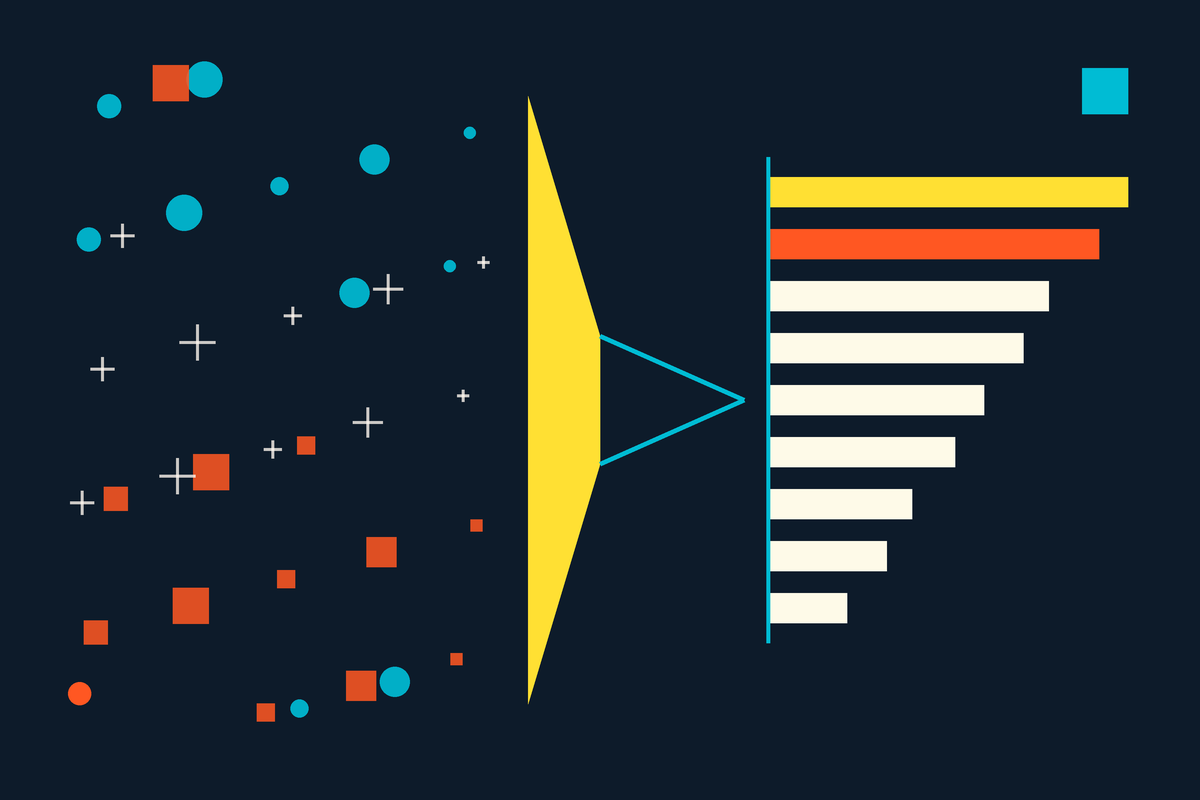
Illustrative funnel of a typical feedback pipeline. The steepest drop is not at capture - it is between "captured" and "read." That drop is the whole business Kapiche is chasing.
Understanding why comprehension is harder than collection is worth a second. Collection is a design problem: make the box appealing, make the click cheap, attach the context automatically. There are good, repeatable answers. Comprehension is a language problem: thousands of messy, contradictory, human sentences have to be grouped, weighted and interpreted. There is no clean widget for that. It is the part where AI is genuinely earning its place rather than being sprinkled on for the pitch deck.
The TakeawayBuy the half you're missing
The useful lesson here is not "pick Userback" or "pick Kapiche." It is to know which half of the problem you are actually short on. If your feedback shows up vague and contextless and engineers waste hours reproducing bugs, your gap is capture, and a tool built around context solves it. If your feedback shows up in volumes no human can read and your best insights arrive too late to matter, your gap is comprehension, and no amount of new capture will help - it will make things worse.
Plenty of teams need both, and the ones with a feedback loop that actually loops usually own both ends: catch it clean, then read it at scale. What is quietly notable is that two of the clearest expressions of each half came out of Australia - Brisbane and Queensland - in a category otherwise crowded with much larger US names. They did not try to be everything. Each picked one hard problem and got good at it. That, more than any feature list, is what makes the split worth watching.
Feedback collection has been eaten by software. Feedback understanding is still being chewed. The companies working that second, harder problem are the ones to keep an eye on - because collecting what customers say was never the point. Knowing what they mean is.
ExploreLinks & sources
- Userback (capture) - userback.io
- Userback features - userback.io/features
- Kapiche (comprehension) - kapiche.com
- Why teams choose Kapiche - kapiche.com/why
- Kapiche on LinkedIn - linkedin.com/company/kapiche
- Kapiche reviews - Gartner Peer Insights
QuestionsThe FAQ
What is customer feedback software?
It is the category of tools that help companies collect and make sense of what customers say - bug reports, feature requests, survey comments, support tickets and reviews. In practice it splits into two jobs: capturing feedback cleanly, and comprehending it at scale.
How are Userback and Kapiche different?
Userback is a capture tool - it makes it easy for users to send annotated screenshots, session replays and bug reports with context attached. Kapiche is a comprehension tool - it reads large volumes of open-ended feedback and surfaces themes, trends and sentiment. One catches feedback, the other explains it.
Why is understanding feedback harder than collecting it?
Collection is a design problem you can solve with a good widget and a few clicks. Understanding is a language problem - thousands of unstructured comments have to be read, grouped and interpreted. That is where feedback programs tend to stall, and it is the part AI text analytics is aimed at.
Do companies need both capture and comprehension tools?
Often, yes. A team can capture feedback beautifully and still drown in it. Capture reduces friction for the customer; comprehension reduces friction for the team trying to act on what was said. Owning only one half leaves the loop broken.
What role does AI play in customer feedback tools?
On the capture side, AI auto-categorizes submissions as bugs, feature requests or general feedback and attaches context. On the comprehension side, it clusters open-ended text into themes and reads sentiment without needing a human to build a taxonomy first.