A cart reminder and a mortgage statement can arrive in the same inbox. To the recipient, both are email. Inside the company, they are almost opposite objects. One is an experiment: change the subject line, adjust the timing, watch conversion and try again. The other is evidence: use the approved language, merge the correct account data, render it precisely, deliver it through an allowed channel and keep a record. Customer communication software has spent years wrapping both jobs in the same friendly words - personalization, journeys, AI and omnichannel. Those words are accurate. They are also a poor way to make a shortlist.
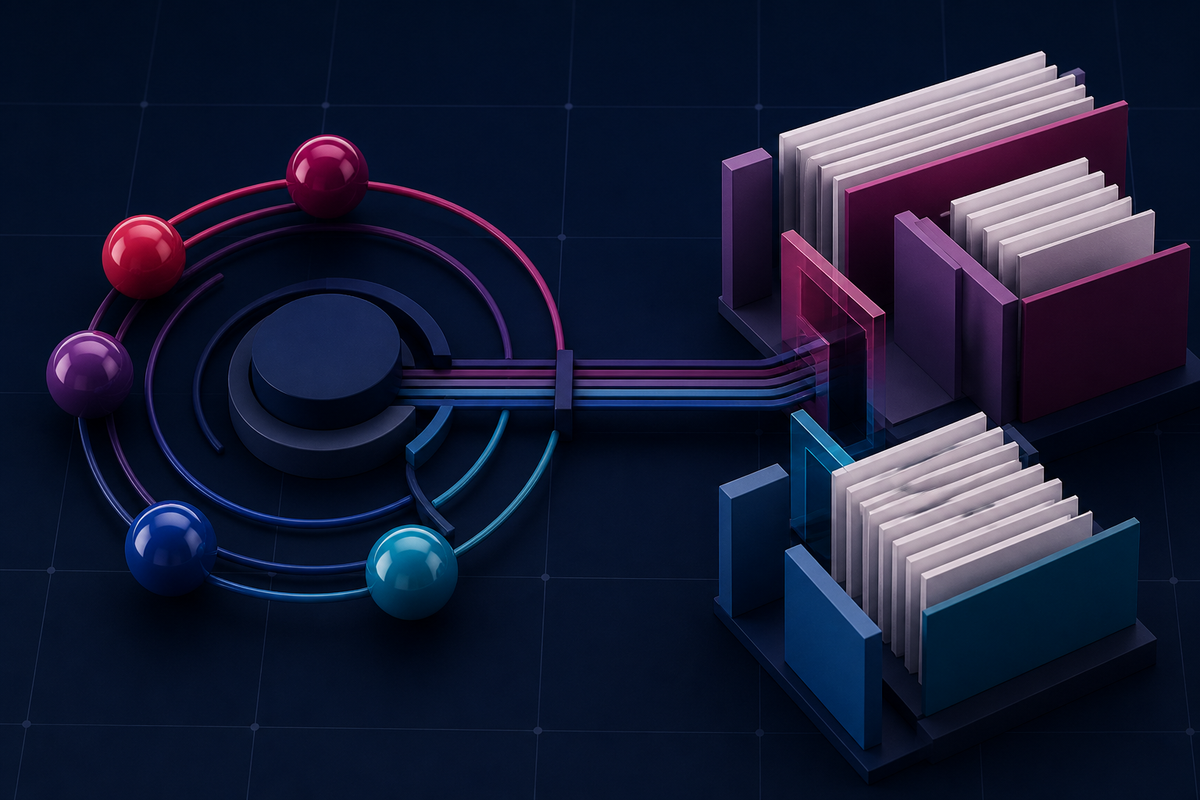
The eight companies in this field guide make the problem visible. CleverTap, Braze, Customer.io, Bird and Intense Technologies lean toward customer engagement: ingest a signal, decide who should hear what and coordinate a response across digital channels. Experlogix, Hyland and Doxim lean toward customer communications management, or CCM: compose documents from trusted data, control changes and deliver output that operations or compliance can stand behind. The line is not a wall. Each group borrows from the other. It is better understood as a center of gravity.
The market's two centers of gravity
Optimize timing, audience, channel and next action.
Control composition, approval, rendering, delivery and retention.
A reflex and a printing press
An engagement platform behaves like a reflex. A person opens an app, abandons checkout, reaches a usage milestone or becomes inactive. The platform updates a segment and changes the next message. Braze's own definition centers on real-time, cross-channel engagement, with orchestration across email, web and mobile push, SMS and in-app messages. Its explanation separates that work from CRMs, which hold relationship records, and from older campaign automation built around schedules.
CleverTap presents a similar loop with a stronger retention vocabulary: customer data and analytics feed segmentation, personalization and campaign orchestration. Customer.io starts from profiles, events and attributes, then lets teams build workflows and send through email, SMS, push and in-app channels. Bird combines messaging infrastructure with campaign tools, drawing email, SMS, WhatsApp, push and other channels into one operating surface. Intense Technologies' UniServe Reach, according to the 2025 Omdia CPaaS assessment, adds visual journey orchestration, segmentation and campaign analytics across channels including SMS, voice, IVR and messaging apps.
Do you need a system to notice what the customer just did, or prove exactly what your company sent?
A document-first CCM platform behaves more like a digital printing press attached to a records office. “Printing” may produce HTML, a PDF, an accessible document, a portal item or physical mail. The defining work happens around the output: templates, business rules, approved clauses, source data, versions, exceptions and archives. Doxim's definition explicitly includes creating, delivering, storing, managing and retrieving communication. Its offering spans digital delivery and print for regulated markets including financial services, utilities and healthcare.
Hyland's Content Composer creates personalized communications and integrates with enterprise applications, office software and Hyland's OnBase content system. Experlogix approaches the category through document automation: data from CRM or ERP systems flows into governed templates and workflows. Those products can personalize at scale, but the personalization sits inside a controlled artifact. A wrong offer is wasteful. A wrong interest rate, policy clause or billing amount can become a dispute.
Where each vendor earns a look
The point of a market map is not to declare a winner. It is to shrink the search. Public product pages reveal what each vendor wants to be hired to do. Read them as invitations, then verify the details in a trial, proof of concept and contract.
CleverTap
Worth a look for consumer apps focused on retention, behavioral analytics, lifecycle segmentation and coordinated mobile-first campaigns.
Braze
Built around real-time data activation, journey orchestration and cross-channel engagement for product and marketing teams.
Customer.io
A natural candidate for web and mobile products that want event-driven workflows, flexible profiles and hands-on campaign control.
Bird
Pairs campaign operations with communications infrastructure across email, SMS, WhatsApp, push and RCS.
Intense Technologies
UniServe Reach connects multi-channel journey design with segmentation and communications operations, with a visible telecom and enterprise heritage.
Experlogix
Fits document-heavy workflows that pull CRM or ERP data into templates, approvals and automated generation.
Hyland
Content Composer makes sense when outbound communication belongs beside enterprise content, process and records management.
Doxim
Targets regulated organizations needing managed composition and delivery across digital channels and physical print.
These descriptions are starting points, not boundaries. Bird now describes a broader AI-powered business platform. Intense combines engagement, communications and CPaaS functions. Doxim speaks about engagement as well as document management. CleverTap and Braze offer governance suitable for large teams. Category borders blur because customers do not experience a taxonomy. They experience one company, even when ten internal systems assembled the conversation.
The overlap is where architecture matters
Most mature companies need both instincts. A bank may use an engagement platform to teach a new customer about mobile deposit, then a CCM system to generate monthly statements. A streaming service may orchestrate recommendations and renewal nudges, while document automation produces contracts for business partners. The useful design question becomes ownership: which system decides, which system composes, which system sends and which system remains the record?
That handoff is where polished demos often become ordinary integration work. Identity has to agree across systems. Consent and channel preference must travel with the customer. A template change needs a clear owner. Delivery events need to return to analytics without creating a second, contradictory source of truth. If two platforms can both send email, the team must decide which one may send which class of email. Otherwise “omnichannel” turns into duplicate messages with different logic.
The people in the room offer another clue. When growth marketers and product managers own the budget, they tend to care about event freshness, experiments, audience building and the time from idea to launch. When operations, legal, records teams or line-of-business administrators lead, they tend to care about template permissions, exact output, review queues, exceptions and retention. Procurement should resist flattening those needs into a single score. A ten-point advantage in campaign creation does not compensate for a missing approval control, and an immaculate archive does not make a sluggish journey engine responsive.
Scale needs a similarly precise definition. It might mean millions of behavioral events arriving out of order, a burst of push notifications after a live match, thousands of individualized policy packs, or truckloads of statements entering the postal system before a deadline. Ask vendors to model the actual peak, including retries and downstream limits. A generic claim about enterprise scale is less useful than a diagram showing where data waits, what happens when a provider fails and how an operator resumes work without sending twice.
- List ten real messages, not ten desired features.
- Name the event or record that starts each message.
- Mark who may write, approve, change and send it.
- Define its required channel, format and accessibility.
- Decide what evidence must survive after delivery.
- Demo a correction, failure and audit - not only the happy path.
The last question does more work than a hundred-item feature matrix. Ask an engagement vendor to show a late event, a duplicate profile and a suppressed message. Ask a CCM vendor to show a clause change, an approval rollback, a malformed data record and a reissued document. Ask both to export the history in a form another system can use. A platform's assumptions become visible when the script breaks.
Buy around the expensive mistake
Software evaluation usually begins with ambition: better personalization, higher engagement, a consistent experience. It should also begin with failure. For a product-led app, the expensive mistake may be waiting a day to react to behavior or making every channel feel unrelated. For a utility, insurer or government agency, it may be sending an unapproved notice or failing to reproduce the document a customer saw. For an industrial sales team, it may be generating a proposal from stale product and pricing data.
This frame also makes AI easier to evaluate. Generating copy is one small task. The harder questions are whether the model may select an audience, alter approved language, choose a channel or act without review. An engagement team may tolerate controlled experimentation in a promotional message. A regulated document owner may restrict generation to suggestions inside an approval process. “Has AI” tells a buyer little. Authority, traceability and fallback behavior tell much more.
The split in customer communication software is not a prediction that the market will divide cleanly. Vendors will keep expanding. It is a buying lens for a category whose vocabulary has become too smooth. Start with the communication whose failure would be hardest to explain to a customer, regulator or chief financial officer. Decide whether its core problem is reaction or production, then evaluate the adjacent capabilities. The shortlist will be less fashionable and more useful.
Frequently asked questions
What is customer communication software?
It is software used to create, personalize, orchestrate, deliver and sometimes store customer-facing messages across digital and physical channels.
How does a customer engagement platform differ from CCM?
Engagement platforms generally emphasize real-time behavioral data and journey orchestration. CCM systems generally emphasize document composition, governance, high-volume delivery and records.
Which platforms here are engagement-first?
CleverTap, Braze, Customer.io, Bird and Intense Technologies place strong public emphasis on cross-channel journeys, behavioral signals or campaign orchestration.
Which platforms here are document-first?
Experlogix, Hyland Content Composer and Doxim put stronger emphasis on document automation, controlled composition, regulated communication, print or archival workflows.
Can a company need both kinds of platform?
Yes. A business may use an engagement platform for product and marketing journeys while relying on CCM for statements, notices, contracts and other governed documents.