A bank can fit on a phone screen. Making it work takes rather more room. Behind the balance, the transfer button and the reassuring check mark sit systems that must exchange information correctly. Avanza Solutions makes much of that connecting machinery. Its product names sound like an unusually ambitious garage: Symmetry, Rendezvous, Vision, Novus. Their jobs are more prosaic, and considerably more useful, than the names suggest.
Consider Bank Makramah in Pakistan. Its August 2024 agreement to upgrade Avanza’s Novus Suite covered an enterprise service bus, card management and transaction switching. Translated from procurement language, the bank was investing in how its systems communicate, how it issues and manages cards, and how transactions travel through ATMs, checkout terminals and online channels. Those are practical foundations for the services customers actually touch.
Avanza occupies an interesting corner of financial technology: the supplier behind the institution whose name appears on your statement. It sells software and implementation expertise to organizations, including banks, insurers, telecom operators and government bodies. Its website reports more than 350 customers across more than 45 countries and over 500 product deployments. Those are company figures, but the customer agreements give the numbers something tangible to stand on.
Rendezvous has a very literal job
The product that best explains Avanza may be Rendezvous. An enterprise middleware platform, it connects existing customer channels to back-end systems and helps institutions add new channels. Think of a bank with an ATM network, a mobile application and a service desk, each needing access to information elsewhere. Rendezvous provides a common route for those exchanges. The work is about messages, connections and transaction processing - the parts of banking that rarely make an advertising campaign.
Around it sits a catalog of specialized products. Symmetry handles digital banking; Ambit covers internet and mobile banking; Acura supports digital onboarding. Novus switches transactions across channels, while Vision covers prepaid and debit-card production. Unison Ace serves customer relationship and experience management. Together, these offerings let Avanza sell several parts of an institution’s digital operations, with implementation work connecting the pieces to the customer’s existing estate.
The distinction between a product and its deployment matters here. A bank buys capabilities, then needs them to fit its own processes. Avanza’s public materials emphasize customization and integration, alongside finished software. That combination makes the company both a product vendor and a delivery partner. It also explains why the commercial relationship can extend beyond the day a system is switched on.
A request enters the bank
Middleware exchanges information
The bank’s services and records
The customer list explains the business
First Women Bank chose Ambit 2.0 for internet banking in 2017. Its own newsletter described a browser-based service intended to make banking more accessible to customers. The bank’s purpose gave that project a particular weight: an institution established to support women’s economic participation was adding a way to bank beyond the branch. The software’s usefulness was measured in access to an existing institution, rather than the creation of another banking brand.
FINCA Microfinance Bank’s 2016 agreement addressed another version of the same problem. It wanted to bring multiple business applications together and extend digital financial services. Rendezvous was assigned the integration role, with Vision supporting monitoring and reporting. In Uganda, Housing Finance Bank selected a combination of Novus, Rendezvous and Vision for ATM and point-of-sale interactions, transaction processing and debit-card operations. Different institutions; a recurring need to connect channels to the machinery underneath.
More recently, Punjab Provincial Cooperative Bank signed an agreement for ATM and middleware solutions in August 2025. That is a useful counterweight to the industry’s fixation on conversational AI. Even as vendors sell intelligent assistants, banks continue to buy the infrastructure that makes ordinary transactions possible. Avanza’s opportunity stretches across both kinds of spending.
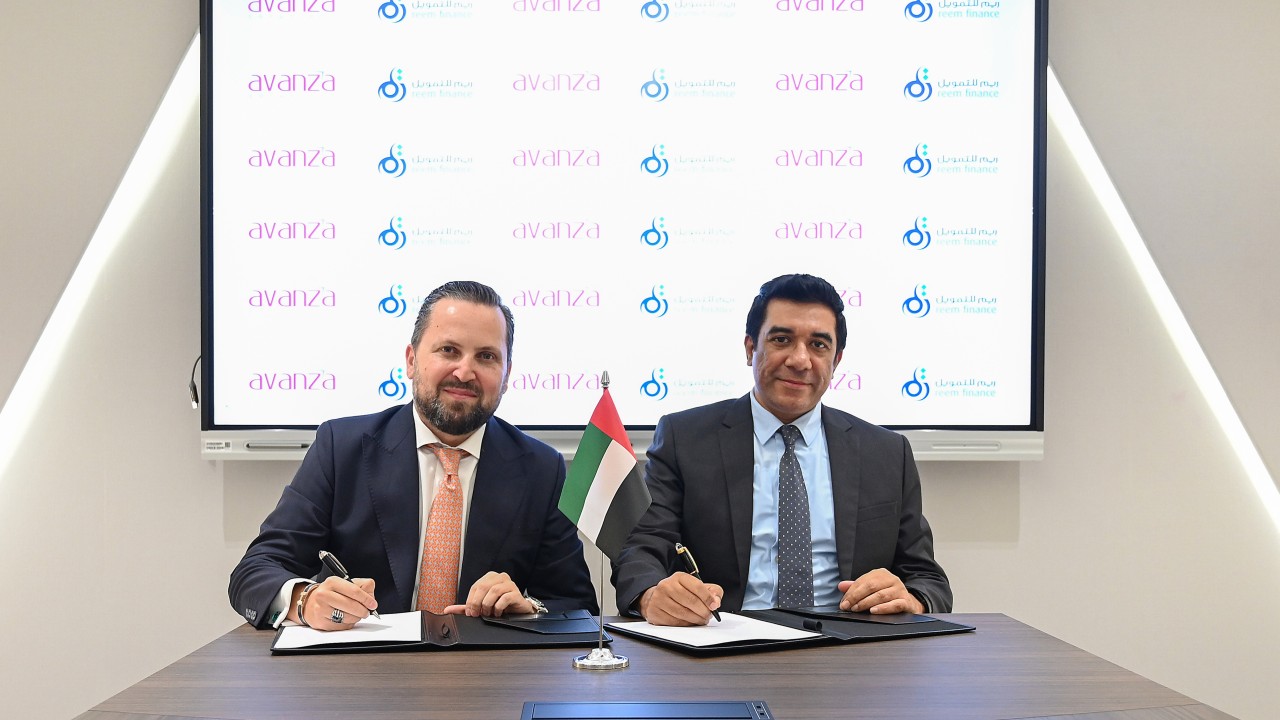
Reem Finance offers a fuller view of the sales proposition. In November 2024, the Abu Dhabi institution announced an agreement spanning Symmetry, Rendezvous, Unison Ace and Vision wallet and card capabilities. Its chief executive, Seraj Faidi, cited product fit, breadth, room for expansion and customization in the selection. His phrase “flexibility in supporting customizations” gets closer to the buying decision than a page of promises about transformation.
A company built around the handoff
Avanza’s current company history dates its work to 2000. By 2015, it was expanding its Dubai office to support sales, marketing and customer service. Balall Yaqub, identified in the contemporary announcement as one of its founders, inaugurated the space with then-CEO Mahmood Kapurwala. Today, the company identifies Omer Ahmed Khan as chief executive. The geographic pattern is commercially sensible: a Dubai headquarters, substantial roots in Pakistan and customer relationships across several regions.
In a 2016 interview, Waqas Mirza, then managing director and chief marketing officer, described a business focused on the Middle East, Southeast Asia, Central Asia and Africa. He also drew a distinction between ordinary distribution and joint work with companies such as IBM, NCR and Avaya. Avanza’s partnerships, he said, included collaborative development and routes to market. That helps explain its role among larger technology suppliers: specialist banking software can become part of a much bigger installation.
The company describes its mission in terms of digitizing organizations and its vision as innovation centered on people. A more concrete glimpse of its working culture appears in its public discussion of an AI Ambassadors program: employees across functions are assigned to share knowledge and support practical adoption. That is a stated internal initiative, rather than a verdict on what it feels like to work there. It does, however, show the current emphasis on making AI part of everyday work.
The price of getting connected
Avanza’s commercial history includes both capital-expenditure and operating-expenditure models. Kapurwala described that flexibility in 2014, alongside tailored solutions and continuing support. The present catalog makes the service side explicit: ATM acquiring, card issuance and management, and enterprise middleware are offered as services. A buyer can therefore evaluate ongoing provision as well as a software implementation, depending on the product and contract.
Its ATM service includes transaction processing, network monitoring and alerts when a machine malfunctions or runs short of cash. The middleware service advertises prebuilt connectors, routing, data transformation and a pay-as-you-go model. These are concrete jobs to outsource. For procurement teams, the useful comparison is the whole operating arrangement: who implements it, who monitors it, who maintains integrations and what happens when requirements change.
There is a dollar figure in the wider Avanza story. In August 2018, Avanza Group and Premier Systems announced plans to invest more than $5 million in a local payment gateway through Avanza Premier Payment Services. That was an announced investment in a separate joint venture. It should not be confused with a funding round for Avanza Solutions or the price of installing its banking software.
Premier’s history dates the venture’s establishment to 2018 and says PayFast received commercial approval in 2021. Allied Bank’s 2019 reporting also records collaboration with APPS so customers could pay merchants through their bank accounts. The sequence illustrates the work beyond writing a checkout page: a payments business needs institutional connections before its network becomes useful to customers.
Announced investment plan for the payment-gateway joint venture, 2018.
AI arrives through the service desk
Unison FuXion puts a newer face on Avanza’s integration business. The product combines banking CRM expertise with Salesforce technology, adding generative AI capabilities such as customer-information summaries and recommendations. Its advertised features include service cases, complaint handling, onboarding and connections to core banking systems. The service bus remains part of the pitch. An assistant can only be useful to a bank employee if it can reach relevant information.
Avanza announced its official Salesforce partnership in September 2025. Its consulting offering now covers implementation, migration, custom development, license optimization, training and managed services. This broadens the company’s route into enterprises already using Salesforce. It also gives Avanza another way to sell the operational knowledge accumulated around customer service and integration, alongside its own product catalog.
The market has other capable suppliers. TPS’s IRIS, for example, offers multichannel payment processing, switching and integration with banking systems. Avanza’s case is therefore a combination of product coverage, customization and relationships with named institutions. Reem Finance’s selection criteria are instructive: fit the institution’s plans, cover the required functions and allow changes. That is a more useful comparison than treating every vendor’s claim of flexibility as a competitive victory.
“flexibility in supporting customizations”Seraj Faidi, CEO, Reem Finance
On selecting Avanza, November 2024
The screen is only the beginning
Avanza’s February 2026 essay on Salesforce returns is unusually useful reading for a prospective customer. It describes how projects can lose value after launch: staff adoption weakens, governance slips, customizations accumulate and managers stop trusting the data. This is the company’s diagnosis of a general implementation problem, not an account of a particular failed Avanza deployment. Its emphasis is revealing all the same. Technical completion and useful daily operation are different milestones.
That diagnosis supplies something readers can copy. Map one customer task across its systems before adding another interface. Decide who owns the information and who maintains the workflow after launch. Judge the project by whether employees and customers can finish the task. These are practical implications of Avanza’s own integration and adoption arguments, rather than a promise that buying a named product produces the result.
They also define the conditions for a sensible purchase. An institution seeking a connected set of banking functions has a reason to examine Avanza’s breadth. One unwilling to maintain data quality, assign operational ownership or adapt processes will struggle to turn those capabilities into better service. Avanza’s recent writing places that continuing responsibility squarely in view. The check mark on the phone is the small, visible end of a much longer job.
Follow the connections
Explore the company’s products, announcements and demonstrations.