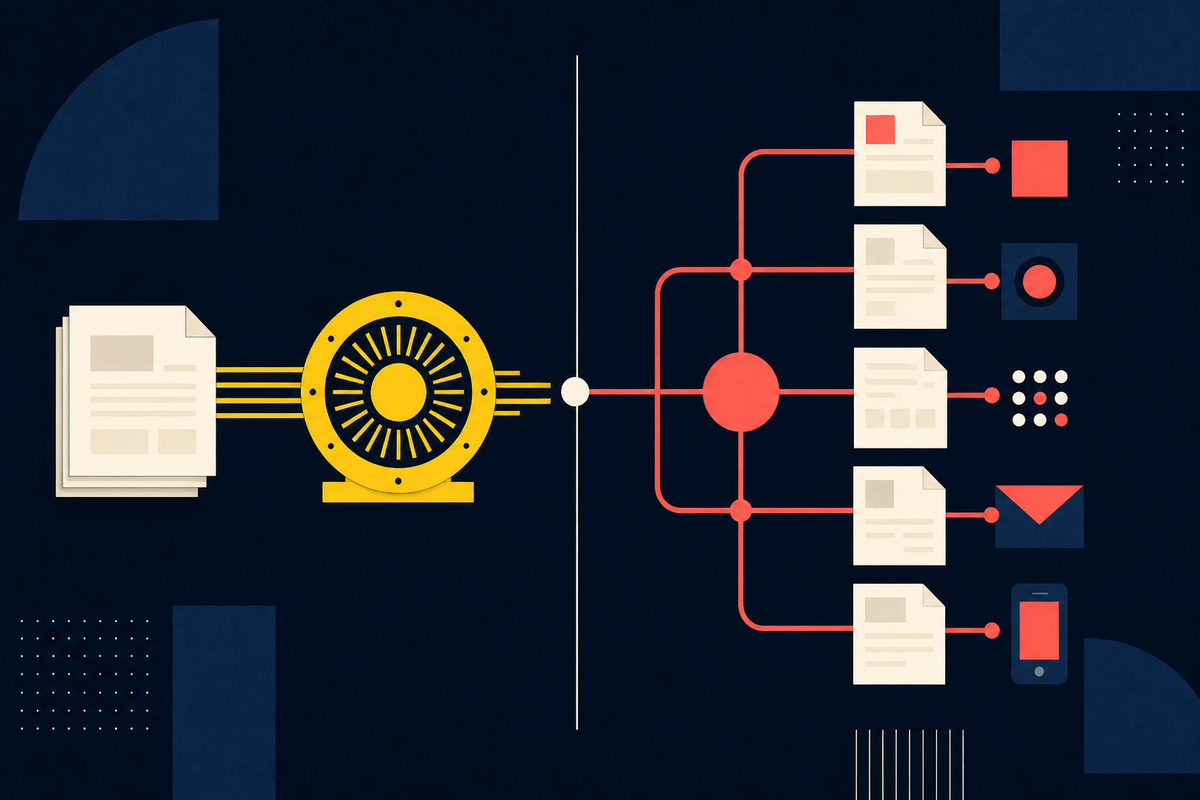
A policy letter lands in a customer’s inbox. It looks like one thing: a few pages, a logo, a name, some numbers, perhaps a disclosure in small type. Inside the company that sent it, the letter may have crossed a database, rules engine, template library, approval queue, rendering service, email gateway and archive. Comparing Docmosis with Cincom Eloquence only by looking at that final PDF is like comparing a motor with a railway because both make something move.
The products overlap, but their centers of gravity do not. Docmosis is a focused document-generation engine. A software team sends structured data to a template and receives PDF, DOCX, ODT or text. It can call a cloud API, run the Tornado service on its own infrastructure, or embed the Docmosis-Java library in a Java application. Cincom Eloquence is presented as customer communications management, or CCM: a broader system for designing, governing, generating and delivering personalized communications across print and digital channels.
That difference is the comparison. A buyer choosing between them is deciding where the new system should begin and end. If an existing application already knows when to send a letter, who may approve it, where to archive it and which channel to use, the missing piece may be rendering. If those responsibilities are fragmented across departments and legacy tools, rendering may be the smallest part of the repair.
Start with the boundary, not the checklist
Docmosis stays close to the application. Its templates are ordinary DOCX or ODT files containing fields and logic. Data arrives as JSON or XML. The engine preprocesses and caches templates, then uses separate converter processes for output. Docmosis says the same broad REST interface is available in its Cloud and Tornado products, which gives teams a practical route from a hosted proof of concept to a self-managed deployment.
Eloquence puts a larger operating model around the document. Cincom describes centralized templates, reusable approved content, visual conditional logic, approval workflows, version control, audit trails, batch and on-demand generation, plus delivery through print, email, SMS, web and mobile channels. Its target users include communications managers, operations teams, compliance officers and customer-service staff alongside IT. That breadth is especially relevant in insurance, banking, healthcare and the public sector, where the wording sent to a customer can be a regulated record.
The humble Word template is not the whole story
Both approaches recognize a stubborn fact about business documents: the people who understand them often live in Word. Docmosis lets template authors work in Microsoft Word or LibreOffice Writer. Cincom says Eloquence embeds licensed Microsoft Word in its authoring environment and adds graphical tools for logic. Neither asks every change to begin as a developer-designed page.
The distinction appears after the first template works. In a Docmosis implementation, a development team will typically own the surrounding application logic, deployment pipeline, permissions and delivery integrations. This can be clean and economical when those capabilities already exist. The application remains the source of truth, and document generation behaves like another infrastructure service.
With Eloquence, the case is that communications deserve their own governed layer. A compliance officer can maintain approved language in one repository. A business rule can select a jurisdiction-specific disclosure. A workflow can request review, produce a batch, route output to different channels and retain an auditable copy. Buyers should verify each of those steps in a demonstration, but the intended ownership model is clear.
Choose the smaller boundary
Best when your product already owns workflow, identity, delivery and audit. The document service receives clean data and returns a file.
Choose the wider boundary
Best when communications require shared governance across business, compliance, operations and IT, with several delivery channels.
Deployment tells you who is expected to operate it
Docmosis offers three explicit paths. Cloud is managed on AWS across selectable U.S., European and Australian regions. Tornado is a self-hosted service for Linux, Windows or containers and exposes a REST API. Docmosis-Java embeds the engine in a Java stack. The company reports SOC 2 Type II compliance achieved in 2025 and offers GDPR documentation and a data-processing addendum for Cloud customers.
Cincom says Eloquence supports cloud and on-premises deployment, with open-standard integrations into CRM, ERP and core systems. Its product pages also emphasize accessible PDF/UA communications, controlled content, audit trails and regulated-industry use cases. These are not equivalent security claims, and procurement teams should request the actual assurance reports, architecture diagrams, retention behavior and subprocessor lists that apply to a proposed environment.
The deployment question is operational, not ideological. Self-hosting can answer data-residency or network constraints, but it transfers patching, monitoring, capacity and disaster recovery to the buyer. A managed service removes some of that burden, but requires close review of regional processing, deletion and incident-response commitments. A product having an on-premises option does not make the implementation effortless.
Pricing reveals product shape
Docmosis publishes prices. As of June 2026, its Cloud Professional plan starts at $49 per month for a 4,000-page monthly quota. Business starts at $64 and Enterprise at $78 at that usage level, with differences in users and environments. The company says it does not charge overages or immediately stop output at quota, although repeated overruns can require an upgrade. Tornado and Docmosis-Java perpetual licenses start at $3,795, with the first year of support and updates included.
Cincom does not publish a standard Eloquence price on the cited product pages. That is common for enterprise CCM, where cost can depend on modules, volume, environments, services and integration scope. It also means a buyer cannot responsibly compare subscription figures alone. Ask Cincom for a five-year cost model, then add the internal cost of implementing the workflow that would sit outside Docmosis. The cheap-looking line item can become expensive if it leaves a large custom system to build. The broad platform can also be wasteful if most of its governance and channel machinery goes unused.
Run a proof built from the ugly cases
Do not begin with a two-page invoice that every tool can render. Bring the template everyone avoids: nested tables, optional sections, page-break rules, several languages, a long disclosure and a missing-data path. Feed it production-shaped data. Change approved wording. Roll the template back. Generate one document and a representative batch. Interrupt a job. Trace what was sent and who changed it.
- Map ownership. Name the team responsible for source data, rules, templates, approval, rendering, delivery, archive and support.
- Test change, not just creation. Time a safe wording update from request to production and verify separation of duties.
- Price the missing pieces. Include custom workflow, channel integrations, monitoring, migration, training and vendor services.
- Inspect failure. Confirm retries, idempotency, partial-batch handling, logs, alerts, recovery and audit evidence.
There is no public head-to-head benchmark here, and there should not be a pretend winner. Docmosis can be the disciplined choice for a software company that wants document generation without adopting a communications suite. Cincom Eloquence can be the disciplined choice for an enterprise trying to consolidate controlled customer communications across people, systems and channels.
The sharper decision comes from drawing the system boundary before inviting vendors into the room. Put every responsibility on the page. Circle the ones your organization already performs well. Mark the handoffs where nobody has clear authority today. The uncircled work, including those neglected handoffs, is the product you need to buy.
Questions buyers ask
What is the main difference between Docmosis and Cincom Eloquence?
Docmosis is primarily a document-generation engine for applications and workflows. Cincom Eloquence is a broader CCM platform for centralized governance, personalization and multichannel delivery.
Can both products be self-hosted?
Yes. Docmosis offers Tornado as a self-hosted REST service and Docmosis-Java as an embedded library. Cincom says Eloquence supports cloud and on-premises deployment.
Do both use Microsoft Word templates?
Both support familiar word-processing authoring. Docmosis uses DOCX or ODT templates made in Word or Writer. Cincom says Eloquence embeds licensed Microsoft Word and adds visual logic and governance tools.
How does pricing compare?
Docmosis publishes Cloud and perpetual-license prices. Cincom does not publish standard Eloquence pricing on the cited pages, so a scoped quote and full implementation cost model are required.
Which should a software team choose?
Choose according to scope. If the application already owns workflow, delivery and audit, test Docmosis. If the organization needs centralized, regulated communications across channels, evaluate Eloquence. Use a proof of concept with real edge cases.