A signature made with a computer mouse is an unlikely place to begin a founder’s story. It lacks the theatrical possibilities of a garage, a midnight revelation, or a cheque arriving just in time. Yet in 2006, while Craig Johnson was chief executive of the young Tulsa company Tenstreet, getting that signature onto a truck driver’s application was part of the point. A person wanted work. A carrier wanted a driver. Between them stood a surprisingly demanding clerical exercise.
Johnson and his co-founders chose to work inside that exercise. Their subject was the passage from interest to employment: the missing information, the requests for verification, the documents that somebody needed before somebody else could say yes. Trucking supplied the setting. The plot concerned how much effort two willing parties could expend before they managed to do business together.
It is a useful way into Johnson’s career because it keeps the attention where his early public remarks put it: on the working details. The products he discussed had practical jobs to perform. Make an application easier to finish. Help an employer hear a driver’s concerns. Give a smaller fleet access to tools it could afford. There is character in a sequence of choices, even when the choices involve forms.
A mouse, a signature, a usable application
Tenstreet was founded in Tulsa, Oklahoma, in 2006. Johnson’s fellow founders were Tim Crawford, Mike Hanisch, Bryan Riddle, and Dale Reagan. The group set out to address hiring inefficiencies for North American long-haul carriers. Employment verification was an early target; Xchange moved requests away from the manual business of faxing them back and forth.
By July that year, Johnson was explaining IntelliApp, a web application that prompted drivers to fill gaps in their employment histories and allowed them to sign electronically. It could sit on a carrier’s own website, carrying that employer’s branding and requirements. Recruiters could access the information online, record notes, and follow applicants through hiring.
His explanation joined two concerns that can easily pull in opposite directions: an application had to be easy enough for someone to complete and thorough enough for a recruiter to use. Removing effort from one side while handing extra work to the other would merely move the queue. The design had to consider both people.
The mouse-made signature belongs in this story for that reason. It connected the convenience of an online form with a document an employer could actually act on. An incomplete application may look encouraging on a dashboard. It still leaves a person with questions to answer. Johnson’s early pitch concerned the distance between receiving information and being able to use it.
The job continued after the hire
By 2008, Johnson was discussing Tenstreet Xtend, a retention service built around communication between employees and management. It combined reports and metrics with personal contact with drivers. The first 90 days after a hire were a particular focus. Getting someone through the door was followed by the less photogenic work of giving them reasons to stay.
Johnson described the aim as helping drivers “feel more connected to their employers.” The service was meant to surface recurring problems, including ones tied to a particular terminal or type of driver. That specificity matters. A fleet-wide average can conceal a very local difficulty; a conversation can give the difficulty a name.
There is an operating philosophy visible here, although it would be extravagant to turn it into a claim about every decision Johnson ever made. In this instance, the technology was there to help an organisation listen and respond. The useful output was an issue someone could address. A report earns its keep when it changes what happens next.
“feel more connected to their employers”Craig Johnson, discussing Xtend, 2008
A free version in an expensive year
In March 2009, Tenstreet offered a free Basic Version aimed at fleets with roughly 200 trucks or fewer. Johnson explicitly connected the decision to smaller carriers’ difficulties in a weak economy. The tools included a customised application page, digital signatures, checks for missing information, and delivery of applications by email.
The decision introduced another dimension to his early tenure. A product can be well suited to a problem and still be unavailable to the business that has it. Tenstreet made a limited set of recruiting functions accessible without a software bill. More extensive versions offered additional capabilities. There was a commercial ladder, with a first rung small operators could reach.
Johnson pointed out that smaller fleets could use transportation-specific technology similar to that used by larger customers such as Prime, CRST, and FFE Transportation. The appeal was concrete: the administrative problem did not disappear because the fleet was small. The software offer recognised that the means to deal with it might be.
Later in 2009, Tenstreet introduced its Communication Engine, extending into orientation, training, and electronic driver files. Johnson explained that training could use Tenstreet material, a carrier’s own content, or a mixture. Once again, the proposal accommodated the employer’s existing operation. The software had to fit into a business already in motion, with its own procedures and people responsible for carrying them out.
The driver gets a progress bar
On September 3, 2015, Johnson published an introduction to Driver Pulse. The announcement was short enough to read between tasks. It described a smartphone app through three functions: a progress bar, the ability to like or block a carrier, and real-time messaging between drivers and recruiters.
The progress bar is the revealing detail. Applying for work often requires giving away information before receiving much in return. Here, a driver could see movement through the recruiting process. The like-or-block function also gave the driver an explicit say, while telling the carrier something about that person’s interest.
Johnson’s description did not require a grand theory of the future. It asked the reader to imagine a candidate seeing an update and a recruiter answering a message. Those are small exchanges with consequences for the people waiting on them. A visible status can replace a question; a conversation can resolve the question that remains.
The launch image has the agreeable bluntness of an early mobile interface: a truck, a green progress bar, a recruiter, and buttons for getting in touch. Its ambitions fit on a phone screen. After years of helping carriers process applicants, the company was giving applicants a place to follow the process themselves.
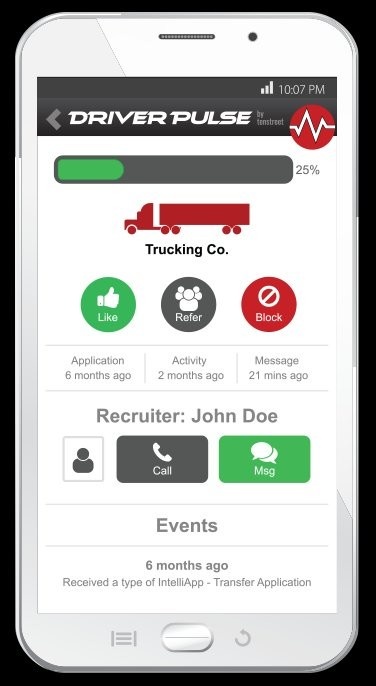
A little less waiting in the dark.
Progress. Preferences. A conversation with the recruiter.
DRIVER PULSE / 2015Ten years, then a different chair
In November 2016, Tenstreet announced an investment from Spectrum Equity after a decade of bootstrapped, profitable growth. Tim Crawford would become CEO. Johnson would lead the board as chairman. The change made a clear division between the founder’s first operating chapter and the company’s next one.
At the time of the transaction, the business reported a database of more than 3.5 million unique drivers and over 150,000 online applications being auto-populated each month. These were measures of repeated use: information already supplied could save effort on another application. The scale gave the original paperwork problem a different dimension.
Johnson’s remark about the milestone centred on colleagues. He spoke of pride in “the high caliber of the professionals that have allowed Tenstreet to succeed.” The wording directed attention toward the people doing the work at the moment the company was introducing a new financial partner and a new chief executive.
The transaction also involved the usual less glamorous machinery of a deal. In his comments about adviser Capstone Partners, Johnson credited help with expectations, negotiations, a letter of intent, and the definitive agreement. Even the business built to simplify paperwork eventually had paperwork of its own. Some forms, apparently, require a supporting cast.
A geek with colleagues to recommend
Johnson’s public LinkedIn introduction calls him an entrepreneur, a geek, and a patriot, and records service in the U.S. Marine Corps. The combination is his own description. It offers a more personal glimpse than the sequence of product announcements, without needing an invented account of how military service shaped his management.
A recommendation from Thomas J. Karalis praises his integrity and commitment to employees, then adds a warning about playing him at golf. Recommendations are testimonials, and this one should be read as a colleague’s view. Still, the golf aside is a welcome interruption in the language of business biography. Someone has evidently considered the competitive implications of a tee time.
The original question keeps returning
In April 2026, Tenstreet marked its twentieth anniversary. The company said Driver Pulse had been used by more than 3.6 million drivers. That later milestone belongs to the business and the teams that continued its development after Johnson’s CEO tenure. It also shows how far the driver-facing application travelled from the modest launch he introduced in 2015.
Tenstreet’s June 2026 analysis, drawn from approximately 5,000 carriers, returned to a familiar concern: communication. The company said driver interest, supported by personalised contact and recruiter engagement, remained its strongest predictor of a hire. Even as it introduced an AI assistant, the problem still involved the quality of the exchange between people.
Read across Johnson’s early decisions and a consistent question emerges: what is preventing the next useful conversation or action? In 2006, the answer could be an incomplete form. In 2008, an unheard concern. In 2009, the cost of access. In 2015, a driver waiting without a clear view of progress. The remedies differed because the obstacles did.
That gives his founding chapter its shape. Johnson helped build a company by paying attention to work that people were obliged to do and had little reason to enjoy. A completed application, an answered message, a signature in the right place: each is a modest event. For a person waiting to start a job, modest events can move the day along.