A truck can be ready to leave while its next driver’s paperwork is still waiting for somebody to answer. That mismatch is a peculiar business opportunity. The vehicle is expensive, the job is urgent, and somewhere between the applicant and the recruiter sits a request for information that another company already has. Tenstreet began by shortening that wait. Over twenty years, it has turned the administrative side of trucking into a place where drivers and carriers repeatedly meet.
- The entry point: replace faxed employment-verification requests.
- The habit: let drivers reuse application information and manage jobs in Pulse.
- The business: sell connected workflows to carriers while keeping the driver app free.
- The catch: faster paperwork still needs a recruiter, a suitable job, and sound judgment.
The first bottleneck had a fax number
Tenstreet was founded in Tulsa in 2006 to tackle hiring inefficiencies for long-haul carriers. Its early target was employment verification: requesting and returning information by fax. There is something wonderfully modest about that starting point. Before a company can improve an industry, it may have to improve the thing beside the office printer.
Xchange moved that exchange online. The important unit of work was a handoff between organizations, rather than a task inside one office. Digitizing a form helps one person. Connecting the person who needs the answer with the person who holds it helps a relationship. A verification network becomes more useful as more participants can respond through it.
Tenstreet’s founders included Tim Crawford, Craig Johnson, Mike Hanisch, Bryan Riddle, and Dale Reagan. A transaction adviser’s account describes a decade of profitable, bootstrapped growth before Spectrum Equity’s majority investment in 2016. That sequence matters: the company had found a recurring problem that customers would pay to solve before outside capital arrived.
An editorial map of Tenstreet’s approach, rather than a performance chart.
A form that remembers
IntelliApp applies the same logic to the driver’s application. A person who has entered their history before can reuse that information for another participating carrier. The saving is unusually easy to understand. Applicants have already done the work; the software remembers it. For someone applying from a phone, a familiar form with fewer empty boxes offers a practical reason to finish.
Driver Pulse gives that convenience a home. Drivers can search for jobs, see application activity, upload documents, and communicate with carriers. They can also use truck-specific navigation and dock information. Those features give the app things to do between job searches, when a recruitment-only app would have little reason to be opened.
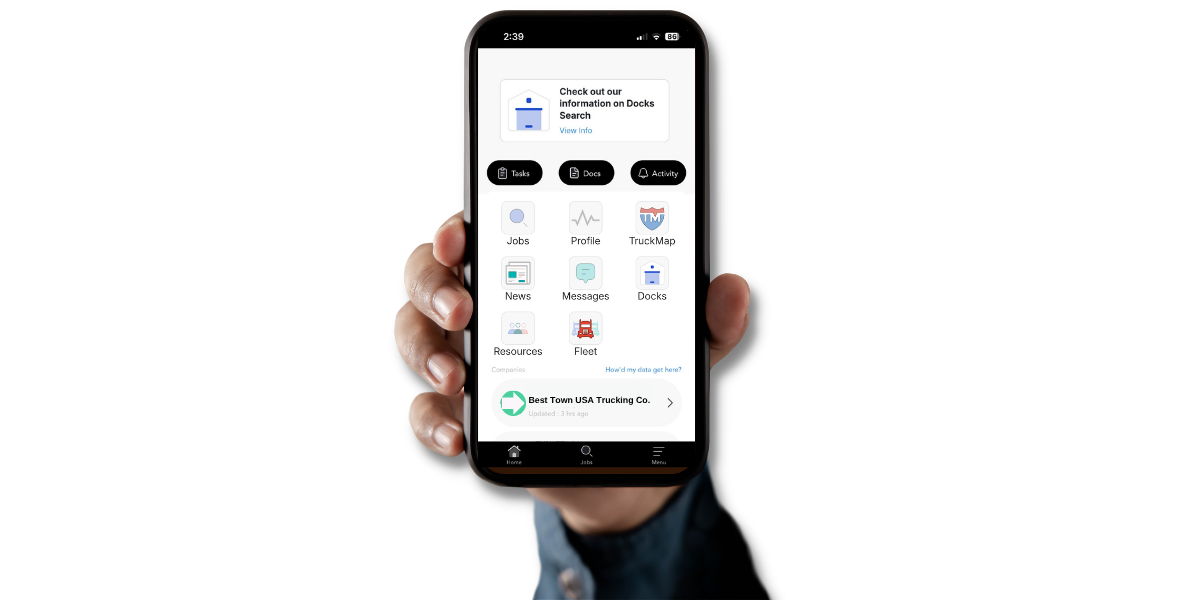
The driver also needs to know where their information went. Pulse’s Application Transparency view shows the companies with which an application has been shared and lets the driver manage contact preferences. Tenstreet says it does not sell driver data. Trust is part of the economics here: a reusable profile is convenient only if its owner is willing to keep using it.
This is Tenstreet’s place in the market: trucking-specific hiring and driver management, with a network attached. Foley overlaps in hiring and compliance, J.J. Keller in compliance services, and SambaSafety in driver-risk monitoring. A fleet can also assemble separate tools. Tenstreet’s appeal is the reduction in handoffs between those jobs, together with an application process many drivers have already encountered.
One recruiter, 487 hires
JoyRide Logistics offers a concrete example. Tenstreet’s case study says the carrier’s outsourced provider could not keep pace with demand that sometimes required 20-30 drivers in less than a week. Seeing the platform’s capabilities prompted assistant safety director Alma Delic’s team to bring recruiting in-house.
“The process with the third-party provider was very slow.”Alma Delic · JoyRide Logistics
The carrier reported 487 hires with one recruiter over two years. Sister company Orior Media connected advertising leads to the dashboard, while applications, checks, and documents lived together. These are customer-reported results published by the vendor. The combination of software, marketing integration, and internal ownership deserves the credit; installing an account is not the whole experiment.
JoyRide’s reported result describes a connected operation, including its advertising partner.
There is an earlier illustration at Great Plains Transport. In 2020, talent placement specialist Joe Richey told FreightWaves that Tenstreet had shortened hiring by 10-15 days. When a candidate’s checks were in order, he said approval and an offer could take 45-60 minutes. The qualification matters. Software can gather the answer faster; the answer still has to support the hire.
The invoice has several moving parts
Tenstreet sells carriers subscriptions and configurable packages. Pricing depends on fleet size, the products and services selected, and other company-specific variables. Its pricing page says an annual contract is not required. For small fleets, On Demand offers month-to-month access, with job openings remaining visible even while the subscription is inactive.
That makes sense for a fleet that hires in bursts. A quiet month does not have to erase its presence in the job market. Drivers, meanwhile, use Pulse free. The carrier pays for a more manageable operation; the driver contributes participation because the tools save time.
Employment checks introduce a less cheerful detail. Tenstreet’s October 2025 support guidance says network providers can charge for responses. A free option can delay sending the request by a provider-set period of one to twenty-seven days. Tenstreet says it opposes charging for verifications, but accommodated providers as the market changed. On paid verifications, it states a ten-percent maintenance fee.
Paperless, then, does not automatically mean costless or immediate. A sensible fleet comparison would put the subscription, advertising, screening, and verification charges beside recruiter time and the delay before a truck can earn revenue. That is an evaluation method, rather than a universal savings promise. The costly part of a process can move when another part becomes faster.
Hiring was only the entrance
A driver’s application creates information the safety department will need later. Tenstreet’s electronic driver qualification files keep documents together and flag missing or expired items. Its Safety Center connects recruiting records with screening, monitoring, and other safety information. In January 2026, Platform Science described Pulse at Work’s integration for communication, training, and driver metrics in its operating environment.
Beyond safety, surveys and rewards give fleets ways to ask about the experience of working there and recognize desired behavior. True Fuel addresses driving habits that affect consumption; True Load Time adds information about waiting at docks. The connecting idea is the driver’s working day. Recruitment creates the relationship, but pay, delays, communication, and daily frustrations influence whether it lasts.

Investment and acquisitions have widened that scope. Providence Equity Partners took a majority position in October 2021, with Spectrum and Crawford retaining minority stakes. In 2025, Tenstreet acquired TextLocate, adding driver communication and freight visibility, and DriverReach, adding a recruitment and compliance business. The DriverReach announcement specifically emphasized combining audiences and improving usability. Old competitor lists miss that change.
TextLocate’s app-free approach is a useful detail. A broker can request location updates through text instead of repeatedly calling a driver. Tenstreet has a driver app, yet it also bought a way to communicate without requiring one. The route into a workflow should suit the person doing the work.
Automation still needs someone to answer
At its May 2026 UConnect conference, Tenstreet introduced Assistant, an AI command center for routine carrier work. The announcement projected a twenty-five-percent saving in time on routine tasks while preserving carrier control over key decisions. That figure is a projection, so it belongs in a purchasing conversation as something to test against the fleet’s own workflow.
The company’s June analysis, based on anonymized data from approximately 5,000 carriers, offered a useful counterweight to the product launch. Personalized engagement remained strongly associated with hiring success. It also warned that longer driver tenure could reflect uncertainty in the freight market, making apparent retention gains vulnerable when conditions improve.
The lesson readers can copy starts with the queue: identify where information waits, enter it once, connect the next handoff, and give a person responsibility for responding. Measure completed hires and their durability alongside application volume. Tenstreet’s tools make sense when those repeated tasks consume real effort and someone is ready to use the time released.
A poor job offer can still be declined. An ignored message can still end a conversation. Incorrect information needs correction, and Tenstreet’s own FAQ leaves compliance primarily with the client. The fax machine was a useful enemy because it was a visible source of delay. The harder question, after removing it, is whether the people at either end are finally having a better conversation.
Take the next turn
Explore Tenstreet, Driver Pulse, its carrier packages, and the company blog.