Imagine a store associate who needs an answer about a new policy before a customer reaches the register. The headquarters memo exists. So does the email chain. Neither is much use to a person standing on a shop floor, with a phone in one hand and a customer in front of them. Enterprise software has spent years solving the problem of sending information. The harder problem is making that information arrive where a decision happens.
That is Convo's wager. The Los Altos company built a collaboration app around a familiar social feed, then gave the feed work to do: hold files, keep comments attached to them, gather votes, record acknowledgements and connect people by chat or call. The product is available on web, iOS and Android. Convo now also sells custom software development and AI-assisted consulting, a second business that makes its website read less like a single-product startup and more like a software studio with a house product.
- What it sells: a workplace collaboration platform and software services.
- Who it serves: enterprise teams, including staff away from desks.
- Its proof point: Convo said H&M used it across more than 500 US stores.
- Its useful trick: comments can point to the precise part of a shared file.
The room where the document can answer back
The first generation of enterprise social networks borrowed the shape of Facebook. Employees posted, liked and followed. Convo arrived in that crowded market with a $5 million Series A from Morgenthaler Ventures in 2013. It faced Yammer and Salesforce Chatter, companies with larger distribution and deeper pockets. A feed alone was never going to be enough. So Convo made the object inside the conversation more important than the conversation's speed.
Open a file in Convo and a teammate can mark a particular area, add a comment and send someone back to that exact place. The company says annotations work across more than 60 file formats, including images, documents and video. Its deep comment threads keep an answer close to the question that prompted it. This is a modest-looking design decision with an expensive adversary: the meeting called because six people are talking about different versions of the same thing.
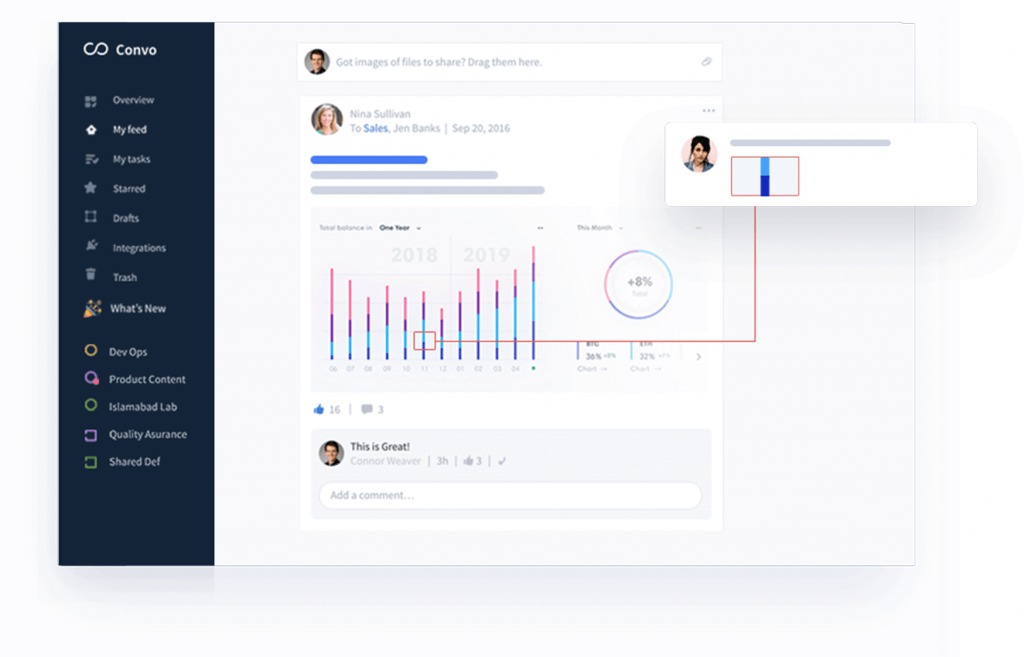
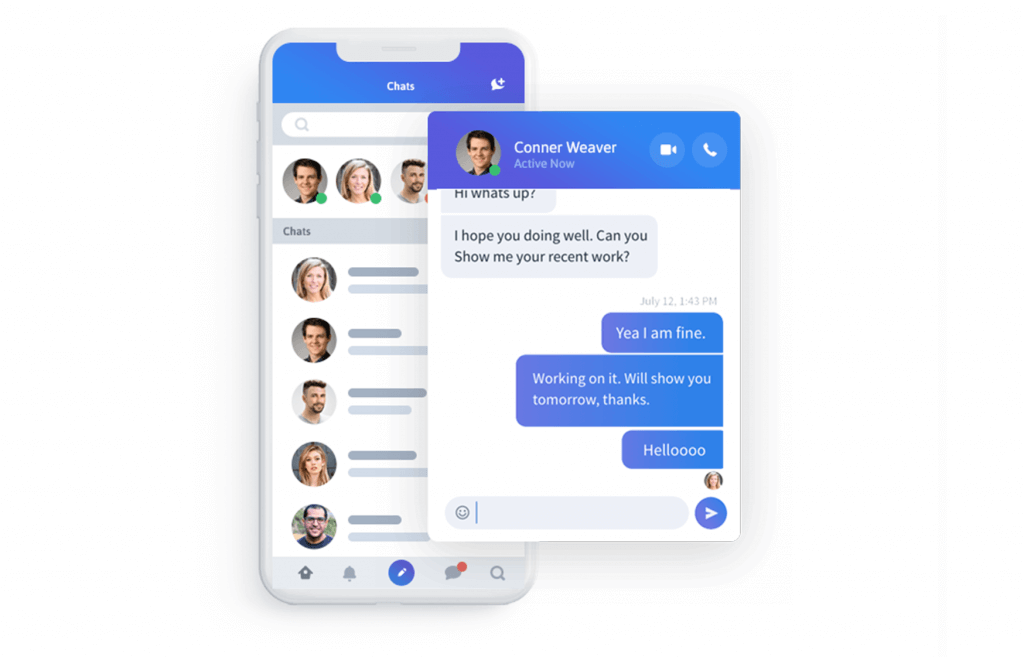
Convo's product writing makes a pointed case against the endless chat channel. A message stream is lively when everyone is present. Return after lunch and it becomes an archaeological site. A post with its own thread, shared files and annotations can be read later without reconstructing the entire day's chatter. Convo still includes direct and group chat, along with audio and video calls. It treats chat as one mode of work, rather than the filing system for all of it.
Five hundred stores make a better test than a demo
In 2018, Convo announced that H&M had deployed its retail-focused platform in the United States. Its figure was more than 15,000 employees across over 500 stores. Those numbers deserve to be read as the company's account of a deployment, not a claim about every H&M employee's daily use. Even so, they describe the right sort of challenge: a workforce spread across locations, shifts and roles, with many people who do not sit at corporate email all day.
Convo's retail pitch was a mobile feed that could connect desk and non-desk employees without requiring corporate email. That distinction changes what counts as a useful feature. A manager may need to know whether a safety update was seen, not merely sent. Convo added acknowledgement posts that let a sender see when recipients opened a message. It also added pinned-content pop-ups, polls and location-tagged posts. Each is a small answer to a concrete management question: Did they see it? What did they choose? Where did the update come from?
There is a boundary here. A read receipt proves that someone opened a post; it cannot prove understanding. A feed cannot fix a policy written badly, a phone with no signal or a manager who ignores replies. For teams trying Convo's pattern, the copyable part is less glamorous than the interface: choose one recurring decision, put its source document and discussion together, and decide in advance what acknowledgement should mean.
The price of a seat, and the price of context
Convo's public pricing is refreshingly specific. Starter is free for up to ten users. Premium is listed at $6.67 per user per month, or $80.04 per user per year. Enterprise requires a sales conversation. The tiers change more than the invoice: Starter limits searchable history to 200 posts; Premium expands users and search; Enterprise adds features including larger calls, analytics and account support. The pricing page lists calls of up to four participants in Premium and up to 20 in Enterprise.
The buying decision is therefore practical. A small team can test whether its documents and conversations benefit from living together. A larger organization must consider administration, security, search and rollout. Convo lists encryption in transit and at rest, two-factor authentication and enterprise controls. These are procurement questions, not decoration; the more of a company's work that lands in a shared feed, the more carefully access and retention must be managed.
The second act is a services business
Convo's current homepage leads with AI-powered software consulting. It offers web and mobile app development, UX and UI design, product management, ERP integration, cloud services and custom workflows. Its portfolio describes work for Zip Homes, product-discovery company Zoovu, an education testing platform called TEPS, teen mental-health app BeMe and SOAR STEM School. The pages describe Convo's role in those projects; they do not publish contract values or independent outcome measures.
The apparent turn makes commercial sense. A company that spends years asking enterprises how information travels inside their teams learns where the awkward seams are. Some clients may want the ready-made feed. Others may need a custom application, integration or workflow. Convo now offers both. Its AI language emphasizes human decisions assisted by software, though the public site gives few measurable results for that newer service line. The product history supplies the more tangible record.
One partnership shows how this broadened work can meet local constraints. In 2020, Pakistan Telecommunications Company Limited and Convo announced a memorandum of understanding to bring localized collaboration software to enterprises in Pakistan. Convo's chief executive, Osman Rashid, pointed to banks that needed data hosted within the country. That is a different sales conversation from persuading a team to abandon email: infrastructure location can determine whether a customer is allowed to buy at all.
What the feed has to prove
Convo fits between chat tools, intranets and workflow software. Microsoft Teams and Slack can carry quick conversations; a company portal can publish policy; a task system can track action. Convo's claim is that the moment between those activities matters. Put the instruction, the document, the question and the response in one place, and the next person may inherit a decision rather than a mystery.
That claim works best where the same material is discussed by many people across time or location: retail operations, distributed project reviews, onboarding and regulated communications. It is less compelling for a tiny team that already shares a room, or a group whose work is mostly brief, disposable messages. Software cannot make a conversation worth keeping. Convo's bet is that, when it is worth keeping, the workplace feed should be able to earn its keep.