Colleen Barry has a neat way of explaining a complicated business. Start with the thing everybody knows: the little box that interrupts a website to ask about cookies. “Those annoying cookie banners,” she once said when asked how she describes Ketch to a friend. Then she widens the frame. The banner is merely the visible edge of a much larger problem - what a company may collect, where that permission travels, how it changes, and whether dozens of systems obey it. In Barry's hands, a nuisance becomes an invitation to look backstage.
That move says something about her work as Head of Marketing at Ketch. Privacy technology sits where software, law, advertising, and ordinary human impatience collide. Each field has a dialect and a professional incentive to keep speaking it. Barry's job is to make the conversation coherent without sanding away the useful difficulty. She oversees work across demand generation, product, operations, brand, and partnerships. She also hosts The Privacy Huddle, a weekly show that has become her most visible classroom.
Her route there was less a leap than a long rehearsal in translation. She grew up in the Chicago suburbs, attended the University of Illinois Urbana-Champaign, and spent much of college managing, marketing, and performing with the Rip Chords, a women's a cappella group. Long before she was arranging lawyers and technologists around a microphone, she was helping arrange voices.
First came the ensemble
In February 2007, the Rip Chords placed second in a regional quarterfinal of the International Championship of Collegiate A Cappella. The result advanced them to the Midwest semifinal. Barry, then a senior in Liberal Arts and Sciences, described the group as soulful, powerful, and known for R&B. Their competitive set contained just three songs. The point was not abundance. It was to take a small selection and work until the blend held.
She later described her college years as an education in creating a captivating brand and story that could drive results. A cappella supplied a practical version of that lesson. A group keeps distinct voices, but nobody gets to ignore tempo, arrangement, or audience. Marketing has its own versions of those constraints. The product team knows the mechanics. Sales hears objections. Legal sees exposure. The customer experiences one company.
“I think each of the groups has a different energy and something different that they bring to each show.”Colleen Barry, speaking as a University of Illinois senior in 2007
After college, Barry joined Burwood Group, a Chicago technology consultancy, through its sales organization in 2009. She started in business development, moved into an account executive role, and learned the ropes selling IT services and cybersecurity technology. In a recent recollection, she was frank about not yet knowing what she was doing and grateful to an experienced colleague who helped rescue difficult deals. The memory has none of the varnish that usually coats a career origin story. Competence arrived through proximity, repetition, and other people.
Sales left fingerprints on the marketing
Barry moved from account work into marketing and partnerships in late 2013, then became Burwood's Director of Marketing Communications in 2017. By the time she left in 2021, she had spent roughly 12 years inside the same company while changing the nature of her job several times. That tenure matters because it put marketing beside the people responsible for closing business, delivering services, and preserving technical credibility.
One lesson was to favor useful depth over the content treadmill. During a search strategy project at Burwood, Barry called the shift from a rigid publishing schedule toward substantial, evergreen material a “real lightbulb moment.” It is an unfashionably durable thought. A publishing calendar can count output. A customer only remembers whether the page answered the question.
Learning the arrangement
Managed group operations and performed as president of the University of Illinois Rip Chords.
Learning the customer
Worked in business development and account sales at Burwood Group.
Building the marketing function
Moved through partnerships management into the director role at Burwood.
Giving permission a vocabulary
Joined Ketch and built marketing around privacy infrastructure, responsible data, and growth.
The result is a marketer unusually preoccupied with alignment. Barry's public writing returns often to the seam between sales and marketing - sometimes with earnest advice, sometimes with delighted disbelief when a sales leader sends the sort of appreciative message marketers treasure. At Ketch, the seam multiplies. Privacy teams must work with marketing, digital, product, engineering, security, and outside counsel. Every handoff is a place where a promise can stop traveling.
The permission story, translated
The host who asks for one more bridge
The Privacy Huddle began in 2023. By July 2026, its numbering had crossed 100. Episodes are usually compact and current: a regulator's latest move, a consent design problem, a demand letter, a data map that cost too much and explained too little. Barry sits with in-house counsel, privacy officers, founders, product leaders, and regulators, then asks the question that connects their expertise to the viewer's work.
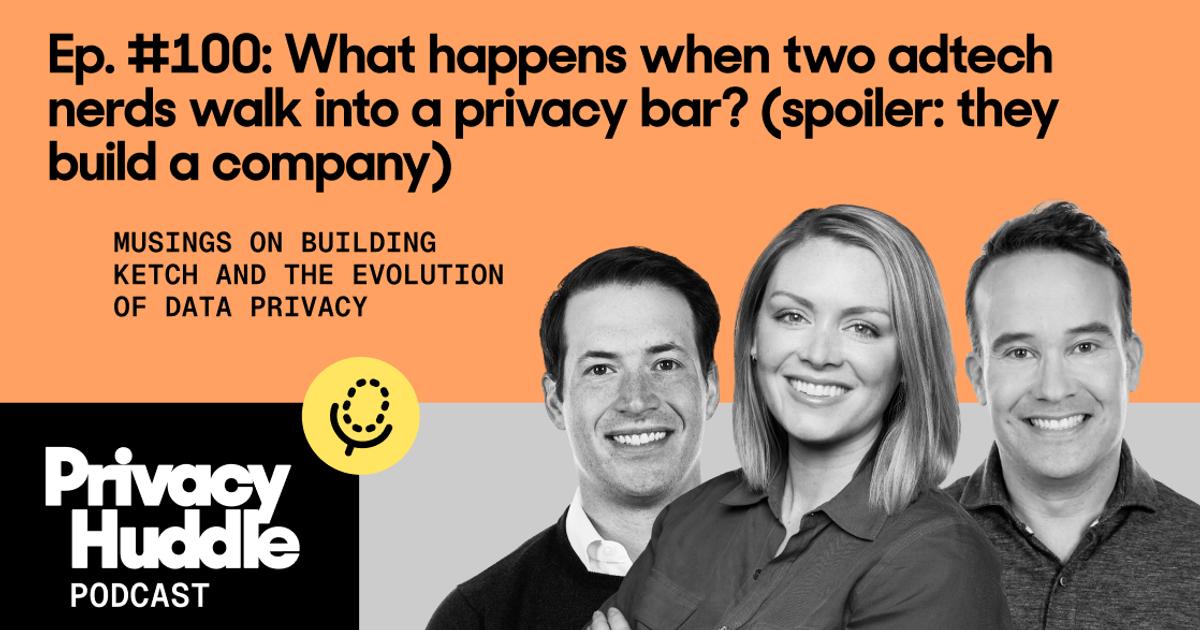
For episode 100, she brought Ketch co-founders Tom Chavez and Maxwell Anderson together to inspect the company's first six years. The warm-up included cocktails. The recording included teasing, abandoned terminology, and an honest account of early product ideas that confused prospective buyers. Barry kept returning the founders to three concepts that endured: orchestration, identity, and auditability. The episode felt less like a victory lap than a friendly audit.
Her hosting persona depends on being prepared without pretending to know everything. In one revealing episode outside the show, Barry asked Anderson whether a slide about digital trackers could be made simpler. Anderson said it was already as simple as the lesson allowed. Another expert agreed: privacy practitioners needed to lean in and learn. Barry later shared the exchange herself, including the jab at her occasional tendency toward marketing fluff.
That is a useful kind of candor. A weak translator removes the machinery and leaves a slogan. A stronger one knows when the machinery is the story. Barry's public conclusion was equally plain: working in data privacy means choosing to remain a student.
Privacy with a sense of occasion
Barry's professional voice has room for octopus mascots, hotel keycards, espresso-martini riffs, and the ongoing campaign to persuade privacy people that banana bread lattes deserve a hearing. At conferences, she notices the booth palette and the last-minute cherry blossoms as well as the panel topic. For customer gatherings, she has helped turn privacy discussion into “Cocktails with Ketch.” The levity is not an escape from the subject. It is a way of giving people a reason to enter it.
Her written portfolio at Ketch shows the other half of the job. Since 2021, her byline has appeared on explanations of GDPR, data privacy, zero-party data, wiretapping laws, consent tools, rights automation, risk intelligence, marketing preferences, and audit-ready reporting. She co-authored a 2025 report on poorly permissioned data and AI. In 2023, she was among the Ketch team credited on a computer animation recognized by the Red Dot Design Award.
In 2026, the role continued to expand in public. Barry moderated conversations with privacy leaders and regulators, helped organize industry gatherings, and led the launch of Iris, a scanning approach designed to improve visibility into the trackers, tags, and cookies operating across a website. The common task is not merely explaining what software does. It is showing why data control belongs in the same conversation as revenue, customer experience, and AI.
Privacy is “a data problem with legal implications.”A recurring Ketch principle Barry has used to frame the market
This is Barry's central argument: permission should not live in a ceremonial banner and die at the next system boundary. A consumer's choice needs to reach the places where the data is actually used. When it does, the business can work with information it has a reason to trust. When it does not, a polished notice becomes stage scenery.
The argument also explains why her varied beginnings fit together. Sales taught her to listen for the objection. Long-form content taught her to answer the actual question. A cappella taught her that distinct voices can share an arrangement without losing their character. Hosting taught her that expertise becomes more useful when somebody keeps the tempo and asks for one more bridge.
Privacy will not become simple because a marketer wishes it so. It can become legible, conversational, and connected to the work people already care about. Barry has made that narrower promise the basis of a career. It is less theatrical than eliminating complexity. It is also much harder to fake.