Ninety-nine seconds is an awkward amount of time in which to explain your life’s work. Long enough to get into trouble with a technical term. Short enough to discover that the audience has no idea why your invention matters. At the inaugural Founders Live Tampa Bay competition in July 2025, five startup founders had exactly that long to make their case. Karla Jo Helms had helped bring the event to town. For someone who makes a living thinking about public understanding, the format was practically a laboratory.
The gathering took place at The Birchwood in St. Petersburg. There were questions after the pitches, and the audience chose a winner. The rules imposed a useful inconvenience: founders could know everything about their businesses and still have to earn the room’s attention. Expertise came with no automatic exemption from being clear.
That problem has occupied Helms for years. She is the founder and CEO of JOTO PR Disruptors, the Tampa-based agency where her titles include Chief Evangelist and Anti-PR Strategist. The second title comes with a small, deliberate provocation. A public relations professional announcing her opposition to PR is rather like a restaurateur declaring war on dinner. You want to hear the explanation.
A dancer learns a different kind of timing
Her first intended audience was a very different one. Helms wanted to dance from the age of five. At college she was a dance major and professional performer, part of a precision dance team whose engagements included government occasions and national sporting events. She attended Kilgore College. Public relations was not the career she had pictured.
There is an appealing temptation to make every early ambition predict the later business. Dance becomes discipline; choreography becomes campaign planning; the stage becomes a boardroom. A life is usually less obliging than that. The useful fact here is simpler: Helms had already invested herself in one demanding craft before establishing a career in another. The founder’s title arrived after an earlier version of the future.
“Never give up means not compromising on your values.”
Karla Jo Helms
She describes persistence as something learned through practice. That is a more interesting account than the familiar founder story in which determination appears fully assembled at birth. It leaves room for uncertainty, adjustment, and the unglamorous business of becoming competent.
Her professional formation in communications came through crisis management. She worked alongside litigation attorneys, private investigators, and the media, helping companies respond when public opinion had become a business problem. This is communications with a deadline that cannot be sweetened by another planning session. An explanation has to survive scrutiny, and an organization has to understand what people already believe about it.
Helms carried that sense of urgency into the agency she founded in 2009. The recurring question in her work became why businesses should wait until a reputation is under pressure before treating public understanding as something that requires sustained attention.
Her early writing also shows a less theatrical side to the business. In a 2009 article about talking to the media, she urged clients to understand the individual journalist: what that person covers, what interests them, and how they approach a story. Courtesy and preparation mattered. The reporter was another person with a job to do.
That observation puts some useful limits around the language of disruption. However forceful the positioning, an interview still involves listening. Someone has to do the homework, answer the question, and respect the other person’s time. Those small professional habits are less conspicuous than an agency’s name, but they help explain how its argument reaches an audience.
A business built around an impatient question
The agency’s founding account starts with research rather than a particularly well-stocked address book. Helms says her team researched 5,000 fast-growth company CEOs to understand what they wanted from PR, how they used it, and how they judged its worth. The point was to design a business around the buyer’s expectations, including the troublesome expectation that spending should lead somewhere measurable.
Fast-growth company CEOs in the market research Helms says informed her agency’s model.
Her complaint about the trade is blunt: too much mystique around publicity, too little clarity about the commercial purpose. The Anti-PR name gives that complaint a memorable wrapper. Beneath it sits a fairly practical proposition. Earned credibility should make a company easier to understand and trust, and its communications should connect to the rest of the business.
There is a distinction worth keeping. A media mention is an observable event. A change in a prospective customer’s confidence is harder to isolate. Helms’s argument asks the agency and its client to keep working on that relationship rather than treating the publication of an article as the end of the assignment.
Her own responsibilities grew along with the business. In October 2014, the company announced that she had acquired full ownership. The announcement emphasized technology, automation, and the organization of work. Even at an ownership milestone, the operating machinery received a substantial share of the attention.
Her role also involves selecting staff and overseeing campaign strategy. The public persona likes a sharp phrase. The business underneath it depends on a much less quotable collection of decisions about people, processes, and delivery.
When the office walls came down
One of those decisions arrived well before working from home became a routine corporate argument. In July 2015, JOTO announced that its entire workforce was going remote. The agency had already used remote contributors. Moving everyone required a more deliberate system for meetings, production, deadlines, and accountability.
Helms’s later account gives the change some texture. A client had recommended Remote, by Jason Fried and David Heinemeier Hansson. An employee also proposed making the switch. Some staff faced lengthy commutes. There was a practical opportunity, but the first six months felt rough to the person running the company.
She missed the stability she associated with a physical workplace. Three staff members left during the first year. By her 2017 account, the group that began with five employees had grown to 17. She also described an unexpected benefit: recruiting beyond the area surrounding the office. These are her historical figures, describing that transition rather than today’s team.
People, before and after the move
Employee counts from Helms’s retrospective account. A historical comparison, not current headcount.
It is a revealing episode because she lets the awkwardness remain in the story. The advocate for measurable execution had to revise her own sense of what a functioning workplace looked like. The office had offered reassurance. Running without it required more explicit agreements about the work.
Ninety-nine seconds in St. Petersburg
A decade later, her attention was also on the surrounding startup community. As Founders Live Tampa Bay’s city leader, Helms wanted regional entrepreneurs to gain exposure and connections beyond their existing circles. She saw a place with worthwhile businesses whose recognition had not caught up with their work.
She also saw fragmentation. “I think it’s a bit too siloed,” she said. Her ambition was to bring founders, investors, and other participants into a more connected local network, with the global competition providing a route to audiences elsewhere. A room can be useful precisely because people have to leave their separate routines to enter it.
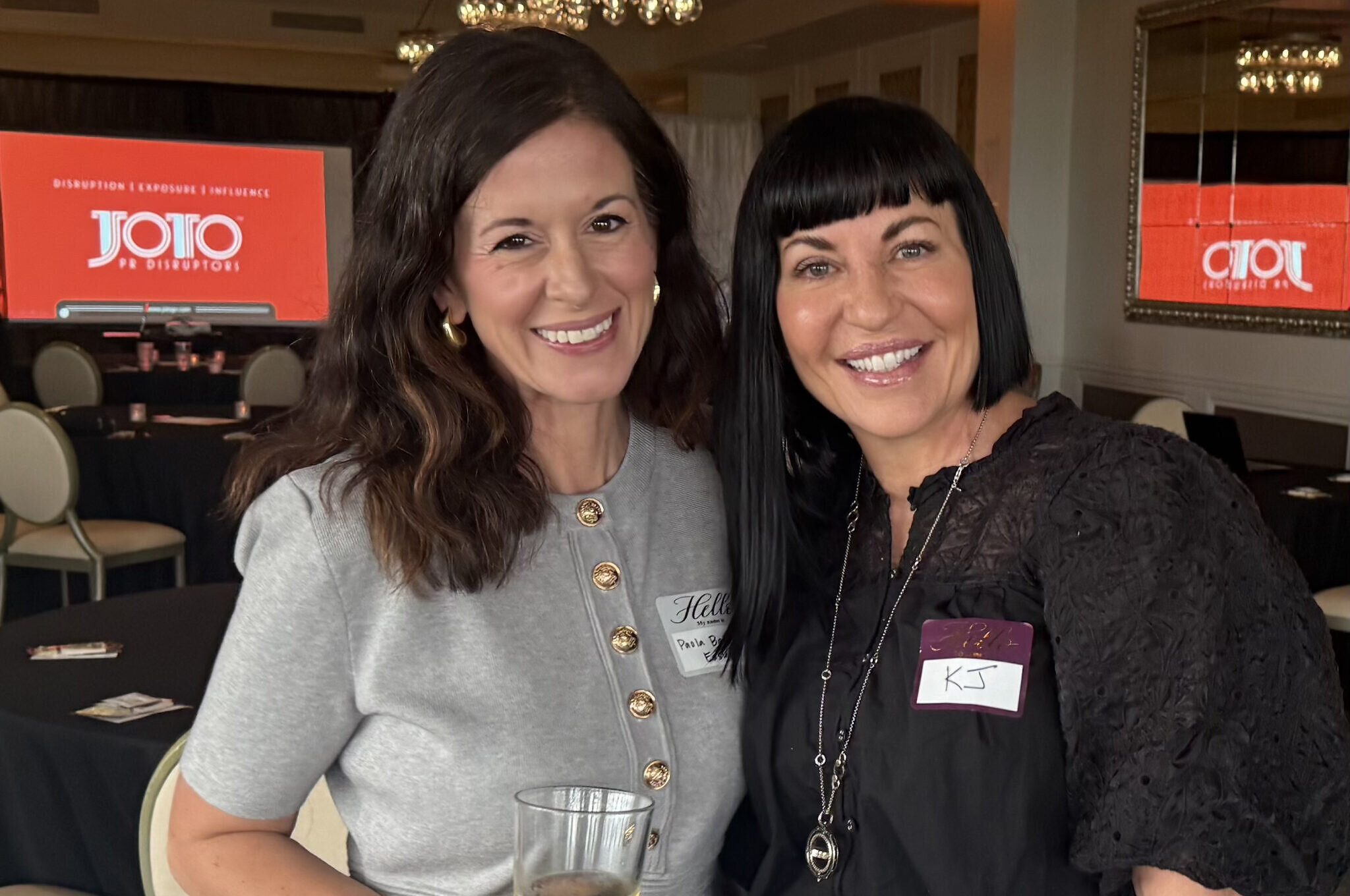
Paola Ballester, left, with Helms at Founders Live Tampa Bay in July 2025. The pitch clock allowed 99 seconds; the photograph was less demanding. Photo: JOTO PR Disruptors / PR Newswire.
The inaugural event on July 17 gave the idea a concrete form. Five founders pitched; attendees asked questions and voted; Paola Ballester, representing Easy PA, won. The format placed the audience inside the decision rather than leaving judgment entirely to an expert panel.
For Helms, the community project extends a concern already visible in her client work: unfamiliar technology needs an explanation people can use. A founder may see the elegance of the solution. The listener first needs to understand the difficulty it addresses. Those are different starting points, and ninety-nine seconds makes the distance between them conspicuous.
The microphone and the machine
On Disruption Interruption, Helms occupies the other side of that exchange. She hosts conversations with people developing businesses and challenging established practices. The subjects range beyond publicity itself. A conversation with Torin Ellis, for example, examined organizational communication, trust, and the human relationships surrounding new tools.
The microphone gives her a recurring opportunity to hear how founders explain change. It also requires a different professional posture. An agency strategist arrives with advice; an interviewer has to keep discovering what the other person knows. The two jobs can inform each other if curiosity gets enough room.
Her published work carries the discussion into other settings. She has written for business publications including Entrepreneur and CEOWORLD, while her 2025 EdUp Experience appearance brought her perspective to institutional narratives. The question changes its setting, but remains recognizable: how does an organization become understood outside its own walls?
In October 2026, her writing turned to earned media and AI search. Her concern was what happens when a prospective customer encounters a machine-generated description of a business before visiting its website. An article can influence that description after the original burst of attention has passed. The reputation keeps traveling, without necessarily sending back a click.
She argues for useful evidence, a defined area of expertise, and consistency between what a business says and what credible outside voices associate with it. This gives her longstanding interest in public opinion another setting. The audience may now meet a summary assembled elsewhere, yet the business still needs to deserve the explanation attached to its name.
Back at the pitch clock, the same problem takes a more human form. A founder has built something, an audience has questions, and time is limited. Helms’s career keeps returning to that encounter. The announcement gets its moment. Being understood takes longer.