On January 9, 1964, Anthony “Tony” Franco opened a public-relations counseling firm in Detroit’s Book Building. It had three employees and four accounts. The phrase public relations still sounded new enough to need explaining. Sixty years later, the company bearing his name was buying Google ads, producing video, building dashboards, advising executives through crises and teaching marketing teams how to use artificial intelligence. This looks, at first, like a story about adding services. It is actually a story about learning what not to preserve.
Franco kept the name, the Detroit address and the belief that business runs on human trust. It did not keep the assumption that publicity alone could solve every communications problem. Today, the agency sells an integrated system: paid media, earned media, shared media and owned media, tied together by strategy and measurement. In the trade, that arrangement is called PESO. In plain English, it means the press release, the social post, the email, the search ad and the landing page should know one another exists.
The fork in the road came early
In 2000, Franco faced an unusually clean choice. It could remain a full-service generalist with clients across industries, or turn itself into a high-tech specialist around accounts such as Microsoft. It chose the generalist path and spun off its high-tech work. This was not a timid compromise. It gave up attractive business to protect a broader idea of the firm.
That decision mattered eight years later, when Detroit’s automotive economy seized up. A varied roster - including Comerica Bank, Panera Bread, ITC Holdings, The Salvation Army and a data firm - made the agency less dependent on one industry’s weather. The first thing to fail was not Franco; it was the premise that expertise must mean a single vertical. The agency discovered another kind of specialty: knowing how to translate complicated organizations for the people they need to reach.

A campaign with the client sitting inside the office
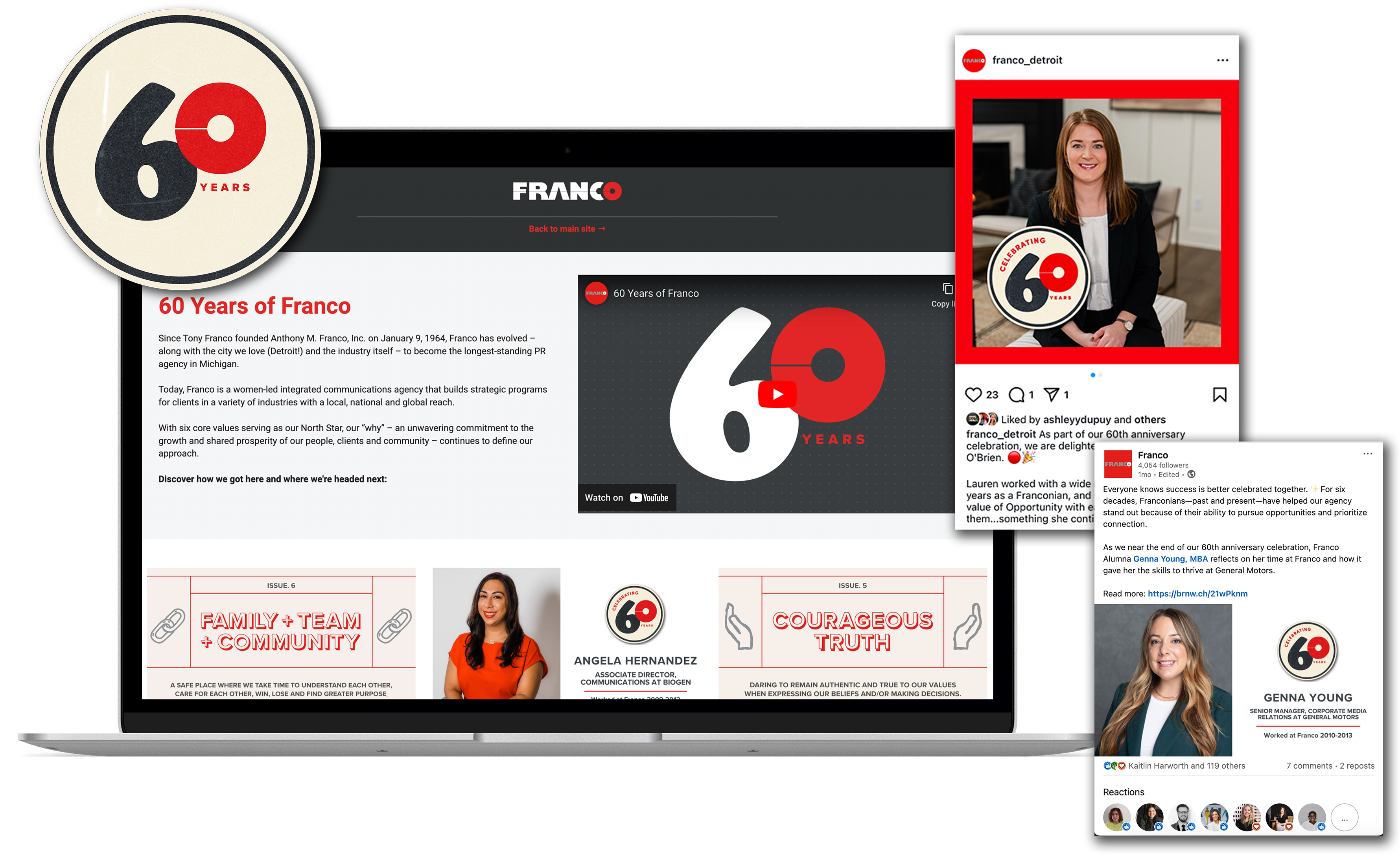
The neatest demonstration arrived in 2024, when Franco turned 60. The anniversary coincided with an ownership transition: CEO Tina Kozak became majority owner, with Tina Benvenuti Sullivan and Nikki Little as minority owners. Franco was now wholly women-owned. A conventional agency might have sent a release, ordered a cake and called the exercise complete. Franco made itself the client.
The team built a vintage-inflected anniversary identity, a landing page, video, alumni stories, email newsletters, podcast episodes, social reels, earned-media pitches, Google and LinkedIn ads and an event with PRSA Detroit. One fact fed every channel: the oldest PR agency in Michigan had changed hands without losing its place in the city.
The social work produced 217,300 impressions, up 33 percent year over year, with a 4.27 percent cross-channel engagement rate. The landing page drew more than 28,000 views and a 77.8 percent engagement rate. Google ads delivered 24,288 clicks and 1.64 million impressions while costs fell by half. The exact campaign budget was not published, but the important cost story was: integration did not mean spending on everything. It meant making each asset do more than one job, then shifting money toward what worked.
What the agency actually sells
A client may arrive asking for media relations. Franco’s job is to decide whether that request is the answer or merely the most familiar noun in the room. Sometimes the real need is an email sequence, a sharper executive position, paid search, a community meeting or a crisis plan. That diagnostic step is the difference between a list of services and an operating model.
The newest example is AI enablement, launched as three defined offers: a combined SEO and AI-visibility audit, a hands-on readiness workshop, and ongoing transformation consulting. Franco publishes a price range of $8,700 to $16,500, depending on scope. That number is useful because agency work often hides behind “contact us.” It also reveals the product underneath the advice: a diagnostic, a roadmap, working protocols and measurement targets - not a magic tool dropped into a team’s lap.
One problem, four kinds of attention
Paid - search, social, digital and traditional advertising that can be targeted and adjusted.
Earned - media coverage, expert positioning and third-party credibility nobody can simply purchase.
Shared - social content and communities where the audience can answer back.
Owned - websites, email, video and research the client controls and can keep compounding.
The customers are a mix that would make a narrow agency nervous: automotive suppliers, hospitals, economic-development groups, nonprofits, restaurants, professional firms and consumer brands. The work ranges from discreet crisis counsel to public launches. For New Economy Initiative’s MI Small Business Helper, Franco combined an event, ambassadors, media outreach and tracked creative. The launch beat its 200-visitor benchmark and generated more than 900 sessions, 3,000 views and 368 new users. For Cabela’s first metro Detroit store, the agency earned more than 100 placements and helped draw over 10,000 opening-weekend visitors. For Hard Rock Cafe Detroit, a localized PR and social campaign accompanied a 140 percent sales increase over 15 months.
These examples reveal the distinction Franco wants buyers to notice. An impression is evidence that something was seen. A store visit, subscriber, applicant, volunteer, sale or new user is evidence that someone moved. The agency business is very good at counting the first thing. Franco’s best case studies keep going until the second.
Three owners, then one acquisition
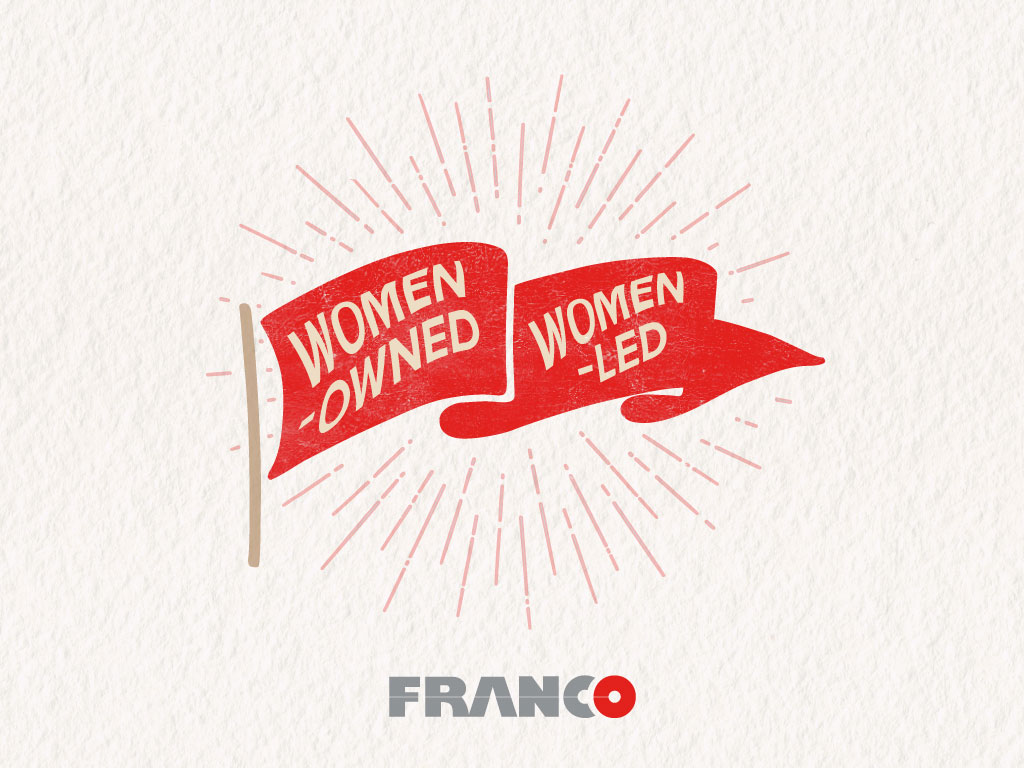
The ownership change was followed by certification from the Women’s Business Enterprise National Council in 2025. That same year, Franco acquired Bianchi Public Relations, a respected automotive and mobility specialist founded in 1992. The purchase price was not disclosed. What Franco bought is easier to name: long client relationships, specialized auto knowledge and experienced people. Bianchi’s clients gained access to Franco’s marketing, digital and creative bench; Franco deepened a sector that has shaped Detroit and the agency since the beginning.
There is a pleasing contradiction here. In 2000, Franco rejected becoming a specialist. In 2025, it bought specialization. The difference is that Bianchi’s expertise became a strong room inside a larger house rather than the whole house. Franco then joined the Public Relations Global Network as its exclusive Michigan member, giving the independent firm access to local partners across more than 40 countries without pretending a Detroit office understands every market on Earth.
The part worth borrowing
Most companies cannot copy sixty years of media relationships. They can copy the sequence Franco uses when its work is strongest.
Name the business movement
Replace “get coverage” with the thing a person should do next: visit, register, apply, donate, buy or trust.
Give every channel one argument
A coherent campaign repeats the same central truth without turning every format into the same piece of content.
Build the measurement before launch
Benchmarks, tagged links and agreed definitions prevent the post-campaign hunt for a flattering number.
Preserve judgment, not habit
Relationships and local knowledge compound. A favorite tactic merely ages.
This approach has boundaries. Integration multiplies a clear idea; it does not rescue an empty one. It becomes expensive theater when the client cannot agree on a goal, give the agency access to decision-makers or move quickly when the evidence changes. Earned media also refuses to behave like paid media: there is no guaranteed placement, and a weak product does not improve because four channels describe it at once. The system works when an organization has something true to say, the patience to coordinate and the nerve to stop funding activity that produces no movement.
Where Franco fits
Broader than a PR boutique. Smaller and more senior-led than a holding-company network. Deepest where Detroit relationships, mobility knowledge and integrated execution overlap.
The wager
Clients will value one accountable team connecting the channels more than a collection of specialists protecting their silos.
A mile up Woodward
In early 2026, Franco left the Renaissance Center, where it had been an original tenant for nearly half a century, and moved about a mile north to the Palms Building in Detroit’s sports and entertainment district. The relocation is almost too tidy a metaphor: the same avenue, a different room.
Franco now has roughly 30 employees and reported $5.38 million in 2024 net fees in O’Dwyer’s industry ranking. It is not a global conglomerate, and that is part of its pitch. It offers the range of a larger agency, the attention of a mid-sized independent and a Detroit network that cannot be hurried into existence. Its competitors can buy the same software and hire for the same channels. They cannot buy 1964.
But age, on its own, is no strategy either. The instructive thing about Franco is the way it makes history submit to a current brief. The founder supplied a name. Detroit supplied a network. Successive owners supplied the willingness to alter the machine. The result is not a company that survived by staying the same. It is a company that became old enough to know which parts were never sacred.