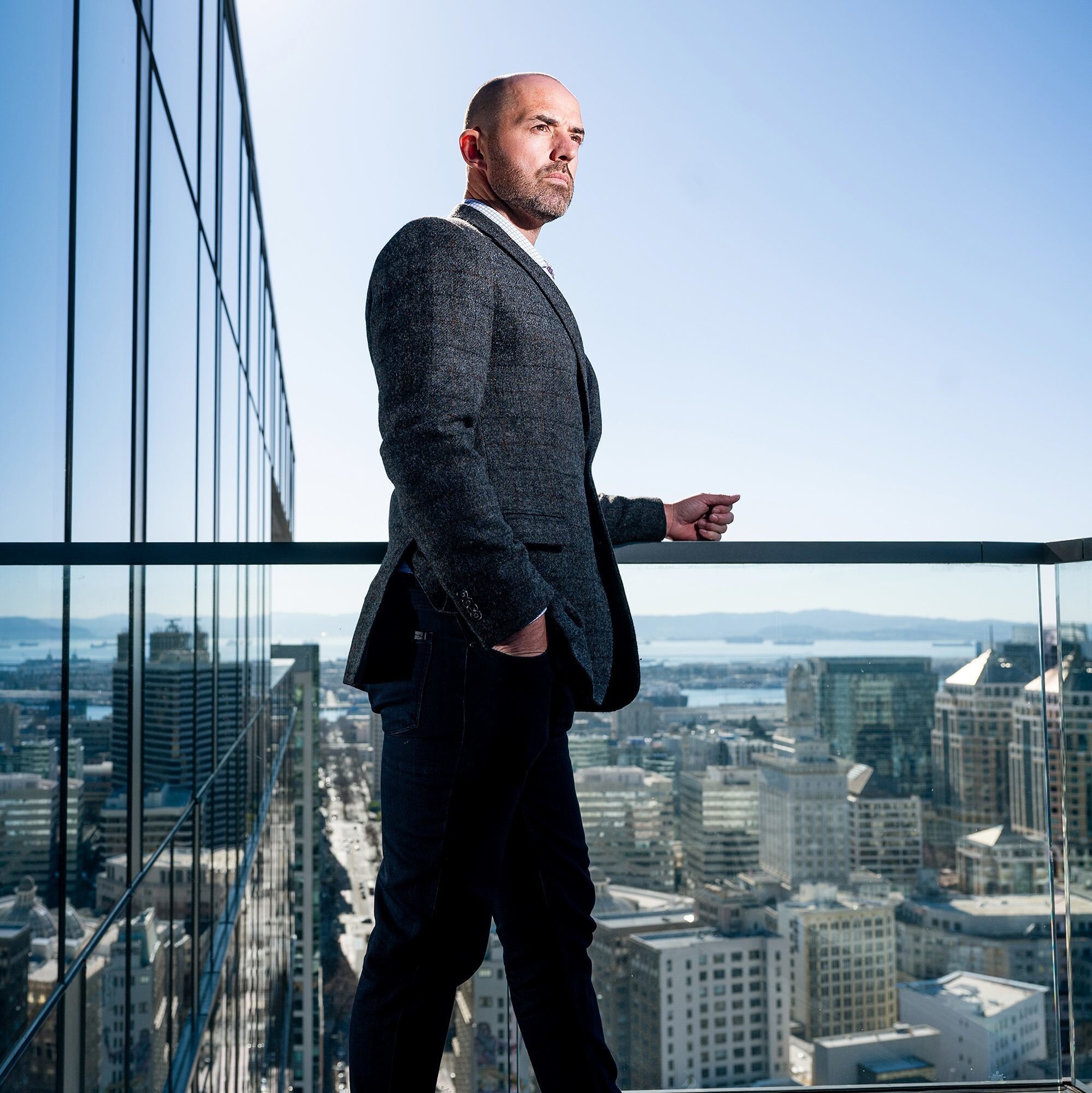
The most revealing part of Colin Behring’s Oakland project may be what lies beneath it. At 1900 Broadway, a 39-story apartment tower rises above the 19th Street BART station. The train is already there. So are the streets, the theaters and the rest of the city. Behring’s proposition is that a developer can arrange enough of a person’s daily life around that fixed point to make the whole day easier.
It is an idea with an unusually long journey behind it. Before Behring assembled buildings in Uptown Oakland, he worked in Shanghai. Before Shanghai, he studied finance and played college football. His grandfather was the developer Kenneth Behring. The surname offered a connection to an established property business; the younger Behring’s first professional assignment was an analyst internship.
Today, he runs Danville-based Behring Co. and has added flexible workspace, shared mobility and venture investing to his real estate interests. The vocabulary has acquired a Silicon Valley accent. The underlying question remains wonderfully ordinary: how much of your life should you have to spend getting to the rest of your life?
Six days to Shanghai
Behring graduated from Cal Poly in San Luis Obispo in 2006 with a business administration degree concentrating in finance. Six days later, he began an internship with Morgan Stanley Properties in Shanghai. There are leisurely transitions from university to employment. This was a fairly brisk one.
He entered a city where high-density living was visible at street level, rather than confined to a planning document. Years later, recalling what impressed him, he recalled how much was available immediately outside his door. That memory supplies a clearer explanation of his Oakland ambitions than any diagram of interconnected businesses.
“You stepped out the door, and everything was there.”
Colin Behring, recalling Shanghai
His education also included time on the field. Cal Poly’s football history lists him as a letterman from 2002 through 2005. In high school, he had rushed for 147 yards in Monte Vista’s 2001 North Coast Section championship victory. The finance degree and the football record belong to the same person, which is a useful corrective to the idea that careers arrive neatly preassembled.
In 2008, he joined his grandfather at Behring Group to work on a mixed-use residential community near Shanghai. He was the family member fluent in Mandarin. His professional biography also records working proficiency in Brazilian Portuguese. These are practical tools in a career that crosses borders, currencies and development cultures.
By 2013, he was assembling his own investment platform, connecting Asia-Pacific interest in American property with opportunities in U.S. multifamily housing. The timing mattered: reduced property valuations and overseas appetite for U.S. investment offered a meeting point. Behring Co. grew around development, private equity and EB-5 financing. His inherited connection to property had become a business with a particular international route.
A building with several jobs
At 1900 Broadway, that route ends in 452 apartments. Behring began looking at the site in 2017, when the outlook for Oakland and the Bay Area’s technology economy was different. The tower ultimately began leasing in 2024. Between the initial idea and the arrival of tenants, the assumptions underneath office work had changed.
The finished project makes room for more than sleeping. Coworking and office space sit alongside residential amenities. A shared Tesla fleet adds another way to get around. Behring calls the approach “Full Stack Real Estate,” borrowing a phrase from software to describe a collection of physical services. The marketing shorthand is Live. Work. Play. Go.
The phrase is ambitious, but its appeal is easy to understand. Housing, a desk and transportation usually come with separate bills, separate arrangements and separate journeys. Putting them close together gives Behring a way to sell convenience across several parts of the same day. It also gives him several businesses to manage.
Design is part of that proposition. His wife, architect Elizabeth Premazzi, whom he met in Shanghai, leads the company’s design team. At 1900 Broadway, she placed the mailroom openly in the lobby to encourage encounters between residents. A parcel collection becomes a small opportunity for conversation. Architecture can be sociable without making a speech about it.
STAK Ventures extends the operating idea into technology. Its platform includes access control, package management, car-fleet integrations and software for flexible offices. In this version of property ownership, opening the doors is the beginning of another assignment. The owner continues trying to make the different uses work together.
The paperwork behind the skyline
There is another side to Behring’s career that no skyline photograph captures. His company operates Behring Regional Center, an EB-5 investment business. Its international investors and its real estate projects bring immigration administration into the same working day as construction and capital markets.
That connection placed the business in federal court. In June 2021, a judge vacated the 2019 EB-5 Modernization Rule following Behring Regional Center’s challenge. The case concerned the authority behind the regulation. The developer’s company had become a plaintiff in a dispute with consequences well beyond its own buildings.
In 2022, another dispute concerned the government’s treatment of previously designated regional centers following new legislation. A preliminary injunction and a subsequent settlement allowed those centers to resume operating under agreed conditions. Behring’s role was that of a business leader backing the litigation, alongside lawyers and other industry participants.
He described the settlement as a reward for standing ground. Whatever one thinks of the program, this is a distinctive piece of his working history: when the administrative framework supporting a business became contested, his company went to court. A property development career can include quite a lot of work in places with no concrete mixer.
The legal episodes also explain why the financing side belongs in his story. The campus depends on capital arriving, buildings being completed and the businesses inside them finding users. Those obligations connect. A delay in one part can travel into another, just as convenience for a resident can travel across several services.
The $14.35 million neighbor
In September 2024, Behring Companies bought the 21-story office tower at 1950 Franklin and its adjacent parking garage for $14.35 million. The tower had been nearly unoccupied since 2020. The garage contained 635 spaces. Both stood close to the apartment building Behring had just brought to market.
The price attracted attention. The relationship between the properties explains the strategy. An empty office building next to a residential tower could become part of the same campus, adding workspace and event capacity. Existing parking supplied another piece. A cheap acquisition becomes more interesting when the buyer already owns something beside it.
The assembled campus combined a newly built residential tower with an older commercial property. Behring could expand the range of spaces available to people using the development without pretending that every building needed to be new. In a business attached to renderings of the future, buying an unfashionable neighbor was a notably concrete move.
STAK Space scheduled its grand opening at 1950 Franklin for April 9, 2025. The program put Behring alongside JLL executives discussing workplaces and the local market. That same spring, the San Francisco Business Times named him its Developer of the Year. Recognition followed an approach that depended on an Oakland recovery, rather than waiting for that recovery to be complete.
There was a less festive number in his earlier account of 1900 Broadway’s opening. In April 2024, he said rents were 15 to 20 percent below the levels anticipated when planning began. The project’s operating idea had arrived in a changed market. Convenient living still had to compete on price.
The next neighbor has computers
In December 2025, Behring acquired 415 20th Street, a four-story building formerly used for Lawrence Berkeley National Laboratory supercomputing operations. The property added a different kind of infrastructure to the cluster: a building with a history of supporting substantial computing equipment.
During August 2026, plans for an AI computing component brought the campus into a public argument. At a press conference, Behring described the idea as “really strong computers in your office.” He appeared beside Oakland Councilmember Carroll Fife. His explanation emphasized the building’s previous use and the connection to neighboring workspaces.
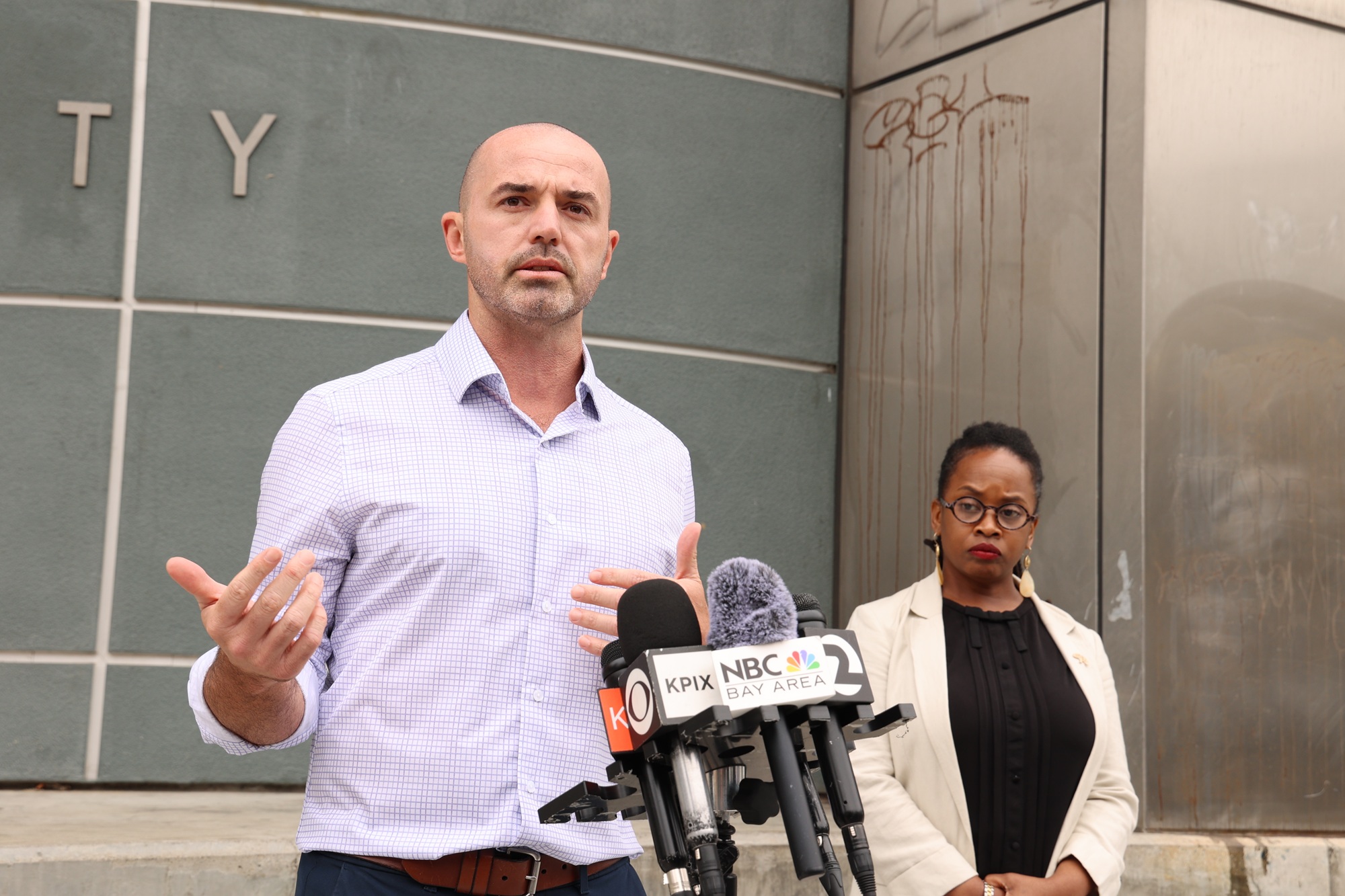
Residents and campaigners questioned the proposal’s resource demands and its economic benefits. Their concerns included water, electricity and who would benefit from a computing facility downtown. Behring’s explanation of an integrated campus met a different question from the neighborhood: what would that integration deliver for the people already there?
On October 6, Oakland’s City Council unanimously approved a 45-day moratorium on data center approvals. The pause gives officials time to consider regulation and hear from the community. It is a citywide measure, arriving while Behring’s building is at the center of the local debate.
The company’s public briefing says the future tenants, uses and mechanical design at 415 20th Street have not been finalized or submitted for approval. That distinction matters. The residential tower is delivered; the computing building’s future remains a proposal. An account of the campus has to keep those stages separate.
Behring’s career has repeatedly returned to the relationship between a building and everything around it. Shanghai supplied an early example of daily life arranged close together. Oakland supplies the test, with its own market, public institutions and neighbors. The same two blocks now contain his accumulated experience in finance, design and operations, along with a debate he cannot settle through ownership alone.
A developer can buy the next building. Persuading a city about its next use takes another kind of work. For Behring, the short distance between the properties has produced a long assignment.
Follow the two blocks
Websites, conversations and further reading.
- Behring Co. - company website
- Colin Behring - LinkedIn
- STAK Ventures - technology and investment platform
- STAK Space - Oakland campus
- Behring Companies - Facebook
- Behring’s EB-5 video channel - YouTube
- Silicon Valley Impact - March 25, 2025 conversation
- Silicon Valley Impact - YouTube channel
- STAK Ventures - Episode 5 conversation and video link
- The Shanghai connection and Oakland campus - The Standard
- Developer of the Year - San Francisco Business Times
- 415 20th Street - company’s public briefing
- The computing proposal - KQED
- October 2026 approvals pause - Oakland North